
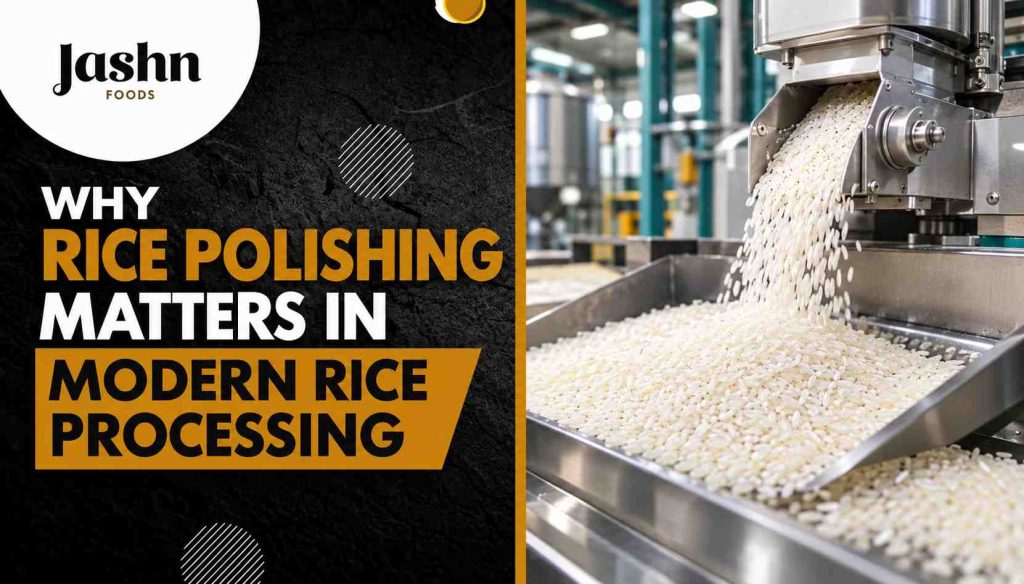
Walk into a rice mill and it quickly becomes clear that the final product depends on much more than the grain itself. Paddy passes through cleaning, husking, whitening, polishing, grading, and sorting before it is ready for sale. Each step has a purpose, and a small problem in one stage can affect the finished rice.
Among these stages, polishing often gets less attention than it deserves. It gives milled rice a smoother and cleaner surface while helping remove loose bran particles left behind after whitening. For commercial suppliers and Basmati rice exporters such as Jashn Foods, getting the process right matters because buyers expect the same quality from one shipment to the next.
Keep your next order on specification with dependable rice processing and supply from Jashn Foods.
Why rice polishing matters in modern rice processing
Polishing and whitening are often treated as the same process, but they serve different purposes. Whitening removes most of the bran layer from brown rice, while polishing focuses on the surface finish of the milled grain. In commercial milling, both stages form part of a much larger processing line.
The aim is not to make rice look excessively shiny. A good polishing process should give the grain the required finish without putting unnecessary pressure on it. Too much mechanical stress can increase breakage, lower whole-kernel recovery, and reduce the usable yield from a batch.
Machine settings also cannot remain identical for every type of rice. Grain variety, moisture condition, milling equipment, and the desired specification all affect the result. A setting that works smoothly for one variety may create problems with another.
The grain goes through more than one transformation
Rice does not enter the polishing machine immediately after harvesting. The paddy first passes through cleaning equipment that removes stones, dust, straw, and other unwanted material. Once the grain has been cleaned, it moves to the husker, where the outer husk is removed.
The grain left behind is brown rice. At this stage, the bran layer is still present and gives the grain its darker colour and different eating characteristics. Whitening removes much of that outer layer and prepares the rice for the finishing stages.
Once polishing is complete, the rice may move through grading and sorting equipment. Whole grains are separated from brokens, while unwanted or defective grains are removed. The sequence matters because every stage affects the one that follows.
Why the level of polishing needs careful control
More polishing does not necessarily mean better rice. In fact, pushing the process too far can increase grain loss without giving buyers any meaningful advantage. Milling should focus on achieving the required finish while keeping unnecessary losses under control.
Long-grain rice needs particular care during processing. Because of its shape, the grain can be more sensitive to mechanical stress, especially when the conditions are not ideal. Small cracks can turn into broken kernels, which can lower the head rice recovery from a batch.
That makes operator judgment important. Experienced mill operators look at the actual output instead of depending on one fixed machine setting. Moisture, grain condition, and variety can all change during production, so the process may need to be adjusted along the way.
How the finishing stage changes appearance
For many buyers, appearance is one of the first things they notice. Clean-looking grains, a more even surface, and fewer visible defects can create a consistent impression when the bag is opened. In retail, that first visual impression can influence how a customer views the product.
Restaurants approach the issue from another angle. They purchase larger quantities and generally want similar results every time they receive a delivery. Noticeable differences between batches can make kitchen planning harder and create uncertainty when the same dishes need to be prepared repeatedly.
Polishing helps create a cleaner and more uniform surface after whitening. It can remove loose bran particles that remain on the grain and improve its overall appearance. Still, there is little reason to polish beyond the level required by the product specification.
The Impact of Technology on Rice Milling
The role of technology in rice milling has become increasingly important as modern equipment has improved. Larger commercial mills can manage different stages with greater precision than older systems, while automated grading, sorting, and monitoring can help reduce variation between batches.
Technology is particularly useful when a mill handles different rice varieties or several customer specifications. Operators can monitor the process, spot changes early, and make adjustments before a small issue turns into a larger production loss. Optical sorting equipment can also identify certain visual defects that would be difficult to remove through manual inspection.
Even with better machinery, human oversight still matters. Equipment can provide measurements and alerts, but someone has to understand what those results mean for the grain. At Jashn Foods, controlled processing and quality checks help support the supply requirements of wholesalers, distributors, food-service buyers, and private-label customers.
Why whole-kernel recovery matters to buyers
A buyer is not paying only for a particular level of whiteness or surface finish. The amount of usable whole rice in a batch also affects its commercial value. Higher breakage can change what a buyer actually receives from the quantity purchased.
Broken rice should not automatically be treated as a poor-quality product. It has its own markets and can be used in flour, snacks, prepared foods, and several other applications. The real concern arises when the percentage of broken grains goes above the level agreed between the buyer and supplier.
That is where milling and grading need to work together. The processor wants the finished rice to look clean while preserving as many suitable whole kernels as possible. A balanced approach can improve recovery and make the final product more predictable for commercial buyers.
What polishing means for nutritional content
Polishing changes more than the appearance of rice. The outer layers of the grain, particularly the bran and germ, contain nutrients such as fibre, vitamins, minerals, protein, and fat. When more of these layers are removed during milling, some of those nutrients are also reduced in the finished white rice.
That does not make polished rice unsuitable for daily meals. White rice remains an important staple in India and many parts of the world. The key point is simply to understand what happens to the grain during milling and why different products may be processed to different degrees.
For commercial mills, the practical approach is to work toward a clear product specification. Removing more of the outer layer simply for appearance may not be necessary. The desired level of milling should match the variety, market requirement, and intended use.
Consistency matters across every batch
Imagine a distributor receiving several shipments over the course of a year. The product name on every bag is the same, but the grains look different each time. Even when the rice cooks reasonably well, that kind of variation can make the buyer question how consistently the supplier is managing production.
Consistency starts long before the rice is packed. Variety selection, drying, storage, husking, whitening, polishing, grading, and sorting can all influence the finished product. Treating polishing as an isolated step misses the bigger picture.
For Jashn Foods, processing consistency is therefore part of the overall approach rather than a separate concern. Bulk buyers often need more than a good-looking sample. They need dependable specifications, predictable packaging, and steady quality when they place repeat orders.
Controlled polishing and grading can make a difference to your next bulk order.
What commercial buyers should check before ordering
A polished sample can look impressive, but appearance alone does not tell the whole story. Buyers should also examine grain length, whole-kernel percentage, broken grains, moisture, defects, aroma, and cooking performance. Looking at these factors together gives a much clearer idea of whether the rice fits the intended use.
The sample should also be compared with the specification agreed for the order. This matters for wholesalers, restaurant suppliers, supermarket distributors, and private-label businesses, where a small difference in grade can have a bigger commercial impact.
It is also useful to ask how the supplier manages milling and quality control. Questions about grading, sorting, polishing, storage, packaging, and inspection can reveal how the process is handled behind the scenes. Jashn Foods works with businesses that need dependable rice supplies for different commercial applications.
How processing influences commercial value
Every processing decision has a cost attached to it. Grain loss, broken percentages, energy consumption, labour, and recovery all contribute to the economics of rice production. A mill cannot focus entirely on appearance and ignore what happens to the rest of the grain.
This becomes especially important when buyers compare quotations from different suppliers. A lower price may not represent the same grain specification, recovery rate, packaging standard, or level of consistency. Comparing the complete product, including the rice price, is often more useful than comparing the quoted price alone.
Well-managed processing helps manufacturers reduce avoidable losses while maintaining the quality their buyers expect. For exporters and distributors, stable quality can also make purchasing, stock management, and future planning easier.
What modern buyers expect from polished rice
Commercial buyers today often want more than a product name and a price. Before placing a large order, they may ask about grain length, specifications, packaging choices, certifications, processing details, and quality parameters. When comparing Indian basmati rice brands, private-label customers can have even more detailed requirements because the rice will be sold under their own brand.
That has made transparency more important across the supply chain. A rice supplier needs to know how to produce the required grade and how to maintain that specification throughout the production process. Clear quality procedures can reduce misunderstandings and help both sides work from the same expectations.
Jashn Foods supplies rice for wholesale, distribution, food-service, and private-label requirements. Its focus is on maintaining processing consistency and meeting the specifications discussed with each buyer.
Source rice processed with controlled milling for better consistency and reliable commercial supply.
The bigger picture
Rice polishing may seem like a small part of the overall milling process, especially when compared with harvesting, packaging, or exporting. Yet it has a direct effect on the appearance and consistency of the finished grain. A poorly managed finishing stage can affect the results achieved through the earlier stages.
The goal is not maximum shine or maximum removal of the outer layer. It is to achieve a controlled finish that suits the rice variety, protects grain quality, and matches the buyer’s agreed specification.
In the end, good rice processing depends on the whole line working together. Cleaning, husking, whitening, polishing, grading, sorting, and packaging each play a role. When those stages are managed properly, manufacturers can supply rice that performs consistently for retailers, restaurants, distributors, and households.
For Jashn Foods, that approach is about more than completing a single order. Consistent processing helps build dependable supply relationships over time.