
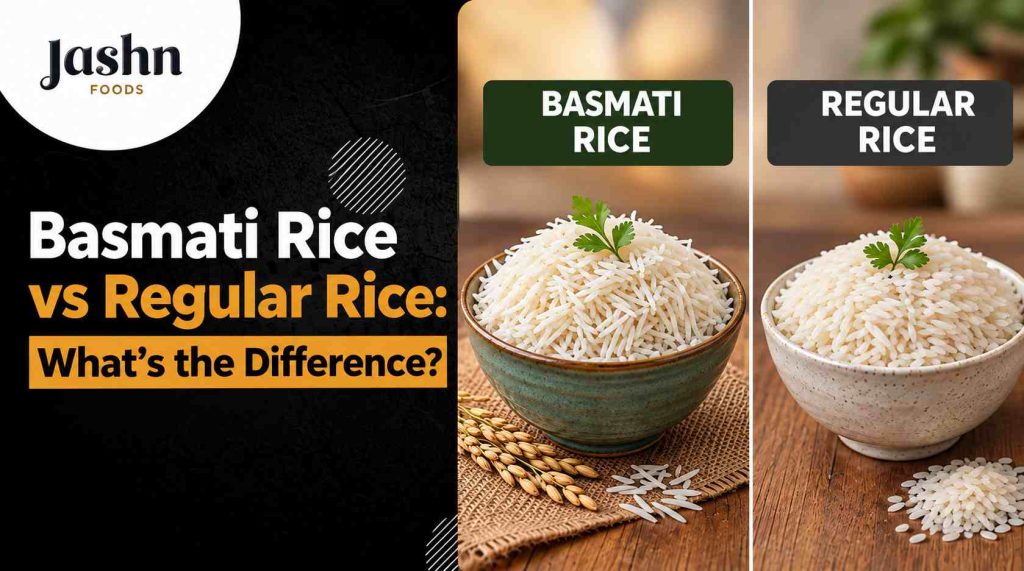
Rice looks simple on the shelf, but the difference between two varieties becomes obvious once they reach the plate. Basmati rice vs regular rice: what’s the difference is a question many households, restaurants, caterers, and food businesses ask before choosing a product. Grain length, aroma, texture, cooking behavior, price, and the type of dish all matter when making that choice.
Some people want fluffy grains for biryani on weekends. Others simply need rice that works well with dal, vegetables, curry, or everyday meals. A restaurant may have a completely different requirement because the same rice needs to perform consistently during busy service.
Jashn Foods supplies basmati rice varieties for households, restaurants, wholesalers, distributors, and other bulk buyers. The right choice becomes much easier when the intended use comes first.
Explore Jashn Basmati Rice and experience the aroma, texture, and taste for yourself.
Basmati rice vs regular rice: understanding the differences
The simplest way to explain the difference is to look at the grain and its behavior after cooking. Basmati varieties are known for their slender grains, characteristic aroma, and lengthwise expansion. Regular rice covers a much wider group, including short-, medium-, and long-grain varieties.
That distinction matters in the kitchen. Two bags of rice may look similar before cooking but produce very different results in the same pot. One may remain fluffy and separate, while another becomes softer and holds more moisture.
The International Rice Research Institute explains that rice varieties differ in grain shape, aroma, taste, and cooked texture. Its consumer guide also notes that cooking conditions need to suit the variety being prepared. International Rice Research Institute – A Consumer’s Guide to Rice
So, there is no universal answer for every kitchen. The useful question is whether the rice suits the particular dish, cooking method, and budget.
Grain length makes an immediate difference
Pick up a few uncooked grains and the difference is usually easy to spot. Long, slender grains have a noticeably different shape from shorter varieties. After cooking, that visual difference becomes even more apparent.
This is one reason long-grain varieties are popular in dishes where presentation matters. A plate of biryani looks different when the grains remain long and distinct instead of becoming compact or sticky. The same applies to pulao and several rice-based dishes served by restaurants.
Grain appearance also matters to commercial buyers. A wholesaler wants a product that looks consistent from one bag to another. A restaurant wants the cooked rice to look familiar every time it reaches the customer’s table.
For that reason, grain length should not be treated as a minor detail. It can influence both the cooking result and the way customers perceive the finished dish.
Aroma changes the character of a meal
Walk into a kitchen where aromatic rice is cooking, and the difference is hard to miss. The fragrance begins to spread before the food reaches the dining table. That natural aroma is one of the features that separates aromatic varieties from many everyday rice options.
The difference becomes particularly noticeable in biryani and pulao. These dishes often rely on rice as a major part of the overall experience, rather than using it simply as a side. Fragrance can therefore add something important without requiring extra seasoning.
Regular varieties with a milder aroma have their own place in cooking. They can work particularly well when curry, dal, vegetables, or sauces provide most of the flavor.
Neither approach is automatically right or wrong. It depends on what the cook wants from the finished dish.
Cooking texture can change the whole dish
Texture is another practical difference that becomes clear after cooking. Some long-grain varieties produce fluffy grains that remain separate when prepared properly. Other varieties can become softer and hold more moisture.
The cooking method matters just as much as the grain itself. Water quantity, soaking, heat, cooking time, and even the size of the cooking vessel can affect the final result. A variety that works beautifully with one method may need adjustments when prepared differently.
IRRI also points out that different rice varieties can require different cooking conditions. Read the IRRI guide to rice
This explains why following one fixed recipe for every type of rice does not always work. The cook may need to change the water ratio or cooking time to get the texture they want.
Discover Jashn Basmati Rice for fragrant, fluffy grains in every meal.
Match the grain with the dish
A good rice choice starts with the meal. Biryani generally calls for grains that can remain long and separate during cooking. Pulao also benefits from a grain that holds its shape without turning heavy.
Everyday meals are less restrictive. Rice served with dal or vegetable curry can work with several varieties because the accompanying food contributes much of the flavor and texture. In these cases, cooking convenience and price may become more important.
The best rice for daily use is therefore different for every household. A family that eats rice twice a day may value affordability and versatility. Another household may prefer an aromatic variety because it cooks it mainly for weekend meals or family gatherings.
Restaurants face the same question on a larger scale. Their choice has to make sense not only in a recipe but also across dozens or hundreds of portions.
Processing matters more than many buyers realize
The variety name tells only part of the story. What happens after harvesting can also affect the rice that finally reaches the consumer. Cleaning, milling, sorting, grading, storage, and handling all have a role in the finished product.
Poor processing can leave a buyer with uneven grains or too many broken pieces. Storage conditions can also influence quality over time. For a business ordering large quantities, such inconsistencies can create unnecessary problems in the kitchen.
This is where choosing credible basmati rice manufacturers becomes important. A dependable supplier should pay attention to processing, quality checks, hygiene, grading, and order consistency rather than relying only on attractive packaging.
Jashn Foods supplies rice for domestic and international markets, including requirements from restaurants, distributors, wholesalers, and private-label buyers. For commercial customers, consistent sourcing can be just as important as the variety itself.
Different cuisines call for different rice
Rice preferences are not the same everywhere. A family in India may select rice for biryani, rajma, dal, pulao, or a regional preparation. A restaurant overseas may have customers looking for rice suited to a completely different cuisine.
A useful comparison is basmati vs jasmine rice. Both are aromatic long-grain choices, but they have different characteristics and are commonly associated with different culinary traditions. The choice should come down to the dish, desired aroma, texture, and customer preference.
This matters for importers and distributors as well. A product that sells well in one market may not have the same demand somewhere else. Understanding local eating habits can prevent businesses from buying a variety simply because it is popular in another country.
Jashn Foods works with buyers who need rice for different markets and commercial applications. Product selection can be planned around the destination market, customer profile, packaging requirement, and intended use.
Why prices differ between rice varieties
Price is often the first thing a buyer notices, but several factors sit behind it. Variety, grade, grain length, processing, demand, packaging, order quantity, and market conditions can all influence the final price.
Premium long-grain varieties may command a higher price because customers specifically seek their appearance, aroma, and cooking characteristics. That does not mean every buyer needs to choose the most expensive option.
A small restaurant serving economical meals may be more concerned with yield and consistent cooking. A premium restaurant serving biryani may place greater importance on grain appearance and fragrance.
The sensible approach is to compare the rice against its intended purpose. Paying more only makes sense when the additional characteristics actually matter to the buyer.
Why 1121 is often discussed by bulk buyers
Among the varieties available in the market, 1121 basmati rice is widely associated with very long, slender grains and considerable elongation after cooking. Research indexed by FAO AGRIS has reported a milled grain length of around 9 millimetres, with cooked kernel lengths reaching considerably higher measurements.
That kind of elongation can be useful for dishes where long, separate grains are part of the expected presentation. Biryani restaurants and food businesses may therefore pay close attention to this characteristic.
Still, a variety name should not be the only basis for a bulk purchase. Buyers should also examine grade, broken percentage, moisture, processing quality, packaging, and the consistency offered by the supplier.
A sample cooking test is often worthwhile before placing a large commercial order. It gives the buyer a chance to see how the actual product performs in the kitchen.
What should restaurants consider?
Restaurants have a slightly different problem from household buyers. They need rice that performs reliably during repeated cooking, often under time pressure.
A chef may prepare one batch successfully on Monday and another on Tuesday. If the rice behaves differently each time, portion control and presentation become harder. Consistency therefore has a direct connection with kitchen operations.
Yield matters too. A restaurant needs to understand how much cooked rice a particular quantity produces. A variety that appears inexpensive before cooking may not offer the same value if its cooking yield does not meet expectations.
Jashn Foods supplies rice for restaurants, caterers, wholesalers, and other bulk buyers. Businesses can discuss their required variety, quantity, packaging, and application before finalizing a regular supply arrangement.
What should wholesalers and distributors check?
Wholesalers and distributors have a wider set of considerations. They are not buying only for their own kitchens. The product has to meet the expectations of the customers who eventually purchase it.
Packaging is one consideration. Product consistency is another. Supply reliability, documentation, order quantity, and the ability to maintain specifications across repeat orders can also influence a long-term business relationship.
A distributor may also carry several varieties rather than depending on one product. That approach allows the business to serve customers with different budgets and cooking preferences.
For international buyers, destination-market requirements deserve attention as well. Product specifications and documentation should be confirmed before an order is finalized.
How to choose between the two
Start with the food you actually prepare. If the main requirement is fragrant biryani with long, separate grains, an aromatic long-grain variety may make sense. If rice is mainly served with everyday curries or dal, other varieties may offer the right balance of taste, texture, and price.
Then look beyond the name printed on the bag. Check the grain appearance, grade, broken percentage, packaging, cooking performance, and supplier consistency. For commercial purchases, request product specifications and samples when possible.
It is also worth testing the rice using the same method used in the kitchen. A short cooking trial can reveal whether the grain stays separate, absorbs water properly, develops the expected aroma, and delivers the desired texture.
In other words, basmati rice vs regular rice: what’s the difference becomes much easier to answer once the intended use is clear. The right choice is not necessarily the most expensive one. It is the variety that delivers the characteristics your meal or business actually requires.
Making the final choice
The difference between these rice categories comes down to more than appearance. Grain length, aroma, texture, cooking behavior, processing, price, and intended use all play a part.
For households, the decision may depend on everyday cooking habits and family preferences. Restaurants need reliable cooking and presentation, while wholesalers and distributors also need stable supply and suitable commercial specifications.
Basmati rice vs regular rice: what’s the difference is therefore best answered from a practical point of view. Consider the dish first, then compare the characteristics that matter for that dish.
Jashn Foods supplies rice varieties for buyers across India and international markets, including restaurants, wholesalers, distributors, retailers, and private-label businesses. If you are sourcing rice in bulk, choosing the right variety at the beginning can make quality and supply management much easier later.
Don’t wait to upgrade your everyday rice—explore Jashn Basmati today