
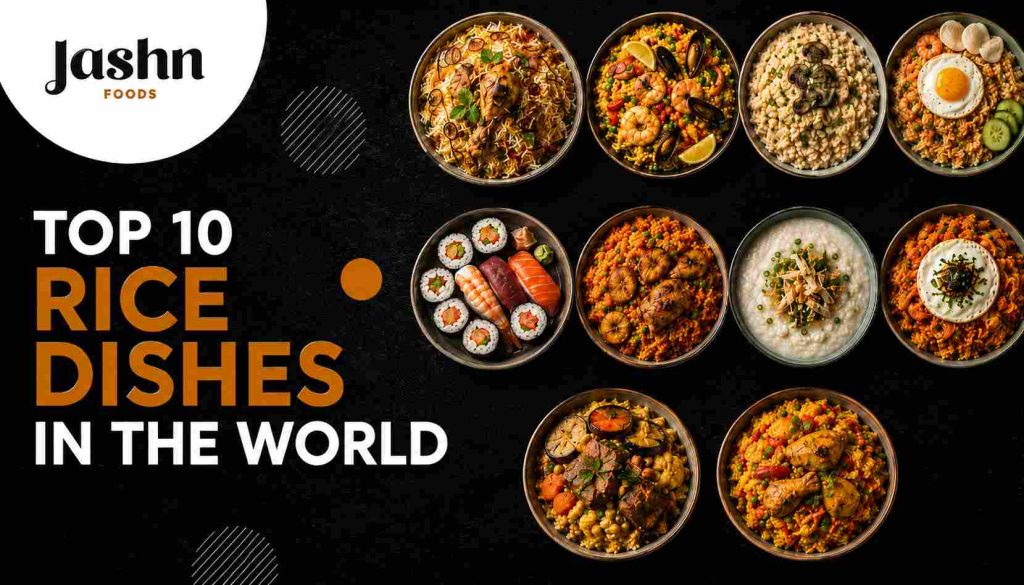
Rice has a funny way of becoming part of almost every food culture. In one country, it is the centre of a festive meal. Somewhere else, it sits quietly beside a curry or gets tossed into a hot wok. The top 10 rice dishes in the world show just how much can be done with one everyday grain. The ingredients change, the cooking methods change, and even the texture can feel completely different.
Walk into a rice market in India and you will quickly notice there is no single idea of “good rice.” Some people want fragrance and long grains, while others prefer softer or stickier varieties. Jashn Foods, among the established basmati rice manufacturers in India, focuses on consistent grain quality for buyers who need dependable cooking results. That same attention to rice selection makes sense when you look at popular dishes from around the world.
Find the grain that fits biryani, pulao, everyday meals and more.
Top 10 Rice Dishes in the World You Should Know
What makes a rice dish memorable is rarely the rice alone. It can be the spice mix, the cooking vessel, the stock, or even the way the dish is served. Some recipes take hours to build flavour, while others come together quickly in a pan. Here are ten dishes that have earned a place in kitchens well beyond their places of origin.
1. Biryani – India
Few rice dishes create as much excitement in India as biryani. Every region has its own opinion about how it should taste, and that is part of the charm. Hyderabad favours a deeply spiced version, Kolkata adds its own distinctive touches, while Lucknow is known for a gentler style with carefully layered flavours.
The rice has to hold its own in such a rich dish. Long, aromatic grains are usually preferred because they look elegant on the plate and stay separate after cooking. Indian basmati rice is a natural choice for many biryani preparations because of its aroma and grain length. A good biryani should give you fluffy rice, tender meat, and enough spice to keep the next bite interesting.
2. Paella – Spain
Paella feels different from biryani almost immediately. Instead of building layers, the ingredients cook together in a broad, shallow pan. Traditional versions are closely linked with Valencia, although seafood, chicken, vegetables, and other variations are now common in many countries.
One detail makes a properly cooked paella especially satisfying. The rice at the bottom can form a lightly toasted layer known as socarrat. It gives the dish a pleasant contrast against the softer rice above. Saffron and a well-made broth then bring everything together without turning the dish into something overly complicated.
3. Risotto – Italy
Risotto is probably the dish that best proves rice does not always need to be fluffy. Here, creaminess is the goal. Cooks add warm stock little by little, allowing the rice to release starch as it cooks.
That slow process takes some patience, but the payoff is obvious. The finished rice feels rich and smooth while still keeping a slight bite in the centre. Mushroom and saffron are popular choices, although seafood, pumpkin, peas, and Parmesan also appear in countless versions. It is a simple idea that becomes surprisingly sophisticated when cooked well.
4. Nasi Goreng – Indonesia
Nasi goreng is Indonesia’s answer to the question, “What should I do with leftover rice?” The answer is much more exciting than it sounds. Rice goes into a hot pan with ingredients such as egg, vegetables, chicken, prawns, chilli, and sweet soy sauce.
The rice should not be too wet when it hits the pan. Slightly dry grains fry more easily and pick up the seasoning without collapsing. That is also why cooked rice from the previous day often works so well. For homes looking for the best rice for everyday use, versatility matters because the same rice may end up in fried rice one day and a simple meal the next.
5. Sushi – Japan
Sushi is often associated with raw fish, but rice is actually at the heart of the preparation. Japanese sushi rice has a particular texture that allows it to hold together without feeling heavy. After cooking, it is seasoned with a mixture that gives the rice a subtle sweet-and-sour character.
There is a reason sushi chefs pay so much attention to washing, soaking, cooking, and cooling the rice. Each stage affects the finished texture. Too much water can make the grains mushy, while too little can leave them dry. Once the rice is right, the toppings have a much better chance of shining.
6. Jollof Rice – West Africa
Jollof rice has a reputation for being bold, comforting, and deeply satisfying. It is especially popular across West Africa, with Nigeria, Ghana, Senegal, and other countries having their own versions. Tomatoes, peppers, onions, stock, and spices usually create the base.
The interesting part is how personal the recipe can become. Two families can cook jollof using similar ingredients and still produce noticeably different results. Some prefer smoky flavours, while others add more heat or allow the sauce to cook longer. It is often served with chicken, beef, fried plantains, vegetables, or grilled foods.
7. Khao Pad – Thailand
Thai fried rice, or khao pad, is a good example of how everyday food can become internationally popular. It usually contains cooked rice, egg, vegetables, meat or seafood, and a mixture of salty, savoury seasonings. Fresh herbs, cucumber, lime, or chilli may appear on the side.
The cooking happens quickly, so preparation matters. Ingredients are normally chopped before the pan gets hot and the rice goes in. Once everything starts moving, there is little time to stop and measure. The result should be fragrant and lightly toasted, with grains that still have some bite.
8. Kabsa – Saudi Arabia
Kabsa is closely associated with Saudi cuisine and is often served when families gather around the table. Rice cooks with meat or chicken along with tomatoes, onions, spices, and dried lime. The cooking liquid becomes just as important as the ingredients themselves because the rice absorbs all those flavours.
The dish has a warm, aromatic profile rather than relying entirely on chilli for impact. Spices such as cinnamon, cardamom, cloves, and black pepper can add depth without overwhelming the rice. Once served with tender meat and a little sauce, kabsa becomes the kind of meal that feels made for sharing.
9. Bibimbap – South Korea
Bibimbap looks colourful before anyone takes the first bite. Rice is topped with vegetables, egg, meat, sesame oil, and often a spoonful of gochujang. Instead of eating each ingredient separately, diners usually mix everything together before eating.
That mixing is what makes bibimbap fun. A plain rice base turns into something much more complex once the vegetables, sauce, and sesame oil are stirred through it. The dish also offers plenty of flexibility, which makes it easy to adapt for different tastes and seasonal ingredients.
10. Arroz con Pollo – Latin America
Rice and chicken sound simple, and that is exactly why arroz con pollo has lasted for generations. The dish appears in several Latin American and Caribbean cuisines, with each region adding its own seasoning and cooking style. Chicken, rice, vegetables, stock, and herbs remain the common foundation.
Some recipes lean towards saffron and garlic, while others use annatto, cumin, peppers, or local spice blends. Everything cooks together, allowing the rice to absorb the juices from the chicken and vegetables. It is hearty without being fussy, making it a natural choice for family lunches and large gatherings.
Why the Right Rice Can Change the Dish
Rice varieties are not interchangeable in every recipe. Grain size, starch content, aroma, and moisture all affect how rice behaves in the kitchen. The International Rice Research Institute explains that rice varieties have different physical and cooking characteristics, which helps explain why certain grains suit particular preparations better.
Think about the difference between sushi and biryani. Sushi needs rice that can hold together, while biryani depends on grains that remain loose and separate. Risotto moves in the opposite direction because its creamy texture comes from starch. The cooking method and the grain work together, so choosing only by price is not always the smartest approach.
Restaurants have an even bigger reason to pay attention. A small change in rice quality can show up across dozens of plates during a busy service. Jashn Foods supplies different rice varieties to restaurants, caterers, retailers, distributors, and bulk buyers who need reliable performance from one order to the next.
Grain quality matters more than you think. Choose yours wisely.
How Indian Consumers Can Choose the Right Rice
Indian kitchens use rice in everything from a quick weekday meal to a large wedding spread. That makes variety important. A fragrant long-grain rice may be perfect for pulao or biryani, while another grain can make more sense for daily meals, regional recipes, or fried preparations.
People comparing top rice brands in India should look beyond the front of the packet. Grain uniformity, aroma, broken grains, processing quality, packaging, and cooking performance all deserve attention. For larger buyers, supply reliability matters too because a restaurant cannot afford major changes in rice quality between shipments.
Jashn Foods keeps a broad range of rice products for different cooking needs and customer segments. Its basmati range is suited to dishes where aroma, grain length, and visual appeal matter. For commercial kitchens, that consistency can be especially useful when the same menu item has to taste right every day.
What These Popular Dishes Have in Common
Despite their differences, the top 10 rice dishes in the world share one important quality. They use rice as more than a filler on the plate. Rice carries stock, sauces, spices, herbs, oils, and other flavours, which gives it an active role in the final dish.
Culture also plays a huge part. A recipe may begin as an everyday meal and eventually become a national favourite. Families change small details over time, restaurants add their own ideas, and travellers carry recipes across borders. That is how familiar dishes find new audiences without losing their original character.
It is also why there is no universal answer to the question of which rice dish is best. Someone may prefer a heavily spiced biryani, while another person may choose creamy risotto. One diner may love the smoky edge of jollof, while another prefers the clean flavours of sushi.
Final Thoughts
The top 10 rice dishes in the world prove that rice can take on almost any personality in the kitchen. It can become spicy, creamy, smoky, sticky, fragrant, or wonderfully simple. The ingredients may come from different corners of the world, yet the basic idea remains familiar: cook good rice and build something people want to eat again.
For Indian consumers and food businesses, the lesson is fairly straightforward. Choose rice based on the dish, not just the label on the packet. When grain quality and cooking technique work together, the difference can be noticed in aroma, texture, appearance, and taste.
Jashn Foods brings this practical approach to its range of rice products, serving customers who value dependable quality for everyday cooking as well as larger commercial requirements. From biryani kitchens to retail shelves, the right grain can make a familiar recipe feel a lot more satisfying.
Great dishes begin with the right rice. See what makes the difference.