

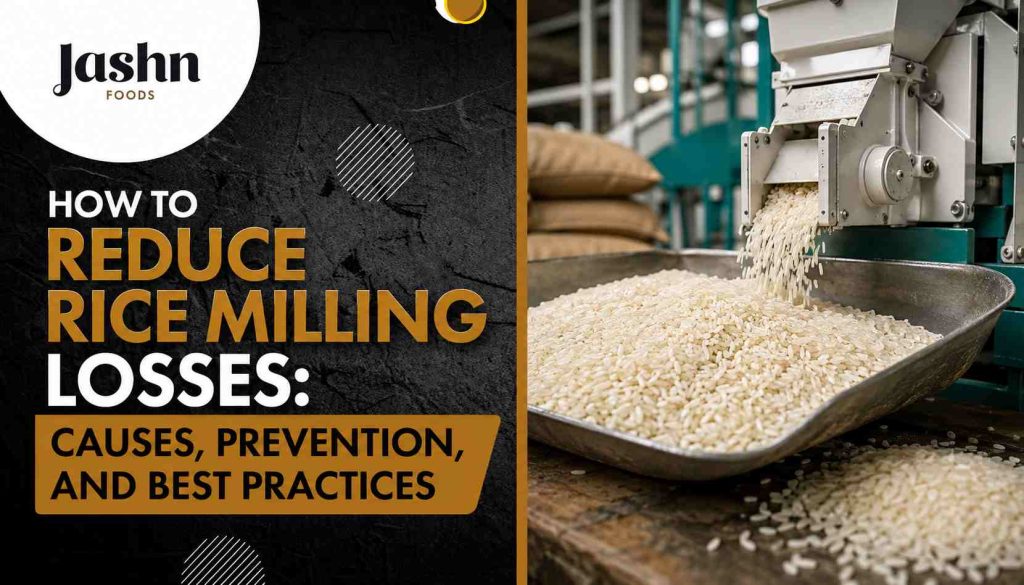
Rice milling is often judged by one number—the percentage of whole grains that leave the mill. Yet that figure reflects dozens of decisions made before the paddy reaches the polishing machine. Harvest timing, drying, storage, equipment settings, and operator skill all influence the final outcome.
If you want to understand how to reduce rice milling losses: causes, prevention, and best practices, the answer begins long before milling starts. Every stage has the potential to protect grain quality or reduce it. Businesses handling high quality basmati rice know that even a small increase in broken kernels can affect market value, customer confidence, and export opportunities.
India processes millions of tonnes of rice every year for domestic consumption and international trade. Buyers now expect consistent grain length, better appearance, and reliable quality. That has made efficient milling more important than ever. Reducing losses is no longer just about improving production. It is about protecting margins, meeting customer expectations, and using every harvested grain wisely.
Choose export-quality rice that helps improve recovery and delivers reliable consistency.
How to Reduce Rice Milling Losses: Causes, Prevention, and Best Practices
Rice milling losses rarely happen because of one major mistake. In most cases, they result from several small problems that build up during harvesting, storage, drying, and processing. One weak step affects the next, and the final yield suffers.
A successful mill treats the entire process as one connected system. Healthy paddy, proper moisture, accurate machine settings, and regular quality checks all work together. Ignoring even one of these areas increases the chances of grain breakage and lower recovery.
For mill owners, the goal is simple. Produce the highest percentage of whole grains while maintaining appearance, cleanliness, and uniformity. That balance separates an average milling operation from an efficient one.
Grain Quality Is Decided Before Milling Begins
Many people assume losses occur only inside the mill. In reality, the condition of the harvested crop has a much bigger influence than most expect.
Paddy harvested too early contains immature grains. Those grains are weaker and more likely to crack during processing. Waiting too long creates another problem. Overripe crops become vulnerable to weather damage, insects, and field shattering.
Harvesting at the correct stage helps preserve grain strength. Careful handling during threshing and transport also matters. Rough treatment creates tiny internal cracks that may not be visible immediately. Those hidden fractures usually appear later as broken rice during milling.
Researchers from the Food and Agriculture Organization have repeatedly highlighted proper post-harvest handling as one of the most effective ways to reduce food losses across cereal crops.
Moisture Deserves Constant Attention
Moisture is one of the few factors that influences nearly every milling stage.
When paddy enters the mill with excess moisture, polishing becomes less efficient. Wet grains also increase the risk of uneven processing.
Very dry paddy creates another challenge. Dry kernels become brittle and break more easily under pressure.
That is why experienced millers never rely on guesswork. Moisture meters have become an essential part of daily operations. They provide quick readings before every production batch. Uniform drying is equally important.
Imagine one section of a grain drying faster than another. Internal stress develops inside the kernel. The grain may look perfect from the outside, but it becomes vulnerable once milling begins. Controlled drying reduces that stress and helps improve head rice recovery.
Storage Can Either Protect or Damage Paddy
Storage often receives less attention than milling equipment. That is a costly mistake. Poor warehouse conditions slowly reduce grain quality even before processing starts.
High humidity encourages fungal growth. Excess heat weakens grain structure.Rodents and insects create physical damage that lowers recovery.
Well-managed warehouses maintain good ventilation and regular inspections. Clean surroundings also reduce contamination.
Simple practices make a noticeable difference.
Paddy should never remain exposed to rain after harvesting. Stacks should allow enough airflow. Moisture should be monitored throughout storage instead of only before milling. These routines require discipline more than expensive investment.
Discover rice varieties trusted by mills, exporters, and bulk buyers across global markets.
Machines Need Care Before They Need Repairs
Even premium paddy cannot produce excellent results with worn equipment. Rubber rollers lose efficiency over time. Screens become damaged.
Polishing chambers gradually wear down. Each problem seems minor on its own. Together they increase broken grains and reduce milling efficiency.
Preventive maintenance is usually less expensive than emergency repairs. Successful mills inspect equipment every day instead of waiting for visible failures.
Bearings receive lubrication on schedule. Loose belts are adjusted immediately. Damaged rollers are replaced before they affect grain quality.
Many leading rice manufacturing companies in India treat maintenance as part of production rather than a separate activity. That mindset improves consistency throughout the year.
Clean Paddy Creates Better Results
The milling process works best when unwanted materials are removed first.
Small stones, dust, straw, and metal fragments place unnecessary stress on machinery.
They also interfere with smooth grain movement inside the equipment.
Modern pre-cleaning systems remove these impurities before milling starts.
The benefits go beyond protecting machines.
Cleaner paddy allows rollers and polishers to work more evenly. That improves grain appearance while reducing unnecessary breakage.
This early step often determines how efficiently the rest of the milling line performs.
Operators Still Make a Difference
Automation has improved rice processing.
It has not replaced experience.
A skilled operator notices small changes that software may not immediately identify.
Grain behaviour changes from one variety to another.
Moisture levels vary.
Machine pressure may require adjustment during production.
Experienced operators respond to these changes without interrupting the milling process.
Regular training helps employees understand why those adjustments matter.
Instead of simply running equipment, they learn how every decision affects grain recovery.
That knowledge becomes valuable during peak production seasons.
Different Varieties Need Different Settings
There is no universal machine setting that works for every type of rice.
Long-grain varieties behave differently from medium-grain varieties.
Kernel hardness changes. Grain length changes. Moisture absorption also changes.
Applying identical settings to every batch often creates unnecessary losses.
Many mills test small quantities before processing full production lots.
Those trial runs provide useful information without risking large volumes of grain.
A few minutes of preparation often prevent hours of reduced recovery.
Better Decisions Come From Better Data
Modern rice mills collect more production data than ever before. Daily reports reveal patterns that operators might otherwise overlook.
Broken grain percentages. Moisture readings. Machine downtime. Head rice recovery. Energy consumption.
Tracking these figures helps managers identify problems before they become expensive.
Instead of reacting after production losses appear, they can make timely adjustments.
Reliable data supports continuous improvement rather than occasional correction.
Smart Technology Is Changing Modern Rice Mills
Rice milling has become more precise over the last decade. Many mills now use sensors, automated controls, and digital monitoring systems to improve consistency. These tools do not replace experienced operators. They give them better information to work with.
The growing use of technology in rice milling helps identify issues before they become major losses. For example, automatic moisture monitoring allows operators to make timely adjustments instead of relying on visual inspection. Optical sorters remove defective grains with greater accuracy than manual sorting, while computerized controls keep pressure and polishing levels more stable throughout production.
Technology also makes production records easier to maintain. Managers can compare daily performance, identify recurring problems, and improve operating procedures over time. Small improvements made consistently often produce better results than one major equipment upgrade.
Inspect Quality Throughout the Process
Waiting until packaging to inspect rice is risky. By then, the opportunity to correct most milling problems has already passed.
Quality checks should begin as soon as paddy arrives at the mill. Moisture content, grain maturity, and impurity levels provide valuable information before processing starts. Similar checks should continue during dehusking, whitening, polishing, grading, and final packing.
Regular inspections help answer important questions.
Is the percentage of broken rice increasing?
Are polishing settings producing excessive brand loss?
Has moisture changed during storage?
Is grain colour remaining consistent?
Finding these issues early allows operators to make immediate corrections. That saves time, reduces waste, and protects product quality.
Every By-product Has Value
Efficient milling is not only about producing whole rice. It is also about making the best use of everything the process generates.
Rice bran is widely used for edible oil production. Rice husk serves as fuel in biomass boilers and power generation systems.
Broken rice has strong demand from food processors, breweries, snack manufacturers, and animal feed producers.
Treating these materials as valuable resources instead of waste improves overall profitability. It also supports more sustainable production by ensuring that every part of the harvested crop has a purpose.
Consistency Builds Buyer Confidence
Domestic buyers appreciate good quality, but international buyers often have stricter expectations. They evaluate much more than grain size or appearance.
A shipment should match the agreed specifications every time. Grain length, colour, moisture, cleanliness, and broken percentage must remain within acceptable limits. Even minor variations can lead to customer complaints or additional inspections.
This is why established rice brands invest heavily in standard operating procedures. They know that a reliable product creates repeat orders, strengthens distributor relationships, and builds trust over time.
Quality is remembered long after price negotiations are forgotten.
Private Manufacturing Demands Higher Standards
Many importers prefer to sell products under their own labels instead of the manufacturer’s name. This has created steady demand for private label rice across several international markets.
Private-label buyers expect consistent quality because their reputation depends on every shipment they sell.
For manufacturers, that means following documented production procedures, maintaining traceability, and monitoring quality at every stage. A single inconsistent batch can affect long-term business relationships.
Reducing milling losses supports these partnerships by delivering a more uniform product with better appearance and higher head rice recovery.
Source premium rice from a trusted manufacturer committed to consistent quality.
What New Mill Owners Should Understand
Entrepreneurs often focus on machinery when planning a new rice mill. Equipment is important, but successful operations are built on much more than machines alone.
Anyone researching how to start a rice mill business in India should understand that operational discipline plays an equally important role. Efficient mills develop systems for procurement, drying, storage, maintenance, quality control, and staff training from the beginning.
Ignoring these areas usually leads to higher operating costs later.
Successful businesses review production data regularly, maintain equipment before failures occur, and train employees to solve problems quickly. These habits create stable performance year after year.
Practical Habits That Reduce Milling Losses
Improving rice recovery does not always require expensive investment. Many gains come from consistent daily practices.
Some of the most effective habits include:
- Harvest paddy at the recommended maturity stage.
- Dry grain slowly and evenly.
- Check moisture before every milling batch.
- Remove stones and other impurities before processing.
- Replace worn rubber rolls on time.
- Keep milling equipment clean.
- Inspect grain quality throughout production.
- Train operators on machine adjustments.
- Store paddy in clean, dry, well-ventilated warehouses.
- Record production data and review it regularly.
None of these practices is complicated. Together, they create a more efficient milling process with fewer losses.
Why Continuous Improvement Matters
The rice industry continues to evolve. Customer expectations are rising. Export regulations are becoming more detailed. Competition is increasing in both domestic and international markets.
Mills that continue learning and improving are better prepared for these changes.
Continuous improvement does not always involve buying new machinery. Sometimes it means analysing production reports more carefully. Sometimes it means retraining operators or refining drying procedures.
Small improvements repeated every season often produce significant long-term gains.
That approach benefits both productivity and profitability.
Conclusion
Rice milling is a process where every stage influences the next. Grain quality begins in the field, continues through drying and storage, and is finally shaped by machine performance, operator decisions, and quality control. When any one of these areas is overlooked, losses increase and product value declines.
Reducing milling losses is therefore not a single task but an ongoing commitment to better practices. Careful harvesting, proper moisture management, preventive maintenance, clean processing, skilled operators, and regular inspections all contribute to higher head rice recovery and more consistent quality.
For Indian rice processors serving domestic markets or exporting worldwide, these improvements offer clear business advantages. Better recovery means stronger profitability. Better quality strengthens customer confidence. Better efficiency also supports sustainable use of valuable agricultural resources.
As the industry adopts smarter technologies and higher quality standards, mills that focus on continuous improvement will remain competitive and better prepared for future market demands.
Consistent grain quality starts with the right supplier. Connect with Jashn Foods now.