
More than 150 countries buy rice grown on Indian soil. It moves from Punjab fields into European supermarkets, Gulf pantries, wherever people cook it for dinner. Before any of that happens though, buyers ask one question first. Does Indian rice meet international quality standards?
That question is worth answering properly. This piece covers how Indian rice meets international quality standards, and it does so stage by stage, from field to freight, including the paperwork most people never think about behind a bag of premium basmati rice.
None of it built itself overnight either. Decades of trade. A fair number of rejected shipments along the way. Some genuinely expensive lessons that reshaped how exporters operate today.
Certified quality, reliable supply, and global standards—secure your shipment today.
Understanding How Indian Rice Meets International Quality Standards
Three layers do the work here. FSSAI handles food safety inside India’s own borders. APEDA governs what leaves the country for export, which is a separate job entirely. And above both sits Codex Alimentarius, run jointly by the FAO and WHO, alongside ISO food safety norms that most importing nations build their own rules around.
None of these layers catch everything alone. That’s not really a flaw, it’s the design. The overlap is why rejected containers are rarer now than they were ten years back.
The Grain Quality Checklist
Grain length gets checked first, almost always. Basmati stretches past 6.6 mm uncooked, and elongates further once boiled, sometimes close to double its raw length. But what factors determine rice quality beyond that measurement? Aroma, for one. Genuine basmati carries a natural fragrance from a compound called 2-acetyl-1-pyrroline, and there’s no processing shortcut that fakes it convincingly.
Moisture content matters. Anything past 13% starts to worry importers, since it shortens shelf life fast and invites pests on a long sea voyage. Broken grain percentage and foreign matter round out the checklist, though buyers rarely mention these unless something’s already gone wrong.
Purity closes it. Mix in even a little cheaper long-grain rice and a contract can void on the spot. It has happened.
The Basmati Geographical Indication
India holds a Geographical Indication tag, a GI tag, for basmati grown across defined belts of Punjab, Haryana, Uttar Pradesh, and parts of Jammu and Kashmir. Not every long-grain rice earns that name, no matter how it’s marketed.
The tag protects the term legally. It also happens to be one of the more reliable ways buyers identify authentic basmati rice before they order, since it confirms the grain actually came from the Indo-Gangetic plains under a defined soil and climate profile. Rice marketed as “basmati-style” from elsewhere usually falls short somewhere, either grain length or aroma or both. Pair a GI certificate with a lab report and there isn’t much left to argue about.
Farm to Godown: Where Quality Begins
It starts with seed selection. Farmers pick approved varieties, follow set sowing windows, and none of that is arbitrary; harvest timing shapes everything that comes after. Cut too early, the grain breaks during milling. Cut too late, it loses aroma.
Then rest. Warehouses age the rice for months, occasionally over a year, and this resting period is really what improves texture and cuts stickiness after cooking. Temperature and humidity need tight control through all of it, kept well away from moisture and pests.
Milling comes last, and it strips husk and bran without cracking the grain. Assuming the operator calibrated the machine correctly for that specific variety, which isn’t always a given.
Certifications That Matter
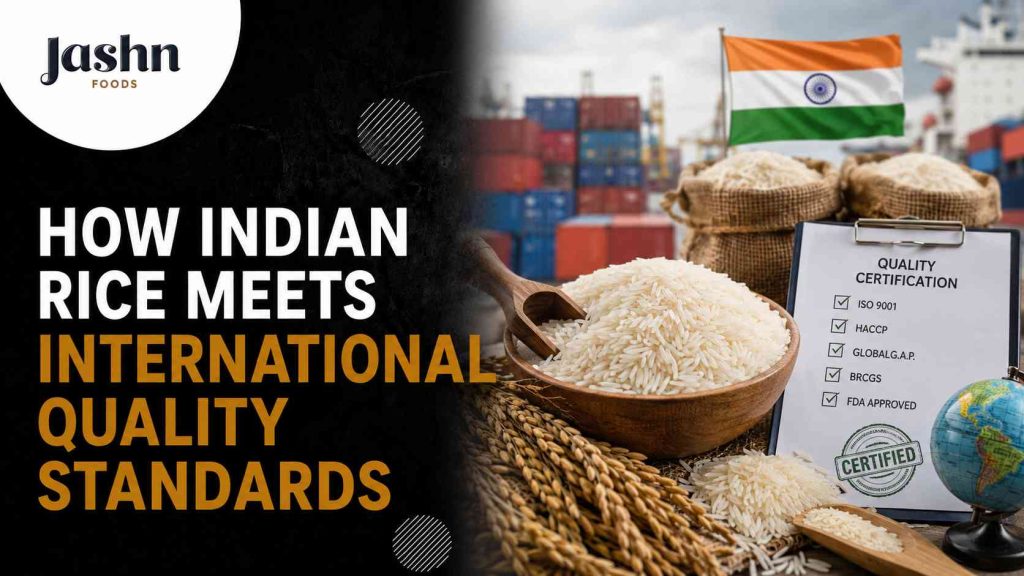
FSSAI licensing is mandatory, full stop, for any Indian food business. APEDA registration, an RCAC, is a separate requirement specific to basmati exporters alone.
Beyond that baseline, plenty of mills also carry ISO 22000 and HACCP certification. Saudi Arabia has required these food safety standards from rice establishments since November 2019; shipments without them don’t clear customs there, period.
Russia and Indonesia layer on their own condition too, asking for pre-shipment clearance from APEDA-authorized labs before a container even gets accepted. None of these certificates last forever. Auditors return, sometimes with little notice, to confirm daily practice still matches what’s written on paper.
Pesticide Residue and the EU Standard
The European Union cut the maximum residue limit for tricyclazole, a widely used fungicide, from 1.0 ppm all the way down to 0.01 ppm. One regulatory change. It hit Indian exports to the EU hard, with reports citing a drop of more than 45 percent in shipments after the tighter limit took effect.
Exporters had to move fast. Punjab banned several pesticides on basmati crops outright. The Export Inspection Agency began testing consignments across roughly 22 different pesticides before anything ships now.
Limits still vary wildly by country: Japan allows tricyclazole residues up to 3 ppm, while the US eventually settled near a comparable figure after years of back-and-forth negotiation. Farmer workshops on safer spraying schedules have become routine in growing regions since then, not just a one-off response.
Lab Testing Before Every Shipment
Nothing ships without an accredited lab check first. Testing covers pesticide residue, heavy metals, moisture, and microbial contamination, on every single export batch, no exceptions carved out.
This step isn’t optional in several markets either. Russia and Indonesia specifically require certification from APEDA-authorized labs before rice enters their ports at all. Labs also check grain length, broken percentage, and moisture on a representative sample from each lot, not just the chemical panel people assume is the whole test.
One failed report can hold up an entire container at port. Exporters who test early, well before booking shipping space, tend to avoid that particular headache.
The Export Journey
Here’s how to export rice from India, roughly in the order it actually plays out. An Import Export Code comes first. APEDA registration and FSSAI licensing follow, then phytosanitary certificates and a certificate of origin, all before the rice ever touches a port.
Pre-shipment inspection and quality testing happen next, and only after clearance does loading actually begin. Skip a step and the risk of rejection at the destination climbs sharply. Paperwork travels with the container the entire way; a certificate of origin, a packing list, a bill of lading, all riding along. New exporters underestimate this constantly. One missing signature, one expired certificate, and a container sits at customs for weeks.
Exporters Who Set the Bar
Consistency separates the exporters buyers keep returning to from everyone else, more than anything else really. Indian basmati rice exporters such as Jashn Foods build their process around repeatable checks at every stage, not a single inspection tacked on right before loading.
That means sourcing from trusted growing regions. Controlled aging timelines. Careful milling. Batch-level testing instead of one sample checked once and hoped for. Buyers notice fast when a shipment doesn’t match the last one, and one inconsistent batch can undo years of trust built slowly through steady deliveries. Quick, clear answers on lab reports and shipping timelines matter almost as much as the grain itself does.
Choosing a Trusted Brand
Domestic shoppers deal with a smaller version of the same problem. Plenty of people search for the best rice brands in India before they’ll commit to filling a kitchen shelf with one.
Look for packaging with lot numbers, FSSAI license details, clear grain-type labeling. That’s usually a good sign. Vague labels, missing certification numbers, or pricing that seems suspiciously low tend to mean the opposite is true.
Cooking behaviour tells its own story too; the grains should stay separate after cooking, not clump into a sticky mass. A brand confident about its sourcing generally just says so, plainly, without hiding behind vague claims about “premium quality.”
Get export-quality rice that meets international buyer expectations.
India’s Growing Global Footprint
India exported over 60 lakh metric tonnes of basmati rice in 2024-25, worth close to $5,944 million, according to APEDA figures. Saudi Arabia, Iraq, Iran, the UAE, and Yemen remain the largest buyers by volume, and that hasn’t shifted much in years.
That kind of scale isn’t luck. APEDA data also shows rising demand from newer markets across Africa and Southeast Asia, spreading out the risk of leaning too heavily on any one region. A wider buyer base brings wider scrutiny along with it, though; every new market arrives with its own testing rules and its own paperwork to satisfy.
The Road Ahead
Standards keep tightening. Pesticide limits, traceability rules, packaging norms, all of it shifts almost every year now, and there’s no real sign of that slowing down anytime soon.
Indian rice has adapted before, more than once. Farmers changed pesticide habits they’d held for generations. Exporters added lab testing nobody demanded a decade back. Mills upgraded lines they’d run the same way for years without complaint. That pattern of adjustment will probably hold going forward too.
Quality isn’t a badge earned once and forgotten about. It’s a habit, repeated at every stage from field to freight, and that habit is really why Indian rice keeps finding its way onto tables far from home.
Explore internationally compliant rice varieties before stocks are allocated.