

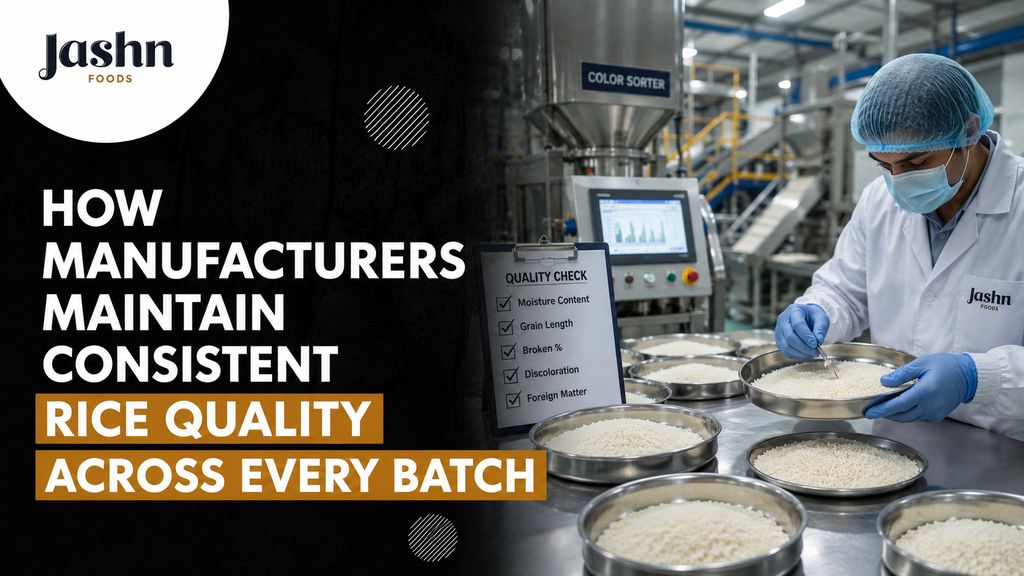
Rice buyers rarely judge a supplier by one shipment alone. They remember what happened with the last order. Did the grains cook evenly? Did the bag contain the expected amount of broken rice? Was the aroma familiar? Did the next shipment behave the same way?
That is why how manufacturers maintain consistent rice quality across every batch matters so much. Good quality on one production day is not enough. Manufacturers need systems that keep raw material, processing, testing, and storage under control every time.
This becomes especially important for Indian rice suppliers serving overseas markets. India produces many rice varieties across different growing regions. Basmati has its own geographical and quality characteristics, while non-Basmati varieties can differ considerably in grain shape, aroma, texture, and cooking behavior.
For a buyer looking for high quality basmati rice, consistency can be just as important as price. A restaurant, retailer, distributor, or importer wants the next shipment to perform like the previous one.
Discover what happens before rice reaches your shipment.
How Manufacturers Maintain Consistent Rice Quality Across Every Batch
The process starts well before rice enters a milling machine. Manufacturers first decide what the finished product should look and perform like. They then build production controls around those requirements.
The specification may include variety, grain length, moisture, broken grains, color, foreign matter, aroma, and other characteristics. Basmati products face additional identity and quality requirements in India. FSSAI standards cover parameters such as grain characteristics, moisture, damaged grains, amylose, uric acid, and the presence of other rice varieties.
That gives manufacturers a practical reference point.
They can compare incoming material with an agreed specification. They can monitor the production line against the same reference. They can then inspect the finished lot before dispatch.
The purpose is not to make every grain identical. Natural agricultural variation will always exist. The goal is to keep that variation within an acceptable range.
Choosing the Right Paddy Before Production
The first serious quality decision happens at procurement.
Manufacturers cannot turn poor raw material into excellent finished rice simply through better polishing. The starting paddy affects recovery, appearance, grain strength, aroma, and cooking behavior.
Teams therefore examine incoming lots before processing begins. They may review moisture, cleanliness, foreign material, grain condition, varietal characteristics, and visible damage. Sampling becomes important here because a large consignment can contain variation that is not obvious from one handful of grain.
Basmati requires particular attention. APEDA describes Indian Basmati through characteristics such as extra-long slender grains, aroma, flavor, and elongation during cooking. These traits are influenced by geography, cultivation, harvesting, processing, and ageing.
A reliable basmati rice manufacturer in India therefore needs more than production equipment. Supplier selection and raw-material controls also play an important role.
Jashn Foods can use product-specific sourcing and inspection practices to maintain the characteristics expected from different rice categories.
Plan ahead before your next rice requirement arrives.
Keeping Moisture Within a Controlled Range
Moisture sounds like a simple measurement. In a rice plant, it has wider consequences.
The moisture level can affect storage, milling behavior, grain breakage, and yield. FAO guidance identifies moisture as an important quality factor because it influences both keeping properties and milling performance.
Manufacturers therefore measure moisture instead of estimating it by appearance or touch.
Incoming paddy may have one moisture level. After drying, that level changes. Conditioning can change it again. Finished rice may need another check before packaging.
The exact target depends on the product and process. What matters most is repeatability.
When one lot enters production much wetter than another, identical machine settings may produce different results. Controlled moisture reduces that variation.
At Jashn Foods, moisture management can be treated as one part of a larger quality-control system rather than an isolated test.
Adjusting the Milling Process
Milling is where small process differences can become visible.
Too much mechanical stress may increase broken grains. Poorly adjusted equipment can affect whitening, grain recovery, or overall appearance. Different varieties may also respond differently to the same machine settings.
Operators therefore watch the milling process rather than simply switching equipment on and waiting for the final result.
They monitor output and adjust settings when necessary. Preventive maintenance also matters because worn components can gradually change milling performance.
This is where manufacturers work to reduce rice milling losses without compromising the appearance or cooking characteristics expected by customers.
The balance is important. Maximum polishing is not always the best outcome. The finished product needs to meet its commercial specification while maintaining acceptable recovery.
For large orders, the same discipline becomes even more important. Several production runs may be needed to complete one shipment. Consistent operating procedures help keep those runs aligned.
Removing Unwanted Grain Variation
No raw material arrives perfectly uniform. Manufacturers use grading and sorting to narrow that variation.
Mechanical graders separate grains according to physical characteristics. Optical sorters can identify kernels with unwanted colors or defects. Together, these systems help create a more uniform finished lot.
This also explains why rice looks different across brands. Two products may start with similar varieties but follow different specifications and processing methods. One brand may select a tighter grain profile. Another may use a different polishing level or sorting threshold.
The difference is not always a sign of better or worse rice. It can reflect the product specification.
Jashn Foods can maintain separate processing requirements for different rice categories rather than forcing every product through one identical process.
Testing the Product Before It Leaves the Plant
Quality control cannot rely entirely on visual inspection.
A grain may look acceptable while showing a problem that requires measurement. Manufacturers therefore use physical checks and, where required, laboratory analysis.
How rice is tested depends on the product, destination, and agreed specification. Common checks can include moisture, grain dimensions, broken percentage, foreign matter, damaged kernels, and other quality or safety parameters.
For Basmati, APEDA’s Basmati Export Development Foundation describes quality-assurance activities that include physical-quality testing and DNA fingerprinting for varietal identification. APEDA also operates systems supporting traceability and authenticity in Basmati production and supply.
Testing becomes more useful when results remain connected to a particular batch.
A manufacturer can then compare one production lot with another. Trends become easier to spot. A recurring deviation can also trigger an investigation before it affects future orders.
Find the right specification before placing your order.
Keeping Specifications Clear
Consistency becomes difficult when nobody agrees on what “good quality” means.
Manufacturers solve that problem by defining specifications before production.
A specification can state acceptable ranges for grain length, moisture, broken kernels, damaged grains, foreign matter, and other attributes. The exact requirements depend on the product.
For export Basmati, this is particularly important because Indian regulations define specific identity and quality requirements. FSSAI’s standards also address authenticity and quality characteristics for Basmati sold in domestic and international markets.
Clear specifications help procurement, production, testing, and sales teams work from the same reference.
They also make buyer conversations easier. Instead of discussing quality in vague terms, both sides can discuss measurable characteristics.
That is useful when a customer places repeat orders months apart.
Protecting Rice After Processing
Quality does not end when milling finishes.
Rice can still be affected by poor storage, moisture exposure, pests, contamination, or rough handling. Packaging also needs to protect the finished grain during transport.
Warehouses therefore need suitable hygiene and handling practices. Finished bags should be stored in conditions that reduce exposure to moisture and contamination.
This matters greatly for export shipments.
A container may travel from an Indian warehouse to a port, then spend time at sea before reaching an overseas buyer. The rice must arrive in the same condition in which it left the production facility.
Good packaging and warehouse controls help preserve that quality.
Manufacturers also benefit from sensible stock rotation. Older lots should not remain forgotten in storage while newer products move first.
Recording What Happened in Each Batch
A production record can reveal more than a final quality report.
It may show which raw material entered the line, what process settings were used, when the batch was produced, which inspections were performed, and where the finished product went.
That information becomes valuable when something changes.
Suppose a customer notices a small difference in grain appearance. A traceable system gives the manufacturer a starting point for investigation.
APEDA’s Basmati quality-assurance work includes traceability mechanisms covering production and supply. This reflects the wider importance of knowing where rice came from and how it moved through the supply chain.
For Jashn Foods, detailed production and quality records can support more dependable repeat supply for domestic and international customers.
Keeping Quality Consistent From One Order to the Next
Rice quality consistency is ultimately about predictability.
A restaurant needs rice that behaves similarly every time. A retailer needs packs that look consistent on the shelf. An importer needs incoming shipments that match agreed specifications.
The challenge becomes greater when several production lots are required for one customer order.
Manufacturers address that challenge through standard operating procedures, product specifications, sampling, process monitoring, and final checks.
How manufacturers ensure rice quality consistency is therefore less about one machine or one laboratory test. It is about connecting many small controls.
- Raw material is checked.
- Moisture is monitored.
- Milling is adjusted.
- Grains are sorted.
- Finished products are tested.
- Records are maintained.
- Storage is controlled.
- Each step removes another source of unwanted variation.
Why Process Control Matters More Than a Final Check
A final inspection can catch a problem. It cannot always undo it.
For example, a manufacturer may discover excessive breakage after a large lot has already passed through the mill. The inspection is useful, but the lost yield and processing time cannot be fully recovered.
A better approach catches problems earlier.
Operators can monitor the product during milling. Quality teams can review samples at defined points. Production managers can compare current results with historical batches.
This makes corrections faster.
It also encourages continuous improvement.
Manufacturers can identify equipment settings that work well, suppliers that provide stable raw material, and process stages where variation tends to appear.
That knowledge becomes part of the next production run.
Serving Buyers in India and Global Markets
Indian rice manufacturers operate in a highly competitive market. Domestic buyers have varied requirements, while international customers often work with detailed specifications.
Exporters also need to understand destination-market requirements before shipping. Product standards, documentation, testing, packaging, and labeling can vary by market.
India’s Basmati sector is particularly important in global trade. APEDA reports that India exported 6.52 million metric tonnes of Basmati rice during 2025–26, valued at approximately US$5.67 billion.
That scale creates strong pressure for reliable quality.
Jashn Foods can serve this demand by focusing not only on product variety, but also on repeatable quality and dependable supply.
For buyers comparing suppliers, it can also be useful to consider better rice prices alongside quality consistency, specifications, logistics, and expected repeat performance.
The cheapest quotation is not always the most economical choice if the product changes from shipment to shipment.
Find the right grain for your market and customer needs.
Conclusion
How manufacturers maintain consistent rice quality across every batch comes down to controlling variation at every important stage.
It starts with suitable raw paddy. It continues through moisture management, milling, grading, sorting, testing, packaging, and storage. Records then connect those stages and make problems easier to investigate.
No manufacturer can remove every natural difference from an agricultural product. The real objective is to keep those differences within clearly defined limits.
That is what gives buyers confidence.
For Jashn Foods, consistent quality means more than producing a good shipment today. It means building processes that support reliable rice quality across future orders in India and international markets.
When buyers know what to expect, supplier relationships become stronger. Repeat orders become easier to manage. And quality becomes something measurable rather than something promised.