
A rice mill tells you everything about how little most of us know about this process. Sacks of paddy get tipped onto a conveyor, and from there, the grain enters a world most shoppers never think about. A bag of rice goes through a long string of checks before it ever gets near a shelf, and hardly anyone talks about them.
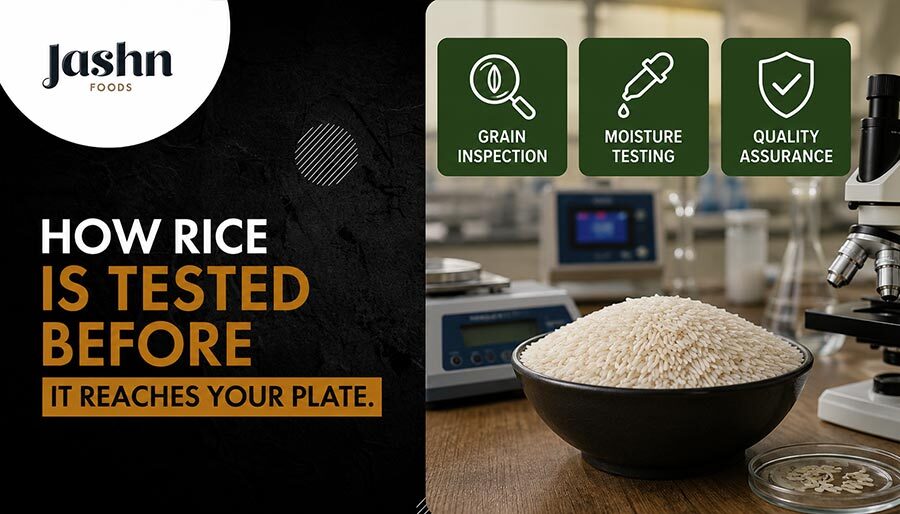
How rice is tested before it reaches your plate, if you actually dig into it, turns out to be a fairly unglamorous grind. Moisture readings. Grain counts. Little plastic pouches of samples couriered off to a lab somewhere. And that grind is exactly why one packet costs double the one sitting right beside it. Premium quality basmati rice earns its price the hard way. Months of grading and rejection sit behind that price, most of it unseen.
At Jashn Foods, every grain is carefully inspected before packing.
How Rice Is Tested Before It Reaches Your Plate: A Look Inside the Quality Chain
Nobody just bags rice and ships it out. There’s a whole sequence to it, and it moves slower than most people assume. Moisture gets checked first, and whatever doesn’t belong in the batch gets cleared out at the same stage. Grading comes next, where size and shape get assessed, sometimes by a trained grader, increasingly by a machine instead. Only after that does a batch reach a lab for chemical checks.
Packaging happens dead last, once everything else has cleared. FSSAI and APEDA sit over most of this in India, and not because either body enjoys paperwork. A poorly tested batch causes real damage. Export consignments have been turned back at port over a single failed residue test before now. That kind of loss is usually enough to make any factory owner take these checks seriously.
None of these stages work in isolation, either. A batch can sail through the moisture test without a hitch and still get rejected a week later at the chemical screening stage. Each check exists because the one before it has blind spots. A moisture meter has no clue about pesticide residue.
A grading machine can’t tell a genuine basmati grain from something dressed up to pass as one. So if the question is still how rice is tested before it reaches your plate, here’s the honest version of it: several gates, not one, and a batch only keeps moving once it earns its way past each of them.
Moisture, Purity and the First Line of Defense
This is where it all starts. The moment raw rice hits the mill, someone runs a moisture meter over it. Takes seconds. Too much water in the grain and mold starts setting in before you know it, along with pests moving into sacks that should’ve stayed sealed. Too little, and milling gets rough.
Workers also pull out stones, husks, weed seeds, whatever shouldn’t be in there. Indian food safety rules cap moisture and foreign matter fairly tightly, usually close to the 14 percent mark depending on the variety, and a batch that misses that stops right there. No exceptions.
It doesn’t end at intake either. Warehouses track humidity and temperature for weeks after, sometimes months. Rice that passed on day one can still spoil if storage conditions go wrong later. That’s why the better mills keep checking, over and over, instead of trusting one good reading and moving on.
Choosing the Right Grain for Everyday Cooking
Here’s something people don’t think about enough. Which rice is best for daily use is a completely different question from which rice you’d buy for a wedding feast. Everyday rice, like parboiled or medium-grain varieties, gets tested for how consistently it cooks. It also gets checked for how well it holds up sitting in a kitchen jar for months.
Nobody’s checking its aroma the way they would for a premium long grain. Starch content and moisture still get measured, just with different goals in mind. A Tuesday-night dinner grain simply isn’t chasing the same bar as one bound for a biryani pot.
Choose rice that’s inspected for purity, consistency, and superior taste before it reaches your kitchen.
Grain Size, Shape and Broken Kernel Grading
Once moisture and purity checks are cleared, someone sits down and actually measures the grain. India’s Agmark system sets a minimum length and a length-to-width ratio for each grade. Graders also count broken kernels in every sample they pull. Fewer breaks and more uniform length gets you a higher grade, which shows up almost immediately in what a retailer will pay for it.
Honestly, most shoppers never even glance at the grade stamp on the bag, which is a bit of a shame given how much work goes into earning it. The broken pieces aren’t wasted, mind you, they usually go into cheaper blends or products like rice flour.
What Sets Trusted Rice Brands Apart
Walk any supermarket aisle in a city like Delhi or Mumbai. You’ll count dozens of rice brands in India fighting for the same shelf space. I once stood in front of one such aisle trying to figure out what separated three nearly identical five-kilo bags. Honestly, the packaging told me nothing.
What actually tells them apart isn’t the label art, it’s what’s behind it: a valid FSSAI license number, a visible Agmark grade, lab reports a company will actually hand over if you ask (most won’t, by the way). Brands that keep testing every batch, instead of getting one certificate years ago and coasting on it, tend to give you rice that cooks the same way every single time.
Pesticide Residue and Chemical Safety Screening
Rice soaks up whatever’s around it while it’s growing, chemicals included, so this test matters more than people realize. Export shipments in particular go through labs recognized by APEDA, checking pesticide residues against limits that get especially strict for markets like the EU.
Domestic batches get screened too, along with checks on uric acid content in basmati under current FSSAI rules. Cross the line and the batch gets rejected, full stop. Somebody’s family is going to cook that rice for dinner, and that’s really the whole point of this step.
Machines That Never Blink
Old-school grading meant rows of workers staring at grain for hours, and tired eyes making mistakes, that’s just how people work. This is exactly where the role of technology in rice milling and processing has quietly taken over a lot of the heavy lifting. Optical sorters now scan thousands of grains every second, pulling out discolored ones before a person would even spot them.
Watching one run at a mill, it honestly looks more like a noisy slot machine than farm equipment, grains flashing past under a strip of light while a jet of air flicks out the bad ones. Image-based systems judge grains by length and shape, catching broken bits and stray particles at a speed no human team could match. None of it replaces good judgment completely, but it does take the fatigue out of doing this by hand, batch after batch.
Basmati Authenticity: Aroma, Elongation and DNA Verification
Basmati gets its own separate round of testing, and there’s a good reason for that. So much of its value comes down to actually being basmati, not something dressed up to resemble it. Since August 2023, FSSAI rules require that natural fragrance basmati is known for, with nothing artificial faking it.
Testers also check the elongation ratio, how much a grain stretches once cooked without snapping in half, and amylose content, which affects how fluffy it turns out. When there’s real doubt about authenticity, particularly in blended basmati products, labs run a PCR-based DNA test to settle it for good. Sounds excessive until you realize how much ordinary rice gets sold under the basmati name when nobody bothers to check.
How Manufacturers Build Trust Through Testing
A trustworthy rice bag almost always has a manufacturer behind it who tests well past whatever the law actually demands. Basmati rice manufacturers such as Jashn Foods run checks at nearly every stage the grain passes through, starting the moment paddy arrives at the gate and continuing through milling, polishing, and finally packing. In-house labs get to moisture, grain length, and purity long before any export or retail lab even sees the batch.
Problems get caught early this way, well before a customer at home ever cracks the packet open. It’s also the reason some brands hold the same quality shipment after shipment, while others drift, some batches strong, others noticeably weaker, without much warning.
Get export-quality basmati processed under rigorous quality control standards.
Why Global Buyers Look for the Same Assurances
This isn’t only something Indian buyers care about. Importers in the Middle East, Europe, and North America want paperwork that matches their own regulations, and a good chunk of Indian standards now line up closely with Codex Alimentarius and ISO frameworks, which makes cross-border trade smoother for everyone.
A shipment that clears Indian testing usually clears international checks too, provided the exporter’s records are in order. Reading this from Delhi or from Germany doesn’t really change the questions buyers are actually asking. Is the grain pure, safe and is it what the label claims? Solid testing answers all three, wherever the rice ends up.
The Bigger Picture
Rice testing was never going to be a single checkpoint. It’s a chain, and every link catches something the others miss. Moisture meters. Sieves. Optical sorters, chemical labs, DNA tests when it comes down to it, all working quietly before a single grain lands anywhere near your kitchen.
So the next time a pot of rice turns out exactly right, that isn’t luck. It’s a system built to catch problems long before they ever get near your plate, and once you know what sits behind it, picking a bag you can trust gets a lot less complicated.
Explore Jashn Foods’ premium basmati rice collection and place your inquiry before your next purchase.