
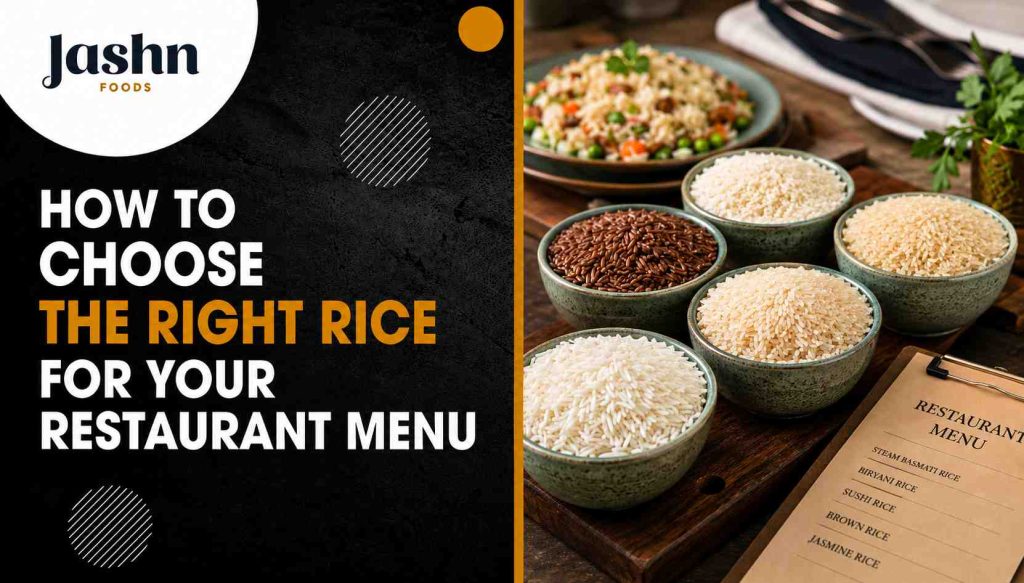
Rice is more than a side dish in a restaurant. It can influence taste, presentation, food cost, and customer satisfaction. Learning how to choose the right rice for your restaurant menu helps you match every dish with the right grain, cooking behavior, and price point.
A biryani needs rice that stays long, aromatic, and separate after cooking. A South Indian meal may need a softer grain with dependable daily performance. Fried rice requires grains that handle high heat without turning sticky.
The right selection also protects your margins. Restaurants buy rice repeatedly, so even a small difference in yield can affect monthly costs.
For this reason, restaurant owners should evaluate rice beyond appearance and purchase price. Variety, grain length, processing, cooking performance, consistency, and supplier reliability all deserve attention.
Tell us your dishes and requirements. We’ll help you explore suitable rice options before your next bulk order.
How to choose the right rice for your restaurant menu
Start by looking at the dishes your kitchen serves most often. Different recipes require different grain characteristics.
For example, premium biryani usually benefits from long, slender aromatic rice. APEDA describes Indian Basmati through characteristics such as long slender grains, aroma, elongation, and a soft, fluffy texture after cooking.
Everyday meals may not need those premium characteristics. A versatile non-Basmati variety can provide reliable cooking performance at a more practical cost.
Think about the menu first. Then choose the rice.
This simple approach prevents restaurants from paying premium prices for qualities their dishes do not actually require.
Match the grain with the dish
The cooking method should influence your rice selection.
Biryani is one of the clearest examples. The grains should remain visually attractive and separate after cooking. Aroma also matters because it contributes directly to the dining experience.
For premium biryani, varieties such as 1121 Basmati, 1509 Basmati, and other suitable long-grain varieties can be considered according to the recipe and budget.
Fried rice needs a different approach. The grain should remain firm enough to withstand tossing, sauces, vegetables, and high cooking temperatures.
For pulao, restaurants can select aromatic grains that provide good separation without necessarily using their most expensive option.
South Indian dishes may require varieties with different texture and cooking characteristics. Sona Masuri, for example, is widely used across Indian cuisine and offers a different eating experience from long-grain Basmati. APEDA lists Sona Masuri among India’s important non-Basmati varieties.
The best rice is therefore not universal. It is the rice that performs consistently in your specific recipe.
Consider grain length and cooking appearance
Grain appearance matters when customers judge a dish visually.
Long, slender grains can create an impressive presentation in biryani, pulao, and festive rice dishes. Shorter or medium grains may work better in recipes where softness and cohesion are preferred.
For Basmati, grain measurements are part of its recognized quality characteristics. APEDA’s Basmati specifications include minimum precooked grain length, length-to-breadth ratio, cooked grain length, aroma, and cooking characteristics.
However, length alone should not decide your purchase.
Two rice varieties can look similar before cooking but behave differently in the kitchen. Always consider cooked length, expansion, texture, aroma, and grain separation together.
A restaurant should judge rice after cooking, not only from the sample bag.
From biryani to everyday meals, discover rice options designed for different restaurant applications.
Check processing and ageing before buying
Processing can significantly influence the way rice behaves during cooking.
Restaurants commonly encounter raw, steamed, and parboiled or Sella rice. Each option can suit different dishes and kitchen requirements.
Steamed Basmati can offer attractive grains and a distinct texture. Sella rice is often selected when restaurants want grains that remain firm during cooking and handling.
Ageing also deserves attention, particularly for Basmati. APEDA’s eligibility characteristics recognize ageing as part of the assessment process, while FSSAI identifies harvesting, processing, and ageing among factors contributing to Basmati’s distinctive characteristics.
Restaurants should therefore ask suppliers about the variety, processing method, and ageing period.
That information gives chefs a better idea of what to expect from each batch.
Evaluate cooking yield, not just purchase cost
The cheapest rice is not always the most economical choice.
Restaurants should calculate how much cooked rice a particular quantity produces. They should also check how much water the rice requires and how much breakage occurs during cooking.
A rice that delivers strong expansion and low breakage can improve portion economics. Consistent cooking can also reduce waste during busy service periods.
This is particularly important for restaurants serving hundreds of portions every day.
Before finalizing a supplier, conduct a controlled kitchen trial. Cook the same quantity using your normal recipe and equipment.
Record the uncooked weight, cooked output, water requirement, cooking time, breakage, and leftover quantity.
This gives your purchasing team practical data instead of relying only on the quoted bag price.
Balance quality with your food-cost target
Premium rice can improve the perceived value of a dish. However, every restaurant has a different food-cost structure.
Fine-dining restaurants may justify premium aromatic rice for signature dishes. A high-volume restaurant may need a more economical variety for everyday meals.
The goal is not to select the most expensive rice. The goal is to select rice that delivers the required experience within your target food cost.
Market movement also matters. Basmati rice prices can vary according to variety, crop conditions, processing, ageing, demand, and market conditions.
Restaurants should therefore avoid choosing a rice solely from one quotation.
Compare quality, cooking yield, consistency, packaging, delivery reliability, and price together.
A slightly higher purchase price can make commercial sense when the rice produces better portions and fewer customer complaints.
Choose a supplier that can maintain consistency
Restaurants need consistency more than occasional excellence.
A rice sample may perform beautifully during testing. The real question is whether future batches will deliver similar results.
This is where supplier selection becomes important.
When comparing leading basmati rice manufacturers, restaurants should examine their quality-control systems, processing capabilities, sourcing practices, packaging standards, and ability to supply consistently.
A dependable supplier should also understand commercial kitchen requirements. They should be able to discuss grain specifications, processing types, packaging options, minimum order quantities, and delivery schedules.
Jashn Foods works with buyers looking for dependable rice solutions across restaurant, wholesale, domestic, and international markets. Its product portfolio includes Basmati and non-Basmati varieties suited to different culinary and commercial requirements.
For restaurants, that wider selection can make it easier to match rice with individual menu applications.
Share your menu and volume requirements with Jashn Foods and explore suitable rice solutions.
Test rice before placing a large order
Never make a major rice purchase based only on photographs or a specification sheet.
Request a sample and test it inside your own kitchen.
Use your regular cooking method. Follow the same soaking time, water ratio, vessel, burner, and cooking duration used during normal service.
Then evaluate several factors.
Check the cooked grain length first. Look at separation and breakage next. Taste the rice while it is hot and after it has rested.
Also observe how the rice performs after holding.
This matters because restaurant food often sits briefly before reaching the customer. Rice that looks excellent immediately after cooking may become sticky or dry during holding.
A proper kitchen trial can reveal problems before they become expensive purchasing mistakes.
Understand food safety and quality requirements
Rice purchasing should also include food safety considerations.
Codex Alimentarius maintains an international Standard for Rice covering quality factors, contaminants, pesticide residues, and hygiene recommendations.
In India, FSSAI has established regulatory standards for Basmati rice. Its 2023 amendment introduced comprehensive identity standards covering categories including milled and parboiled Basmati rice.
Restaurants should purchase from suppliers who follow applicable food safety and quality requirements.
Storage matters too.
Rice should remain protected from moisture, pests, contamination, and poor handling. Cooked rice also requires careful temperature control because Bacillus cereus spores can occur in rice and other foods. FDA food-safety materials identify improperly stored food as a concern for toxin formation.
Good purchasing and good kitchen handling must work together.
Look beyond the bag price
Restaurant purchasing teams sometimes focus too heavily on the price printed on a quotation.
That approach can overlook important commercial factors.
Consider delivery frequency, packaging quality, minimum order requirements, payment terms, stock availability, and replacement support.
A reliable supplier can help prevent sudden shortages during peak periods.
Restaurants should also ask whether the supplier can maintain the same specification over time. Consistency becomes especially important when a particular rice is linked to a signature dish.
When evaluating how to choose the right rice manufacturer, focus on capability rather than marketing claims alone.
Ask for product specifications. Request samples. Discuss your menu requirements.
A supplier willing to understand your kitchen can become a long-term procurement partner rather than simply another vendor.
Use customer feedback to refine your choice
Your customers can tell you whether the rice is working.
Pay attention to comments about aroma, texture, portion appearance, softness, and consistency.
Repeated complaints may indicate a rice-selection problem rather than a cooking problem.
This is why understanding how rice quality impacts restaurant reviews matters for restaurant operators. Customers may not know the technical difference between varieties, but they notice when rice feels undercooked, overly sticky, dry, broken, or bland.
Restaurants should connect customer feedback with kitchen records.
If complaints increase after a supplier change, investigate the rice immediately.
The same principle applies to positive feedback. If customers consistently praise a signature biryani, identify the rice specification behind that result.
Documenting successful combinations helps chefs maintain consistency even when kitchen staff change.
Build a practical rice selection strategy
A restaurant does not need one rice variety for every menu item.
A better approach is to create a simple rice matrix.
Assign each major dish a preferred variety, processing type, quality level, and target cost. Then test those choices periodically.
For everyday meals, focus on dependable cooking and value. For premium dishes, prioritize aroma, grain appearance, texture, and presentation.
For high-volume preparations, give extra attention to yield and holding performance.
Restaurants searching for the best rice for daily use should also consider menu frequency, cooking equipment, customer preferences, and procurement volumes before deciding.
This approach makes purchasing more systematic.
It also prevents chefs from switching rice varieties without understanding the effect on the final dish.
-Why the right rice becomes a business decision
Rice selection eventually affects much more than taste.
It influences food cost, kitchen efficiency, presentation, repeat orders, customer reviews, and brand perception.
A restaurant serving premium biryani cannot treat rice as an interchangeable commodity. Likewise, a high-volume operation should not overspend on characteristics customers may never notice.
The right choice sits between culinary performance and commercial practicality.
Jashn Foods can support restaurants and bulk buyers by helping them explore rice options based on menu requirements, volume, and market needs.
For a restaurant, the smartest starting point is simple: identify the dish, define the required cooking result, test suitable varieties, and compare total value.
Then choose the supplier that can reproduce that result consistently.
That process turns rice purchasing from a routine expense into a strategic part of restaurant operations.
Compare the right variety, quality, processing, and commercial value for your restaurant.