
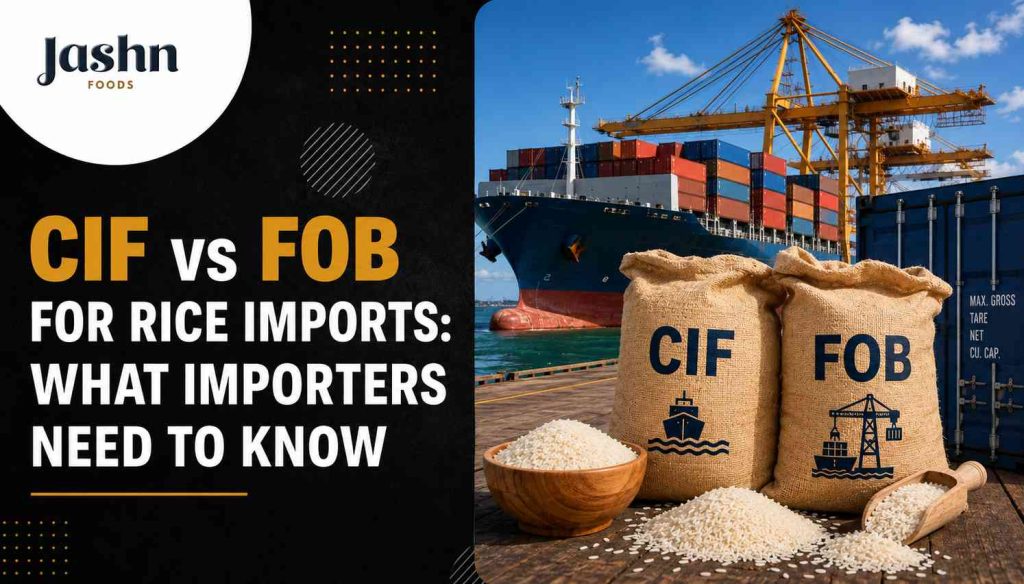
For anyone weighing CIF vs FOB for rice import contracts, the shipping term can shift your total landed cost by several percentage points. Two terms appear on almost every rice trade invoice: CIF and FOB. Understanding the difference isn’t just about paperwork — it shapes who carries financial risk, who arranges freight, and who pays insurance from the moment cargo leaves the mill.
CIF (Cost, Insurance and Freight) means the seller’s quoted price includes the goods, marine insurance, and ocean freight to the named destination port. FOB (Free On Board) means the seller’s responsibility ends once the rice is loaded onto the vessel at the origin port. After that point, all costs and risks shift to the buyer.
Both terms fall under the Incoterms rules published by the International Chamber of Commerce, most recently updated in Incoterms 2020.
Get a clear CIF vs FOB cost breakdown before you place your next order.
What CIF and FOB Actually Mean for Rice Importers
The core distinction is simple: under CIF, the seller arranges and pays for shipping and insurance; under FOB, the buyer does. For rice — traded in large volumes with tight margins — this split has real commercial weight.
Consider a buyer in the Middle East purchasing 1,000 MT of basmati from an Indian exporter. Under CIF Jeddah, the invoice price covers freight from Mundra or Nhava Sheva to Jeddah, plus marine insurance. The buyer pays one quoted price and handles import clearance on arrival. Under FOB Mundra, the buyer must contract their own shipping line, pay freight, and arrange cargo insurance separately.
Neither term is inherently better. The right choice depends on your buying volume, your freight relationships, and how much operational control you want over the shipment.
How Risk and Ownership Transfer Under Each Term
The risk handover point is the same under both terms — the origin port — but many importers don’t realize this. Under FOB, risk passes to the buyer when the rice crosses the ship’s rail at loading. Under CIF, the seller arranges insurance, but risk still transfers at the origin port, not the destination.
Even on a CIF contract, if the vessel sinks mid-ocean, the buyer must claim against the insurance policy the seller arranged. The seller doesn’t simply resend the cargo. This surprises many first-time importers who assume CIF shifts all transit risk to the exporter.
Practically speaking, CIF feels safer because the seller handles the logistics paperwork. The insurance exists for the buyer’s benefit — but the buyer still bears the financial consequence of a transit loss. Know this before you sign.
The True Cost Breakdown Under Each Term
FOB price is always lower than CIF price on paper, because the CIF seller has bundled freight and insurance into the quote. When you compare offers from different suppliers, strip those costs out before drawing any conclusions.
A straightforward formula helps:
CIF price = FOB price + Ocean freight + Marine insurance premium
If one exporter quotes $650/MT CIF Dubai and another quotes $590/MT FOB Nhava Sheva, you need the current freight rate from Nhava Sheva to Dubai before you know which deal is cheaper. Freight rates fluctuate — sometimes sharply — so a FOB deal signed when freight is high can end up costing more than a CIF deal from a month earlier.
For basmati and other premium rice grades, marine insurance premiums typically run 0.3–0.5% of cargo value. Freight rates on India-to-Middle East corridors have historically ranged from $20 to $60 per MT depending on vessel type and market conditions. Always get a current freight quote from your forwarder before choosing which term gives you the better landed cost.
Our guide on top basmati rice varieties in India breaks down the main grades available to buyers and mills — useful context when drafting quality specifications in your supply contract.
Which Term Works Better for Large-Volume Buyers
Larger importers — those buying 5,000 MT or more per shipment — usually prefer FOB. They’ve built relationships with freight forwarders and shipping lines, often at negotiated rates that beat what any exporter would embed in a CIF quote. By controlling their own freight, they can also consolidate shipments from multiple suppliers onto one vessel, cutting per-unit costs further.
Smaller importers typically find CIF more practical. Arranging freight from a foreign port is operationally demanding if you don’t do it regularly. A CIF quote hands you a clean, all-in number, and the exporter — who ships far more frequently — usually secures better freight rates than a first-time buyer could independently.
Mid-sized buyers often negotiate on CFR (Cost and Freight) terms, where the seller arranges freight but the buyer purchases their own insurance. This suits buyers who want freight handled but prefer to choose their own insurer and coverage level.
Get the right pricing, shipping terms, and support for your international order.
Freight, Insurance, and Who Controls the Carrier
The party who arranges freight has more say over carrier selection and routing. Under CIF, the Indian exporter books the vessel. They’ll choose routes and carriers they trust, but the buyer has no direct input into carrier selection, vessel schedule, or port rotation.
Under FOB, the buyer nominates the vessel. This lets you pick a carrier offering better cargo tracking, preferred arrival windows, or specific handling conditions — relevant if you’re importing moisture-sensitive milled rice with strict quality requirements.
Marine insurance under CIF is usually arranged on Institute Cargo Clauses (A) — the broadest standard cover available. Ask the seller for the insurance certificate before the vessel sails; you’ll need it to file any claim at the destination port. Under FOB, arrange your own policy through a local insurer or freight forwarder, and don’t skip it to save the premium.
Protecting the cargo in transit is only half the equation. Our guide on rice storage and post-harvest management covers what to do once your shipment clears customs and moves into your warehouse.
How Indian Exporters Typically Quote Rice
India accounts for roughly 40% of global rice trade, making it the world’s largest exporter by volume. Most Indian exporters — particularly those shipping basmati to the Middle East, Europe, and the US — are comfortable quoting on either CIF or FOB terms.
That said, many mid-size exporters prefer CIF because it gives them control over freight booking and sometimes adds a margin on the freight component. Larger exporters with long-standing buyer relationships will readily quote FOB when asked.
When requesting quotes, always specify your Incoterm and the named port clearly. “FOB Mundra” and “FOB Nhava Sheva” can produce different prices for the same product because inland trucking costs to each port differ. “CIF Rotterdam” and “CIF Hamburg” will similarly differ by the inland freight leg from the European arrival port to your distribution point.
For broader context on where basmati export volumes are heading, this guide on basmati rice market size and forecasts gives a useful overview of trade patterns and demand segments across key importing regions.
Common Mistakes Importers Make When Choosing a Term
The most frequent error is comparing a CIF price to a FOB price without accounting for freight. A $50/MT difference can look significant but evaporate once you add ocean freight to the FOB deal.
A second mistake: signing a FOB contract without confirming vessel availability at the loading port on the agreed date. If your nominated vessel can’t call at that port on time, you may face storage charges at the seller’s facility — and the seller’s contractual obligation ended the moment the rice crossed the ship’s rail.
Third mistake: not specifying insurance coverage type on CIF contracts. Ask the seller whether their policy covers all risks under Clauses A or only named perils under Clauses C. For rice shipments, Clauses A is the standard expectation among experienced importers.
Finally, some buyers ignore the currency exposure embedded in a CIF price. If the CIF contract is denominated in USD but the exporter’s underlying freight booking is in another currency, exchange rate movements can affect the seller’s actual freight cost — and many sellers build a buffer into CIF quotes specifically to cover this.
Setting clear quality benchmarks in your contract is just as important as nailing the Incoterm. Our guide to identifying authentic basmati rice helps you define the standards your shipment should meet before it leaves the country of origin.
Final Thoughts
CIF vs FOB for rice import is a trade-off between convenience and control. CIF gives you a clean, bundled price with logistics managed by the seller. FOB puts freight and insurance decisions in your hands but requires more operational effort on your side.
Neither term wins across every situation. Buyers with established freight relationships and high volumes typically do better on FOB. Importers newer to cross-border rice purchasing often find CIF the more manageable starting point, with a switch to FOB as volumes grow.
What matters most is precision in the contract: agree on the named port, reference Incoterms 2020 explicitly, and confirm the insurance coverage scope — all in writing before the shipment moves. Get those three details right, and managing the rest of the trade becomes far more predictable.
Talk to our team about the right shipping terms for your next rice shipment.