
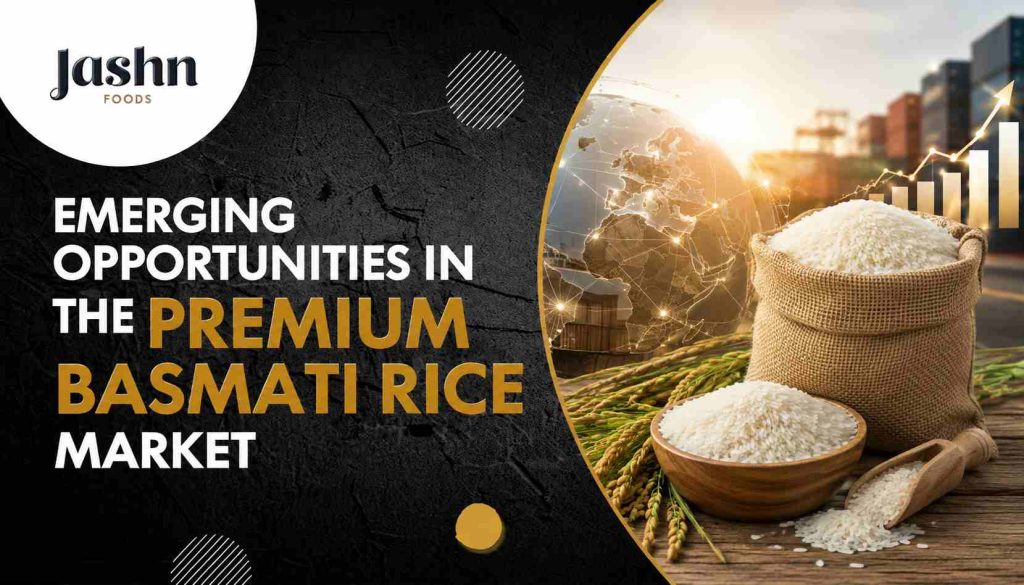
The global rice industry is changing as consumers look beyond price and basic nutrition. They increasingly want better aroma, texture, origin, convenience, and consistency. This shift is creating emerging opportunities in the premium basmati rice market across India and international markets.
Basmati already holds a distinctive position among aromatic rice varieties. Its long grains, aroma, cooking texture, and regional identity give it strong premium appeal. India also has a major advantage because Basmati is a registered Geographical Indication product.
The opportunity now extends beyond traditional retail sales. Premium packaging, specialized varieties, traceability, online commerce, foodservice, and international distribution are opening new paths for businesses.
Get consistent quality, competitive sourcing, and dependable supply for your growing market.
Emerging opportunities in the premium basmati rice market
The strongest opportunities are appearing where quality meets changing consumer expectations. Buyers want products that offer a clear reason to pay more.
India remains central to this opportunity. APEDA reports that India exported 6.52 million metric tonnes of Basmati rice during 2025–26. The export value reached ₹50,138.28 crore, or about US$5.67 billion.
Saudi Arabia, Iran, Iraq, the UAE, Yemen, and the United States were among the leading destinations. These markets show how widely Indian Basmati already travels.
For businesses, this creates room for better segmentation. Instead of selling only standard grades, companies can develop products around specific consumer needs.
Premiumisation is changing consumer buying habits
Consumers are becoming more selective about staple foods. Rice is no longer viewed only as an affordable household necessity.
Many buyers now compare grain length, aroma, cooking performance, processing, packaging, and origin. These factors can influence purchasing decisions in both retail and foodservice markets.
This trend is especially visible among urban consumers. Higher-income households often seek products that improve everyday meals without requiring major changes.
Restaurants are also contributing to this shift. Premium rice can influence the appearance, aroma, and texture of dishes. The result is a broader premiumisation opportunity. Brands can compete through product quality rather than relying only on lower prices.
Greater demand for differentiated rice varieties
Not every consumer wants the same Basmati experience. Some prefer extra-long grains, while others prioritize aroma or cooking consistency. This creates opportunities for carefully positioned varieties. Products can target biryani restaurants, hotels, caterers, households, and institutional kitchens separately.
Specialized varieties can also support different price points. Exporters can create portfolios that cover mainstream premium and high-end segments.
This approach reduces dependence on a single product. It also gives buyers more reasons to remain with one supplier. Product differentiation becomes particularly valuable when competing in crowded international markets.
Opportunities in premium retail packaging
Packaging has become an important part of the premium food experience. A well-designed pack can communicate quality before the consumer opens it.
Premium Basmati brands can use packaging to highlight grain characteristics, origin, variety, aging, and cooking performance. Clear information can make the product easier to understand.
Smaller consumer packs can target households and online shoppers. Larger formats can serve restaurants, caterers, and institutional buyers.
Packaging innovation also creates opportunities for private-label businesses. Retailers can develop exclusive rice ranges with selected suppliers.
For exporters, packaging can be customized according to destination-market preferences. This makes the product more relevant to local consumers.
Traceability can strengthen premium positioning
Consumers increasingly want confidence in food origin and authenticity. Traceability can therefore become more than a compliance requirement.
Basmati has an important advantage here. APEDA operates Basmati.Net as a traceability system designed to support authenticity across the supply chain.
APEDA also supports quality assurance through varietal identification and physical quality testing. Its Basmati Export Development Foundation works on DNA fingerprinting and quality analysis.
These systems can strengthen buyer confidence. They also give premium brands a stronger story around authenticity. For exporters, transparent sourcing can become a commercial advantage. Buyers may prefer suppliers who can provide reliable product information.
Digital commerce is widening market access
Online grocery platforms have changed how consumers discover staple foods. Rice brands can now reach customers without depending entirely on traditional retail networks.
This creates opportunities for premium products with strong visual presentation. Product pages can explain grain length, variety, cooking characteristics, packaging, and sourcing.
Search-driven commerce also helps smaller brands compete for niche demand. A specialized product can reach buyers across different cities and countries. Exporters can benefit from digital B2B platforms as well. Online discovery makes supplier comparison faster for importers and distributors.
The key is consistency. Product information, packaging, quality, and supply capability must match the promises made online.
Connect with a trusted Indian supplier and secure your Basmati rice requirements today.
Foodservice offers another strong growth channel
Hotels, restaurants, caterers, and cloud kitchens buy rice differently from households. They need predictable performance at scale. Premium Basmati can appeal to businesses where presentation and taste directly affect customer satisfaction. Biryani restaurants are an obvious example.
Large kitchens also value grain consistency. Uneven cooking can create waste and affect the final dish. Suppliers can therefore develop foodservice-specific grades and pack sizes. Technical support can add further value.
Businesses that understand these operational needs can build longer-term commercial relationships.
India has a strong export foundation
India’s position in global rice trade gives premium Basmati businesses an important starting advantage. APEDA states that India has remained the world’s largest rice exporter since 2012.
During 2024–25, India’s total rice exports reached 20.19 million metric tonnes. Their value stood at US$12.47 billion. Basmati represented US$5.94 billion of India’s APEDA product exports during the same period.
These numbers show that international demand already exists. The next opportunity lies in capturing more value from that demand. Exporters can achieve this through stronger branding, specialized grades, packaging, certifications, and market-specific products.
Growing interest in premium food creates room for new brands
The phrase premium rice demand is growing reflects a wider change in food purchasing. Consumers increasingly connect food quality with lifestyle and experience.
This does not mean every buyer will choose expensive rice. Value remains important, especially in price-sensitive markets. However, premium segments can grow alongside mainstream products. Brands can serve different budgets through clear product tiers.
A practical portfolio might include everyday premium, restaurant-focused, and luxury Basmati products. Each tier can have a distinct quality proposition.
This structure helps brands avoid competing only on price. Opportunities in private-label and contract supply
Private-label rice offers another route for growth. Supermarkets, distributors, restaurant groups, and online retailers may prefer products under their own brands.
Indian suppliers can support these buyers with customized specifications and packaging. This creates opportunities beyond traditional branded exports.
Private-label contracts can also provide more predictable volumes. However, suppliers must maintain strict quality consistency. Documentation becomes equally important. Buyers may require testing reports, certifications, specifications, and traceability records.
Suppliers that can manage these requirements efficiently can become valuable long-term partners.
How businesses can build a stronger premium position
A premium rice strategy should begin with the product itself. Attractive packaging cannot compensate for inconsistent grain quality. Businesses should define their target customer before selecting varieties and pack sizes. Restaurants need different solutions from retail households.
Quality testing should remain consistent throughout procurement and processing. Storage conditions also matter because rice quality can change when handled poorly. Brand communication should remain specific. Instead of making broad claims, businesses should explain measurable product characteristics.
This approach makes premium positioning more credible. It also helps buyers understand why a product deserves its price.
Technology can improve quality and supply decisions
Modern processing and testing technologies are creating further opportunities. Better sorting can improve visual uniformity and reduce unwanted grains.
Laboratory testing can support product consistency. Digital systems can also improve inventory planning and traceability. Data can help exporters understand market preferences. Businesses can identify which varieties perform better in particular destinations.
Technology does not replace strong sourcing. Instead, it helps businesses manage larger volumes with greater control. This becomes increasingly important as international buyers demand consistency across shipments.
Opportunities for new entrepreneurs in India
India’s large agricultural ecosystem creates several entry points for entrepreneurs. However, entering the rice sector requires more than simply buying and selling rice.
Anyone researching how to start rice mill business in India should first understand sourcing, milling, grading, storage, packaging, compliance, logistics, and customer acquisition. Entrepreneurs can choose different models. These include distribution, private labeling, retail branding, institutional supply, and export trading.
A focused model can reduce initial complexity. For example, a business could specialize in premium Basmati for restaurants or export markets. Strong supplier relationships are especially important. Consistent quality and dependable delivery can determine whether buyers continue placing orders.
What buyers should look for in premium rice
Price alone does not define a premium product. Buyers should evaluate several characteristics before making a decision. Grain appearance is one useful starting point. Aroma, cooking performance, broken percentage, moisture, and consistency also matter.
Buyers should understand the variety and intended application. A rice suited to household cooking may not be ideal for large-scale foodservice. Reliable documentation can provide additional confidence. Export buyers may also require certifications and destination-specific compliance.
For consumers seeking the best rice for daily use, the right choice depends on cooking habits, budget, preferred texture, and meal type.
The future will favor value over volume
The global rice business will remain highly competitive. Large volumes alone may not guarantee strong margins. Premium positioning gives businesses another route. It allows suppliers to compete through quality, reliability, branding, and customer experience.
India has a strong foundation for this strategy. Its Basmati GI status, established export network, production base, and international reputation create meaningful advantages. Companies such as Jashn Foods can participate in this opportunity by combining dependable sourcing with consistent quality and market-focused supply solutions.
The broader rice market size also provides room for businesses operating across different price segments. Premium products can grow without replacing mainstream varieties. The opportunity is therefore not simply about selling more rice. It is about creating greater value from every tonne.
Where the market is heading
The premium Basmati segment is likely to become more specialized. Consumers will continue looking for quality, convenience, authenticity, and dependable performance.
International buyers will also expect stronger documentation and supply-chain visibility. Brands that prepare for these expectations can build greater trust. India is well placed to benefit from this shift. Its existing export strength provides a platform for developing higher-value products. The most successful businesses will understand their buyers before expanding their product range. They will invest in quality before advertising.
They will also treat packaging, traceability, digital commerce, and service as parts of the same strategy. For suppliers and exporters, the message is clear. Premium Basmati is moving beyond a simple commodity model.
The next phase will reward businesses that can deliver consistent quality, clear positioning, and dependable supply. That is where the most promising opportunities are likely to emerge.
Source quality Basmati rice from India and explore reliable supply options before demand grows further.