
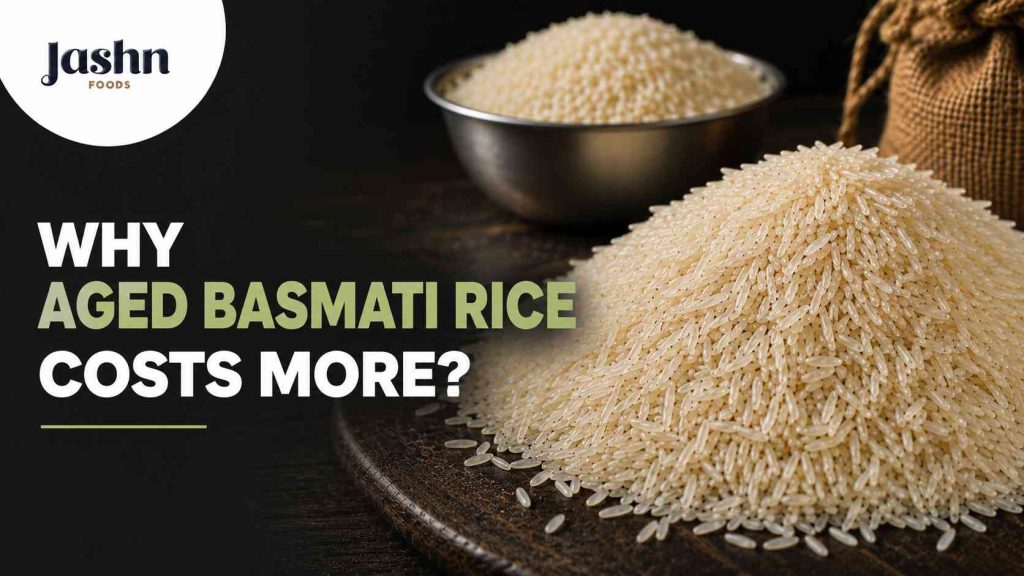
You pick up two bags of basmati at the store. Same brand, roughly the same weight. One costs almost double the other. Why?
That gap is what gets people writing in to ask why aged basmati rice costs more than the regular stuff sitting right next to it on the shelf. And honestly, the price difference isn’t a marketing trick. Somebody paid for that extra cost long before the rice reached your trolley — usually a miller who chose to sit on stock for a year or two instead of selling it fresh. Holding grain that long isn’t free. Warehouse space, capital, spoilage risk, constant testing — it all adds up before a single grain of premium Indian basmati rice reaches a packet.
Here’s what’s actually going on under the hood.
Explore premium basmati trusted by global buyers.
Why Aged Basmati Rice Costs More: The Core Reasons
Freshly harvested basmati carries a lot of moisture, somewhere around 14 to 16 percent. Cook it straight off the field and you’ll get a soft, clingy pot of rice — not the long, separate grains people expect from basmati. So millers park it. For twelve months, sometimes twenty-four, the grain just sits in controlled storage while moisture slowly drops to around 10 or 11 percent.
That waiting period is the whole story, in a sense. The grain hardens. It cooks up longer and drier. It stops clumping.
But waiting costs money. A warehouse full of rice is a warehouse full of unsold inventory, and every month it sits there, someone’s paying rent, insurance, and staff to babysit it. That’s really the short version of why aged basmati rice costs more — you’re paying for the mill’s patience, not just the grain itself.
What Actually Happens Inside the Grain
Aging isn’t just rice gathering dust on a shelf, even though it might look that way from outside. It’s a managed process — cool storage, steady humidity, regular checks — closer to how a winery ages wine than how a warehouse stores sacks of flour.
Inside each grain, the starch molecules slowly reorganize. Food scientists call this retrogradation. Practically, it means the rice becomes less sticky and swells more when it hits boiling water. A properly aged grain can nearly double its length once cooked. Try that with fresh basmati and you won’t get close.
The smell shifts too, which surprises a lot of people. Basmati’s aroma comes largely from a compound called 2-acetyl-1-pyrroline (2-AP for short). Fresh off the field, it smells almost grassy. Give it a year, and that raw edge mellows into the nuttier, rounder scent most of us associate with good basmati. A leading basmati rice manufacturer such as Jashn Foods watches this shift closely — get the aging window wrong, even by a few months, and you lose both the smell and the price tag that comes with it.
The Real Cost of Holding Rice in Storage
Here’s a number that puts things in perspective: aged basmati can sell for three to four times what a farmer earned for the same grain at harvest. That’s not all profit-taking. Processing takes a cut, sure. But a large chunk of that markup is simply the cost of waiting — capital tied up, warehouse rent paid, nothing coming in for months at a time.
Rice millers watch the current basmati rice price on export desks almost obsessively, because every week of delay changes the math on whether holding stock still makes sense.
The export numbers back this up too. India shipped over 6 million metric tonnes of basmati rice in 2024–25, worth close to 5,944 million US dollars, according to APEDA. Domestically, premium 1121 basmati paddy was trading between roughly ₹3,400 and ₹4,600 per quintal in Haryana mandis earlier this year — well above ordinary non-basmati varieties in the same markets. None of that premium shows up on the packet’s front label. It’s buried in warehouse rent, pest control, insurance, and the simple fact that someone chose not to sell six months ago.
Discover premium grains with lasting quality.
Milling and Quality Control Add Their Own Cost
Longer storage does have a practical upside for millers: it improves what’s called head rice recovery, meaning fewer grains snap during processing. Sounds like a straightforward win. It mostly is — but getting there still takes real effort at every stage.
Grains get sorted by length. Broken pieces get pulled out, sometimes by machine, sometimes still by hand. Moisture gets tested again and again to confirm the aging actually worked the way it was supposed to. If you’ve ever wondered why top basmati rice brands charge more for their aged lines specifically, this is most of the answer — the storage, plus this repeated, almost obsessive quality checking.
Packaging plays its part as well. A brand that prints the harvest year or the aging duration on the bag isn’t doing that for fun. That kind of transparency needs testing, certification, and a traceability system that can actually track a grain back to the farm it came from — none of which is cheap.
And then there’s labor, which people tend to forget about. Machines catch most defects, but skilled workers still hand-check samples from every batch that comes through. Wages, training, repeated audits — all of it sits quietly inside the final price, well before the rice reaches a shelf in Delhi, Dubai, or London.
Export Demand Keeps Prices High
India essentially controls the global basmati trade. The Himalayan foothill belt — Punjab, Haryana, Uttarakhand, and parts of Uttar Pradesh — is the only region legally allowed to grow rice that can be called basmati, protected under India’s Geographical Indication tag. Saudi Arabia, Iraq, Iran, and the UAE account for most of the demand, and buyers there consistently ask for aged stock over fresh.
It’s not really about tradition, either. Aged basmati just performs better at scale — in restaurant kitchens, at weddings, in catering halls cooking hundreds of servings of biryani or kabsa at once. Nobody wants a sticky, clumped pot going out at a wedding. So caterers pay extra, every time, for the aged grade.
Things shifted a bit after India dropped its Minimum Export Price rule in September 2024. Prices started moving more freely with demand, monsoon output, and competition from Pakistan. Pakistani basmati, oddly enough, got more expensive faster through parts of 2025, largely because of water supply worries in Punjab province on their side of the border. That briefly made Indian basmati the cheaper option on paper — though buyers who actually care about grain length and aroma kept paying up for properly aged lots regardless.
It’s not only a Gulf story. Indian communities across the US, UK, Canada, and Australia keep buying aged basmati year-round — festivals, weddings, or just Sunday dinners that call for proper long-grain rice.
Discover premium quality from the source.
Does the Health Angle Justify the Price?
Basmati already sits lower on the glycemic index than most white rice. Aging seems to push that a bit further — as the starch structure changes during storage, digestion slows slightly, which can help keep blood sugar response steadier compared to fresh rice.
Still, aged basmati isn’t automatically the best rice for daily use in every kitchen. Fresh or lightly aged batches are cheaper and cook up perfectly fine for a regular weeknight meal. Save the deeply aged stuff — eighteen to twenty-four months — for when grain length and aroma genuinely matter: festive biryanis, guests coming over, that kind of occasion.
Nutritionally, not much changes. Fat and protein dip slightly as the grain matures, but fibre, minerals, and calories stay roughly where they started. You’re really paying for texture and aroma here, not a health upgrade.
How to Tell If Your Basmati Is Actually Aged
A few things to check before you trust the label:
Look at the color. Real aged grains usually carry a faint creamy or golden tint, not bright white.
Press a grain between your nails. It should snap, not crumble.
Smell it raw. A subtle, rounded aroma beats an intense one — sometimes an overpowering smell means something was added to fake it.
Check the pack for a harvest year or aging duration. Brands confident in their process usually print it clearly, because they’ve got nothing to hide.
If a “premium aged” bag is priced suspiciously close to regular rice, that’s worth a second look before it goes in your cart. Real aging costs money, and that cost has to show up somewhere.
Final Word
Aged basmati costs more because every step of getting there costs something — storage, capital, careful milling, export logistics, all of it stacking up before the rice ever reaches your kitchen. Once you see the whole chain, the price stops looking like a markup. It starts looking like exactly what it is: the cost of doing it properly, and waiting long enough to get it right
Source premium-quality rice at competitive prices from Jashn Foods.