
Every Indian kitchen has an opinion on rice starch. Some cooks rinse it three or four times without a second thought. Others swear even one wash ruins the dish. So who’s right? Is removing starch from rice good or bad? Truthfully, it’s not that simple. It depends on the rice you’re using, how you plan to cook it, and honestly, whether you care more about texture or nutrition that day. Cook with high quality basmati rice, though, and a light rinse tends to work out fine either way. Let’s get into why.
Premium rice makes all the difference. Upgrade your kitchen with authentic basmati from Jashn Foods.
Is Removing Starch From Rice Good or Bad? Breaking Down the Science
Rice starch isn’t just one thing. Milling leaves loose starch stuck to the outside of each grain, and there’s also starch sealed inside it. Rinsing only deals with the outer layer. It can’t touch what’s locked inside, and that’s a big deal, because it explains why washing changes texture but does almost nothing to calories or carbs. People have been arguing about this for decades. Food scientists too, though their answer usually lands somewhere in the middle rather than a flat yes or no.
What Happens When You Wash Away Rice Starch
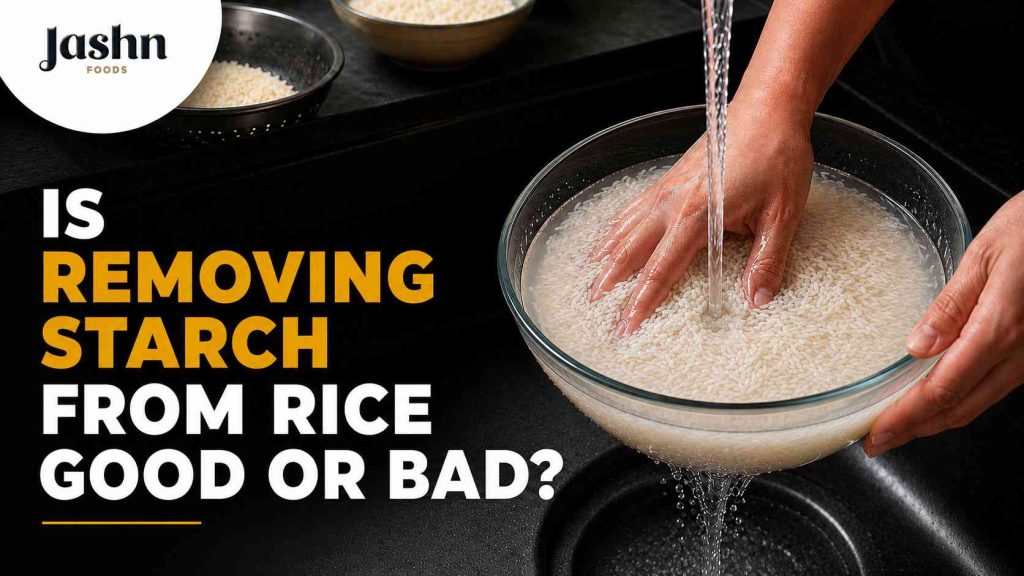
Here’s what’s actually going on. When rice gets milled, tiny bits of starch stick to the surface of every grain, the same powdery residue you feel on your hands after scooping dry rice from a bag. Once you rinse rice before cooking, that loose starch just dissolves off. You can literally watch it happen. Cloudy water at first, clearer with each round.
That surface starch is also what makes rice clump and go sticky while it cooks. Wash it off and the grains pull apart more easily, which is exactly why most cooks rinse before making biryani or pulao. Nobody wants a mushy biryani. Skip the rinse, though, and you get a stickier, creamier bite instead, which is honestly the whole point behind risotto or a good kheer.
The Nutrition Trade-Off Nobody Talks About
This is the bit most blogs conveniently leave out. Does rinsing rice remove nutrients? Yes, a little. Some Western countries fortify their rice, spraying iron, folate, thiamin, and niacin onto the outer surface after milling, and washing that rice can rinse a decent chunk of it straight down the sink.
Basmati sold across India generally skips this artificial fortification, so the loss is smaller here, but it’s not nothing. A bit of copper, some zinc, small traces of protein, all of it goes with the wash water too. For someone eating a fairly varied diet, that loss barely registers. It starts to matter more for people who rely on rice for most of their daily nutrition, not just a side dish.
Arsenic, Heavy Metals, and Why Rinsing Still Matters
Rice grows in flooded paddy fields, and because of that, it pulls in arsenic from soil and irrigation water far more than most other crops do. This isn’t some minor footnote either. Parts of India, especially along the eastern Gangetic plain, already deal with documented groundwater arsenic issues.
Rinsing rice properly removes a large chunk of the bioaccessible arsenic before it lands on your plate. Cooking with extra water, then draining it off, cuts arsenic levels down even further. Different studies have tested different rice-to-water ratios, and honestly, the pattern holds up pretty consistently: more water plus a proper rinse means less arsenic, whether you’re cooking long grain, parboiled, or basmati.
So yes, rinsing costs you a handful of nutrients. But it also lowers your exposure to something you’d rather not have in your body, especially if there are kids at home. Arsenic exposure isn’t a one-meal problem, it builds up slowly, over years of regular eating. Which means a small daily habit like rinsing properly can genuinely add up over time.
Choose high-quality basmati rice trusted by families, restaurants, and chefs. Shop before stocks change.
Starch and Blood Sugar: The Diabetes Angle
There’s a common myth floating around that rinsing rice somehow lowers its glycemic impact. It doesn’t, not really. The starch responsible for blood sugar spikes sits deep inside the grain, not on the surface, so rinsing barely touches how fast your body absorbs glucose after eating.
What actually moves the needle is how you cook and store the rice. Cooling cooked rice, for instance, creates something called resistant starch, which digests more slowly. Reheat that cooled rice later, and studies show it can produce a gentler blood sugar rise than freshly cooked rice does. So if managing blood sugar is your priority, worry less about rinsing and more about portion size, the variety you choose, and how you store your leftovers.
Rinsing Habits Across Indian Kitchens
Walk into ten Indian homes and you’ll probably find ten different rinsing routines. Some families run the rice under water for a full minute, scrubbing it like laundry. Others give it one quick swirl and call it done. A lot of this comes down to region. Bengali households, for example, often cook with plenty of extra water, which naturally cuts down starch and arsenic at the same time.
For everyday basmati rice, most home cooks land somewhere around two to three rinses, and that seems to strike a fair balance. You lose a bit of surface starch, gain fluffier grains, and cut down contaminant exposure, without stripping the rice of everything it has to offer.
How Many Times Should You Actually Rinse
You don’t need the water to run completely clear before you stop. Studies on basmati suggest three to five light rinses do the job just fine for good texture. Past that point, you’re mostly just wasting water.
Go gentle with your fingers. Swirl, drain the cloudy water, repeat. Try not to scrub hard, since that can crack the grains, and cracked grains tend to fall apart and go mushy once cooked. A soft touch keeps both the shape and the bite of the rice intact.
Choosing the Right Rice Matters More Than Rinsing
Worth saying plainly: the quality of your rice matters more than your rinsing technique ever will. Well-aged, properly milled basmati holds its shape and aroma whether you rinse it twice or five times. Cheaper rice, full of broken bits and dust, usually needs a heavier wash just to look presentable on the plate.
If consistent results matter to you, it genuinely helps to buy from best basmati rice brands in India, ones that handle proper aging, sorting, and cleaning before the rice even reaches your kitchen shelf. Good sourcing quietly does half the work your rinse would otherwise have to.
Check that the grains look uniform in length and colour before you buy. Look at the packaging for the ageing period too, since well-aged basmati cooks up longer, less sticky, with a noticeably stronger aroma. Unaged, cheaper rice tends to carry more dust and broken grains, which means more surface starch and a heavier rinse just to get it clean. Spending a bit more upfront usually saves you effort, and frustration, later at the stove.
Discover premium basmati rice with exceptional taste, aroma, and quality. Order before your preferred variety runs out.
Why Good Sourcing Makes Rinsing Easier
Sourcing quietly does a lot of the heavy lifting here, more than people realise. Jashn Foods sorts and cleans its basmati carefully before packaging, so the grains reach you with far less loose dust and debris to begin with. That means a shorter, gentler rinse is usually all you’ll need. You’re not scrubbing away grit at that point. You’re just rinsing off a light, natural coating of surface starch, exactly the way it’s meant to work.
Matching Your Rice to the Meal
Not every meal calls for the same rice, and that’s worth remembering. For everyday dal-chawal or khichdi, a shorter grain that holds onto a bit more starch often tastes better and cooks faster anyway. For biryani, pulao, or festive spreads, longer aged basmati with a proper rinse gives you that classic, separate-grain look everyone expects.
Think of it as matching rice to the occasion instead of following one fixed rule for everything. When picking the best rice for daily use, lean toward consistency, quick cooking time, and how well it holds up after reheating the next day. Save your finest aged basmati for the special-occasion meals, where presentation actually matters.
Final Verdict
So, is removing starch from rice good or bad, really? Neither, on its own. Rinsing trades a small bit of nutrition and stickiness for better texture and lower arsenic exposure. Skip it, and you keep more nutrients but also more of the starch and contaminants that come along with it.
Which choice is right for you depends on your rice, your recipe, and honestly, what you’re prioritising that day. Start with decent quality grains. Rinse gently, not obsessively, there’s no prize for washing rice ten times. And remember, what happens in the pot usually matters more than what happens at the sink.
Compare our premium basmati varieties and find the perfect rice for your everyday meals.