
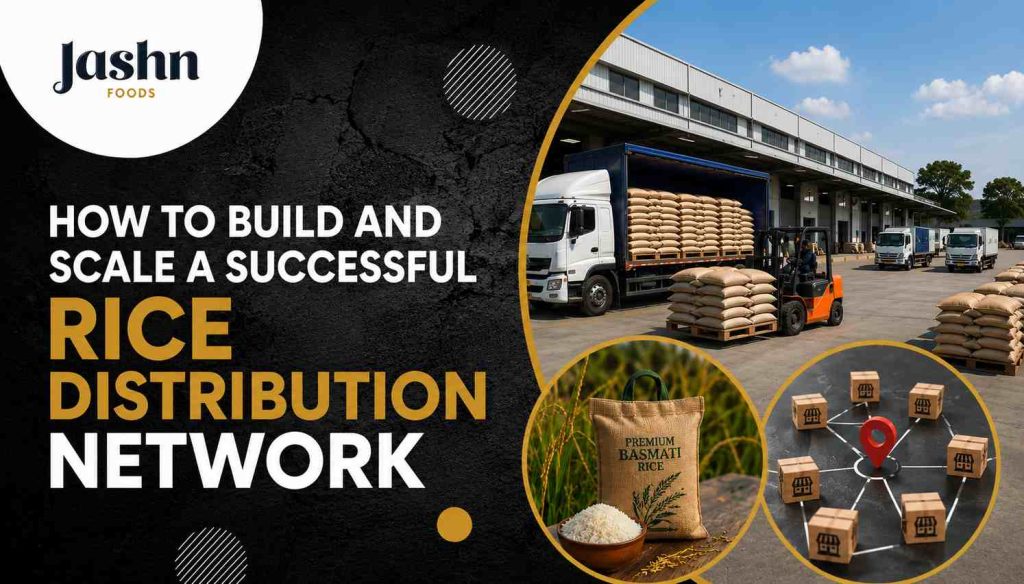
From the outside, rice distribution can seem like a fairly simple business. You purchase rice from a mill, sell it to retailers or other buyers, arrange transportation, collect payments, and repeat the process.
That picture changes pretty quickly once the number of orders starts growing.
Suddenly, you have to worry about keeping enough stock without putting too much money into inventory. Customers want faster deliveries. Transport costs start eating into margins. Some buyers want credit, while suppliers still expect to be paid on time.
This is where a distribution business either becomes organised or starts becoming difficult to manage.
If you are planning to build a rice distribution network in India, it is usually better to grow step by step rather than trying to cover several markets at the same time. Establish one market, understand what works there, fix the weak spots, and then take the same approach into nearby markets.
For distributors looking for a dependable supply partner, manufacturers, Jashn Foods can be an option when consistent quality and regular availability are important.
Secure consistent quality and supply for your wholesale or distribution business.
Understanding How to Build and Scale a Successful Rice Distribution Network
Start by Understanding Your Customers
One of the easiest mistakes for a new distributor to make is spending too much money before knowing exactly who will buy the product.
A large warehouse may look like progress, but an empty warehouse does not generate sales.
Start by talking to potential customers in the area you want to serve. These could include restaurants, hotels, supermarkets, grocery stores, wholesalers, caterers, or institutional buyers.
Their requirements can be quite different.
A restaurant may regularly purchase 25 kg or 50 kg bags and care mostly about consistency and dependable delivery. A supermarket may prefer smaller retail packs and attractive packaging. A wholesaler might be more concerned with pricing, loading time, and uninterrupted supply.
Ask practical questions:
- Which rice varieties sell most frequently?
- How much do they purchase in a typical month?
- How often do they reorder?
- Who supplies them today?
- What problems do they have with their current supplier?
- Are late deliveries or inconsistent quality common?
- Do they prefer cash purchases or credit?
These conversations give you a much clearer picture of the market than simply assuming that every type of rice will sell equally well.
Choose a Supplier That Can Support Your Growth
Your customers may deal with you directly, but the quality of the rice you sell ultimately depends on your supply chain.
If the quality changes from one shipment to another, customers are unlikely to blame the mill. They will remember the distributor who supplied the product.
For that reason, supplier selection deserves more attention than simply comparing purchase prices.
Before entering into a long-term arrangement, look at the manufacturer’s processing capacity, quality-control procedures, storage facilities, packaging capabilities, minimum order quantities, and normal dispatch timelines.
It is also worth asking how the supplier manages periods of high demand. Rice requirements can increase around festivals, wedding seasons, holidays and certain export cycles. A supplier that is reliable during normal months but struggles whenever demand increases can create problems for a growing distributor.
Jashn Foods, for example, operates a rice manufacturing and processing facility in Karnal, Haryana. Its published infrastructure includes processing, quality testing, packaging and storage, including a stated storage capacity of 25,000 MT.
The important point is not simply the size of a supplier’s facility. What matters is whether that supplier can maintain the quality, volumes and delivery schedules your customers expect.
Build stronger customer relationships with dependable rice supply and consistent quality.
Don’t Start With Too Many Rice Varieties
Having a large product catalogue can look impressive when you are starting out.
It can also leave you with a warehouse full of slow-moving stock.
Instead of purchasing every variety you can source, begin with the products your target customers are already asking for. If basmati is popular among your customers, build around the grades and pack sizes they actually purchase. If your market has stronger demand for non-basmati rice, make that the focus.
Basmati can serve several segments, including retail, restaurants, hospitality and export markets. Non-basmati rice can help distributors reach customers looking for different price points and consumption requirements.
The key is to watch what happens after the first sale.
A large one-time order is useful, but regular repeat purchases are a much stronger indication that a product belongs in your core inventory.
Pick a Territory You Can Serve Reliably
There is no prize for having the longest list of cities on your company website.
A distribution business is stronger when it can consistently deliver to the customers it already has.
For a new distributor, it often makes sense to concentrate on one city or a manageable group of nearby locations. Consider road connectivity, delivery distances, warehouse expenses, competition and the concentration of potential customers.
Customer density matters more than many new distributors realise.
Ten customers located within a relatively compact area can be more attractive than ten customers scattered across several distant towns. Shorter routes mean lower fuel consumption, less driver time and fewer complications when several orders need to be delivered on the same day.
Once your first territory is working well, expansion into neighbouring markets becomes easier because you already have experience with local pricing, transportation and customer behaviour.
Organise the Warehouse Before It Becomes a Problem
Warehouse management may not sound particularly exciting, but it has a direct impact on distribution costs.
When bags are stacked without a clear system, employees waste time looking for specific products. Older inventory can remain hidden behind newer stock. Damaged packaging may go unnoticed. During a busy dispatch period, these small issues quickly become expensive.
Rice should be stored in a clean and dry environment and protected from moisture, pests and avoidable packaging damage.
Create clearly marked storage areas and maintain records for incoming stock. Keep track of varieties, batches and quantities rather than relying on someone remembering what is where.
Fast-moving products should be easy to access.
It is a basic operational improvement, but it can make loading considerably quicker when several orders are waiting to leave.
Stock rotation is equally important. Older inventory should not sit at the back of the warehouse simply because nobody noticed it was there.
Make Delivery a Reliable Part of Your Service
Customers generally do not need an elaborate delivery system.
They need you to deliver the right quantity, to the right place, at the time you promised.
As order volumes increase, route planning becomes more important. If several customers are located in the same area, try to combine those deliveries rather than sending separate vehicles for every order.
Keep records of fuel expenses, kilometres travelled, waiting time and failed or delayed deliveries. After a few months, this information can reveal which routes are costing too much and where deliveries can be combined more efficiently.
Transportation is one of those costs that can quietly reduce a distributor’s margin. An order may look profitable when you only compare the purchase and selling prices, but the calculation changes once freight, loading and handling are included.
Reliable delivery also has a less obvious benefit.
It builds confidence.
A buyer who knows that your deliveries arrive when promised may be less inclined to switch suppliers simply because another distributor offers a slightly lower price.
Strengthen your sourcing now so your distribution business is ready for larger orders.
Keep a Close Eye on Cash Flow
Sales figures can sometimes make a distribution business look healthier than it actually is.
Imagine selling ₹20 lakh worth of rice in a month. That sounds encouraging. But if a large portion of those sales is sitting in unpaid invoices and you have already paid your supplier, the business may still be short of cash.
This is why cash flow deserves as much attention as sales.
Before giving credit to a new customer, understand their payment habits. Decide how much credit you are comfortable extending and establish limits instead of allowing outstanding balances to grow indefinitely.
The same applies to large orders.
A big order from a customer who pays very slowly is not automatically better than several smaller orders from customers who pay on time.
When calculating your selling price, include the costs that occur between purchasing the rice and receiving payment from the customer. Transportation, loading, storage, packaging, discounts, taxes, handling and credit risk can all affect the final margin.
Sales value is not the same thing as profit.
That distinction becomes increasingly important as the business grows.
Introduce Technology Before the Business Gets Complicated
A spreadsheet can work perfectly well when you have a small number of customers and products.
The problem begins when the business expands.
You may have multiple purchase orders, several rice varieties, deliveries happening in different locations, customer credit balances and payments arriving on different dates. At that point, keeping everything in separate spreadsheets or WhatsApp messages becomes difficult.
You do not necessarily need an expensive system from day one.
A basic inventory or ERP solution can help you monitor available stock, incoming purchases, pending orders and customer payments in one place.
Start with the areas where your team repeatedly checks information manually.
If employees are constantly asking, “How much stock do we have?” or “Has this customer paid?” those are obvious areas where better record keeping can save time.
Good data also becomes extremely useful when you are ready to expand. You can identify which products are selling quickly, which customers are ordering regularly and where money is getting stuck.
Build the Business Around Repeat Customers
Getting a customer to place one order is useful.
Getting that customer to call you again next month is much more valuable.
Different buyers have different reasons for returning.
A restaurant wants rice that performs consistently in the kitchen. A retailer wants the product available when the shelf needs replenishing. An exporter may need specifications, documentation and packaging to remain consistent from shipment to shipment.
Try to understand those differences.
Instead of giving every buyer the same sales pitch, focus on what actually matters to that customer.
For some, it may be price. For another, it could be delivery speed or consistent grain quality. Someone else may care about packaging or the ability to supply larger quantities during peak demand.
Jashn Foods states that it offers both basmati and non-basmati varieties and provides services covering processing, quality control, warehousing, packaging and distribution support.
For a distributor, having a supplier that can support several customer requirements can make it easier to expand the product range later.
Learn Distribution Before Investing Heavily in a Rice Mill
People researching how to start a rice mill business in India often begin with machinery, land, processing capacity and investment requirements.
Those are important considerations, but there is another side of the business that is easy to overlook: understanding the customer.
Distribution can provide that experience.
By working directly with buyers, you get to see which varieties actually move, what price points customers accept, which complaints come up repeatedly and how much transportation affects the economics of an order.
That knowledge can be valuable if you eventually decide to invest in manufacturing.
Rather than making a large production investment based entirely on assumptions, you can use real sales experience to determine what the market is asking for.
Explore Markets Outside Your Home City
India’s domestic market provides a substantial opportunity for rice distributors, but businesses with the right capabilities can eventually consider export markets as well.
Exporting brings additional requirements. Documentation, product specifications, packaging standards, destination-country regulations and logistics all need to be handled properly.
According to APEDA, India produced an estimated 150.18 million tonnes of rice during 2024–25. APEDA also reports rice exports of 20.19 million metric tonnes during the same period, valued at approximately USD 12.47 billion.
Those numbers illustrate the size of the broader industry.
For companies considering international expansion, APEDA’s official export guidance can provide information about the requirements involved in exporting rice.
The important thing is not to rush into exports simply because the market is large. Build the domestic operation first, understand your supply chain and make sure your documentation and quality systems are capable of supporting international buyers.
Consider Building Your Own Brand Once Demand Grows
There is another growth opportunity for established distributors: selling rice under their own brand.
Private label products allow a distributor to build an identity that belongs to the business rather than relying entirely on the manufacturer’s brand.
But private labeling also creates additional responsibility.
Once your name is printed on the package, customers associate the product quality directly with your company. If one batch performs well and the next one is noticeably different, the problem becomes a brand issue.
For that reason, private labeling makes quality consistency even more important.
Jashn Foods states that it provides private label solutions for basmati and non-basmati rice, including customised pack sizes and packaging materials. Its published options include pouches, laminates, jute bags and non-woven bags.
This can be worth considering once a distributor has established stable demand rather than as the first step in the business.
Launch your private-label rice range with consistent quality, custom packaging, and reliable bulk supply.
Know Your Numbers Before You Expand
One question comes up frequently when people research the industry: Is rice business profitable in India?
There isn’t a single answer.
Revenue alone does not tell you whether a distribution business is profitable.
Two distributors could each generate ₹1 crore in sales and still have very different results. Their procurement prices, freight expenses, warehouse costs, credit periods, inventory losses and customer mix could all be different.
Track profitability at a more detailed level.
Look at the margin on individual products. Compare customers. Measure delivery costs. Monitor how quickly inventory moves and how long customers take to pay.
You may discover that a product with a high sales volume produces a surprisingly small margin, while a smaller customer segment generates much better returns.
Those are the numbers that should influence your expansion decisions.
Expand Only After the First Model Works
Expansion is much less risky when you are copying something that already works.
By this stage, you should know who your customers are, which products move, which suppliers you can rely on, how much inventory you need and what your delivery routes cost.
That is when the idea of how to build and scale a successful rice distribution network becomes practical rather than theoretical.
Instead of opening five new territories at once, start with one nearby market.
If the additional sales justify the transport and management costs, continue expanding. Later, you can consider another warehouse, a dedicated sales representative or a local distribution partner.
Growth should be connected to actual demand.
Opening warehouses or hiring staff before the order volume exists can put unnecessary pressure on working capital.
Build a Distribution Network That Can Grow Without Constant Firefighting
Successful distribution is rarely built around one big decision.
It comes from getting many ordinary things right.
Choose suppliers carefully. Keep stock under control. Deliver when you say you will. Follow up on outstanding payments. Pay attention when customers complain. Keep accurate records.
Then use what you learn.
For businesses exploring how to build and scale a successful rice distribution network, the objective should not simply be to sell more bags every month. The bigger goal is to create an operation where purchasing, inventory, sales, transportation and payments work together.
Jashn Foods can be considered by distributors looking for basmati and non-basmati rice, bulk supply, customised packaging and export-oriented support. Its published facilities and product portfolio are intended to serve both domestic and international requirements.
The best time to expand is not necessarily when you feel ready to become bigger.
It is when your existing operation is stable enough to handle more business without everything becoming dependent on you personally.
Start with one market. Learn it properly. Build reliable customer relationships. Keep your cash under control. Put simple systems in place.
Then grow from there.
Get the quality and volume support you need before the next customer inquiry arrives.