
Most people rarely think about rice until they need to buy it or cook it.
A restaurant manager places an order every week. A family picks up a bag during a grocery trip. A caterer stocks inventory ahead of a busy wedding season. The rice arrives, gets stored, cooked, and eventually served on the table. At first glance, the process seems simple.
But the journey behind every bag of rice is far more complex than most people realize.
To understand how the rice supply chain operates in Chennai, you need to look beyond supermarket aisles and kitchen shelves. Long before rice reaches the city, it has already passed through farms, processing facilities, storage locations, and transportation networks. By the time it reaches the final buyer, numerous people have played a role in moving it along.
What makes this even more interesting is that most consumers never notice any of it. They simply expect rice to be available whenever they need it. Whether someone purchases an everyday variety or premium basmati rice, the expectations remain the same: dependable quality, steady availability, and consistent taste.
Meeting those expectations requires a supply chain that functions almost year-round without interruption.
Connect with Jashn Foods and experience quality, consistency, and reliable supply with every order.
How the Rice Supply Chain Works in Chennai
At a glance, the process seems straightforward. Farmers cultivate rice, mills process it, and retailers sell it. In reality, there are many more steps involved.
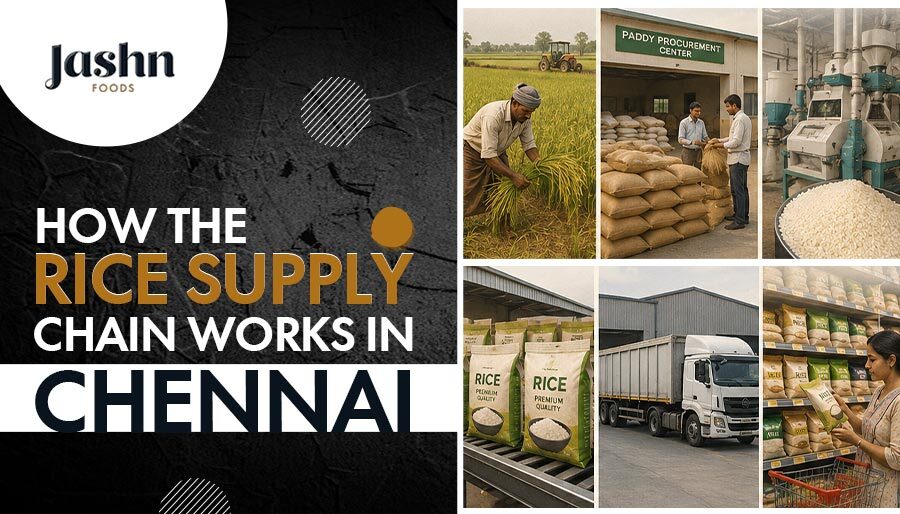
Between harvest and purchase, rice passes through several stages. It may move through collection points, processing facilities, warehouses, distribution centers, wholesale markets, and retail outlets before reaching consumers.
Every stage has a specific purpose. Mills focus on processing and maintaining quality standards. Warehouses safeguard inventory. Transport providers move stock from one location to another. Distributors manage deliveries and stock levels. Retailers place the product directly in front of consumers.
In a city like Chennai, where rice remains one of the most widely consumed staples, every part of this chain plays a critical role. A transportation delay, inventory shortage, or quality issue can create challenges for businesses across the city.
For that reason, supply-chain planning often starts weeks or even months before rice in Chennai appears on store shelves.
A City Where Rice Demand Remains Constant
Food preferences may change over time, but rice continues to be a central part of daily life in Chennai.
Visit a local restaurant during lunch hours. Walk through a hotel kitchen before evening service. Step inside a catering facility preparing for a large function. In almost every case, rice is among the key ingredients being used.
Demand comes from multiple sectors simultaneously. Households buy rice regularly, but so do restaurants, cloud kitchens, schools, hospitals, and catering businesses. Some organizations consume hundreds of kilograms every week.
Unlike products that experience sharp seasonal fluctuations, rice maintains relatively stable demand throughout the year. While that consistency offers some predictability, it also means distributors must avoid prolonged supply disruptions.
Consumers may not think much about fully stocked shelves. Supply-chain teams certainly do.
Where the Journey Begins
Before warehouses, trucks, and retail stores become part of the story, everything starts on farms.
Rice cultivation is still a labor-intensive activity that requires careful planning and months of effort. Farmers prepare fields, manage irrigation systems, monitor crop health, and make decisions that directly influence both yield and grain quality.
Farming, however, is never entirely predictable.
A season may begin under ideal conditions yet still face challenges later. Rainfall patterns can change unexpectedly. Water availability may become an issue. Weather conditions that seem insignificant to city residents can have a major impact on agricultural operations.
Once harvest season arrives, activity increases rapidly. Machinery enters the fields, workers begin harvesting, and transportation teams prepare to move freshly harvested paddy to the next stage.
For farmers, harvest represents the result of months of dedication. For the supply chain, it marks the beginning of a much longer journey.
Get access to carefully sourced rice backed by dependable delivery and quality assurance.
Moving Paddy from Farms to Processing Centers
Freshly harvested paddy is not ready for consumers.
Before it can be sold, it must first reach a rice mill, and this stage is more important than many people assume.
Transportation influences both efficiency and product quality. If harvested crops remain exposed to unfavorable conditions for extended periods, quality can deteriorate. That is why logistics planning becomes especially important during peak harvest seasons.
Many people involved in agricultural transportation describe the process as a race against time. Vehicles must be available when needed. Routes have to be coordinated efficiently. Deliveries must arrive according to schedule.
Although consumers rarely think about this phase, it forms a vital part of the entire supply chain.
What Happens Inside a Rice Mill?
Many people have heard of rice mills but have never seen one in operation.This is where the real transformation begins.
When paddy arrives at a mill, it still contains husk, dust, and other impurities that need to be removed. The grain goes through cleaning and processing stages before becoming suitable for consumption.
Not every grain that enters the mill leaves in identical condition. Sorting and grading processes help maintain consistency, which is one reason established suppliers are often able to deliver reliable quality over time.
Experienced mill operators often emphasize the same point: consistency matters.
Consumers may not inspect individual grains, but they quickly notice when cooking results differ from one purchase to the next. Proper milling helps minimize those variations.
The Warehouse Factor
When people think about the rice business, warehouses are rarely the first thing that comes to mind. That is understandable.
Warehouses operate behind the scenes, away from public attention. Yet many industry professionals consider storage one of the most important stages in the supply chain.
Rice may remain in storage for considerable periods before distribution. During that time, environmental conditions must be managed carefully. Moisture levels, ventilation, cleanliness, and inventory rotation all play a role in preserving quality.
A well-managed warehouse rarely attracts attention. A poorly managed one becomes noticeable very quickly. The impact can be felt throughout the supply chain, from distributors to end consumers.
Packaging and Preparing for Market
After quality checks are completed, rice is packaged according to market requirements.
A family purchasing a monthly supply has different needs from a restaurant buying in bulk. Packaging formats are designed to serve those different customer groups.
Packaging also provides protection. It helps safeguard the product during transportation, storage, and handling while making inventory management more efficient.
At this stage, the rice is finally ready to move into distribution channels and make its way toward consumers.
Keeping Chennai Supplied Every Day
Anyone familiar with Chennai knows that moving goods across the city is not always easy.
Even so, rice continues to reach stores, restaurants, wholesalers, and institutional buyers every day.
Behind those deliveries are planners coordinating stock levels, warehouse teams preparing shipments, drivers managing routes, and distributors balancing supply with demand.
The challenge becomes even greater during festival periods and wedding seasons, when consumption often increases and businesses purchase larger quantities.
A fully stocked shelf may not seem remarkable.
From a logistics standpoint, it often reflects hundreds of successful decisions made behind the scenes.
Choose Jashn Foods for reliable sourcing, premium quality, and timely deliveries every time.
Why Rice Prices Change
Price changes are usually the first thing consumers notice. The reasons behind those fluctuations, however, are often more complex than they appear.
Crop production, transportation costs, fuel expenses, labor availability, storage requirements, and market demand all influence pricing. Sometimes a single factor changes. In other situations, several factors shift at the same time.
The basmati rice price is often shaped by a combination of production conditions and market demand, but similar forces affect many other rice varieties as well.
By the time consumers notice a price increase or decrease, the factors driving it may have been developing for months.
How Technology Is Quietly Transforming the Industry
The rice industry has long relied on experience, relationships, and practical market knowledge. Those qualities remain important today. What has changed is access to real-time information.
A distributor who once depended heavily on phone calls and manual records can now track inventory levels, monitor shipments, and analyze demand trends through digital systems. Warehouse teams can manage stock with greater accuracy. Businesses can forecast purchasing requirements more effectively.
Technology has not replaced industry expertise. Instead, it has strengthened the ability of businesses to use that expertise more efficiently.
As a result, many companies operate with a level of visibility and control that was difficult to achieve a decade ago.
Why Reliable Suppliers Matter
Every supply chain ultimately depends on trust. Restaurants trust suppliers to deliver on schedule. Retailers depend on distributors to maintain inventory. Consumers expect brands to provide consistent quality with every purchase.
That is one reason many buyers prefer established rice manufactures in India such as Jashn Foods that understand both quality expectations and distribution requirements. Reliability helps reduce uncertainty, and in a competitive market, that reliability becomes a significant advantage.
Strong supplier relationships often solve potential problems before customers ever notice them.
Final Thoughts
Rice may be one of the most familiar foods found on dining tables, but the journey behind it is far from ordinary.
From cultivation and harvesting to milling, storage, transportation, and distribution, every stage relies on people working together to keep products moving efficiently. Most consumers never witness those efforts directly.
They simply expect rice to be available whenever they need it.
The fact that this expectation is fulfilled day after day reflects the planning, coordination, and dedication of countless people working behind the scenes. What appears to be a simple purchase at a store is actually the final step in a long journey that began far away and passed through many hands before arriving in a kitchen in Chennai.
Ensure consistent quality and uninterrupted supply for your home or business. Connect with Jashn Foods today.