
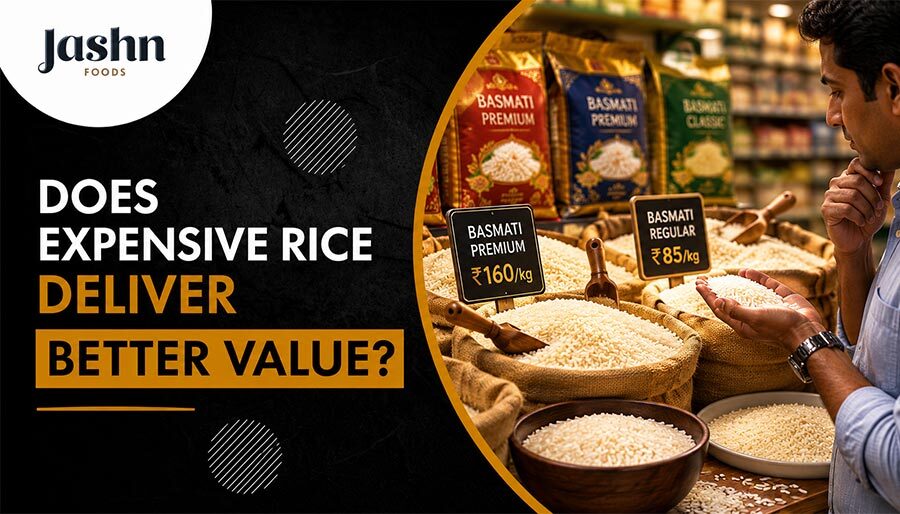
When shopping for rice, many consumers face the same question: does expensive rice deliver better value than lower-priced alternatives? Honestly, it’s a fair thing to wonder. Most of us have stood in a grocery aisle holding two bags — one significantly cheaper than the other. Trying to figure out if the price difference actually means anything once the rice hits the pot.
The short answer is: sometimes yes, sometimes no, and it really depends on what you’re cooking and who’s eating it. Walk into any grocery store or wholesale market and you’ll find a wide spectrum of options. From budget bags stacked near the entrance to premium varieties tucked behind glass or displayed with careful packaging. But here’s what most people don’t think about at the checkout: the price you pay is only part of the equation. Even though fluctuating rice prices often influence purchasing decisions. The real measure of value lies in what you receive in return. Whether you’re a household consumer, restaurant owner, food distributor, or international importer, the more you understand about what separates good rice from average rice, the better your buying decisions become.
Partner with Jashn Foods for premium-quality rice backed by rigorous sourcing and quality standards.
Understanding Does Expensive Rice Deliver Better Value?
What Defines Value in Rice?
Many people mistakenly equate price with value, and it’s an easy trap to fall into. But they really aren’t the same thing. A low sticker price tells you what something costs at the register. It doesn’t tell you how it cooks, how much you’ll waste, or whether you’ll actually enjoy the meal.
When evaluating rice, factors such as grain uniformity, purity, shelf life, texture, taste, and cooking yield all play a significant role. Anyone who has cooked a pot of cheap rice and ended up with a clumpy, mushy mess that went mostly uneaten knows exactly what I mean. You didn’t save money — you wasted it. A product that cooks consistently, produces less wastage, and delivers a better dining experience may offer greater value despite having a higher initial cost.
For businesses, value also includes operational efficiency. Think about a busy restaurant on a Saturday night. The last thing a kitchen needs is a rice variety that behaves differently from one batch to the next. Rice that performs consistently can reduce customer complaints, improve food presentation, and support brand reputation. Things that don’t show up on a receipt but absolutely show up in the long run. In this sense, value is often measured by long-term satisfaction rather than short-term savings, and that shift in perspective changes everything.
Quality Characteristics That Matter Most
Rice quality is influenced by several characteristics that directly affect the consumer experience. Grain length, aroma, texture, appearance, and aging are among the most important factors, and once you start paying attention to them, you notice the differences immediately.
Take premium basmati rice, for instance. It is often recognized for its distinctive fragrance, slender grains, and exceptional cooking performance — and if you’ve ever cooked genuine basmati, you know that the smell alone fills the kitchen before the dish is even plated. That aroma comes from specific growing conditions in particular regions of South Asia. You can’t manufacture it in a lab or speed it up with shortcuts. Properly aged rice tends to absorb flavors more effectively and produces a lighter, fluffier texture after cooking, which is why it works so beautifully with rich curries, biryanis, and spiced dishes.
There’s also the matter of how grains hold up structurally. Rice that holds its shape after cooking, without becoming sticky or clumped, creates a visually appealing dish and a genuinely better eating experience. These quality traits require careful cultivation, processing, and storage practices — none of which come free. As a result, products with superior characteristics generally command higher prices because they deliver a more satisfying culinary experience, and frankly, that’s fair.
How Sourcing Impacts the Final Product
Most people don’t think much about where their rice comes from or what happens between the field and the bag. But the journey from farm to table involves a lot more than harvesting and packaging. Each step has a real impact on what ends up in your kitchen.
Cultivation methods, harvesting practices, milling standards, storage conditions, and transportation all contribute to the final product consumers receive. Rice that’s stored badly absorbs moisture and develops off-flavours. Rice that’s milled too aggressively loses texture and nutritional value. These aren’t theoretical concerns — they show up in the bowl.
Reliable rice suppliers in India understand this better than most. India has been producing and exporting rice for centuries, and the best suppliers treat quality control as a non-negotiable rather than an afterthought. They run moisture checks, screen for foreign matter, and test cooking performance before anything leaves the facility. Suppliers who prioritize strict quality control measures help ensure consistency across batches, reducing the risk of contamination, broken grains, or uneven cooking performance. A well-managed supply chain not only protects product integrity but also creates greater confidence among domestic and international buyers — which, in a competitive market, is worth quite a lot.
Connect with experts who understand quality, sourcing, and global buyer expectations.
Premium Varieties Often Deliver Distinct Advantages
Not all rice varieties are created equal, and the differences between them go beyond marketing language on a packet.
A good example is 1121 basmati rice, which is widely valued for its extra-long grain length and remarkable elongation after cooking. We’re talking about a grain that can nearly double in length when cooked, while staying firm and separate. It’s visually striking and culinarily impressive, which is why it’s the go-to choice for high-end restaurants, wedding caterers, and five-star hotel kitchens. These characteristics make it particularly popular among restaurants, caterers, and consumers seeking a premium dining experience. And once you’ve served it to guests, it’s hard to go back to something lesser.
There’s a practical financial argument too. In many cases, premium varieties also produce higher cooking yields — meaning you actually use less rice per serving to achieve the same result. For a home cook that difference is small but real. For a commercial kitchen cooking 50 or 100 kilograms a week, it adds up to genuine savings over a season. That efficiency can offset the higher purchase price over time in ways that don’t show up until you’re looking at the numbers monthly.
Why Brand Reputation Influences Purchasing Decisions
Trust is a funny thing in the food industry. Consumers frequently rely on trusted brands when making food purchases, not because they’ve run scientific comparisons, but because they’ve bought the product before, it worked, and they didn’t feel the need to experiment next time. That kind of loyalty is earned, not given.
Many well known rice brands invest heavily in quality assurance systems, advanced processing technologies, and rigorous testing procedures. Behind a recognisable brand is usually a significant infrastructure — not just for making the product, but for making sure it stays consistent across thousands of bags and dozens of batches. These investments help ensure that customers receive a product that meets expectations every time. Which sounds like a low bar until you experience what happens when it doesn’t.
While branding alone does not guarantee superior quality, established companies often have stronger systems in place to maintain product consistency. They have more at stake. A brand that has spent years building its name in the market will fight hard to protect it. This reliability becomes an important factor when evaluating overall value — especially for buyers who cannot afford to experiment with an unknown product every time they restock.
International Demand Reflects Quality Standards
Here’s something worth considering: the global rice trade is enormous, and the buyers operating in it — importers, distributors, large-scale food businesses — are not sentimental. They make purchasing decisions based on data, experience, and hard-earned lessons about what goes wrong when you cut corners.
One factor international buyers frequently evaluate is rice importing cost from india. Between freight, logistics, customs duties, and exchange rate fluctuations, bringing rice across borders is genuinely expensive. None of these costs are trivial. Yet despite these added layers, many importers continue to source premium Indian rice because of its established reputation for quality and consistency. They’ve done the calculation and concluded that premium product at a higher total cost outperforms cheaper alternatives that arrive inconsistent, underspec, or requiring rejection.
The willingness to absorb additional costs speaks volumes about perceived value — and about how experienced buyers define it. When the most informed participants in a market repeatedly choose the more expensive option, that’s a signal worth paying attention to.
Choosing the Right Rice Partner
Whether you are purchasing rice for personal consumption or commercial distribution, selecting the right supplier is one of the most consequential decisions. Because everything downstream depends on it.
A trusted company should offer consistent quality, transparent sourcing practices, strong quality control measures, and dependable customer support. When a shipment is delayed or a question arises about a batch, you want a supplier who picks up the phone and gives you a straight answer. Businesses that maintain these standards are better positioned to deliver long-term value to their customers — and they tend to attract buyers who stick around.
Jashn Foods understands the importance of combining quality, reliability, and customer satisfaction. By focusing on carefully sourced rice and maintaining high production standards, the company aims to meet the evolving expectations of domestic and international markets alike — not just as a supplier, but as a partner that takes the outcome seriously.
Partner with Jashn Foods for premium-quality rice backed by rigorous sourcing and quality standards.
So, Does Expensive Rice Deliver Better Value?
The answer depends on how value is defined — and most of the time, we define it too narrowly.
If value is measured solely by the lowest purchase price, then expensive rice may not always appear to be the best option. That framing makes sense in a spreadsheet. But in a kitchen, a restaurant, or a food business, the variables that actually matter — consistency, yield, quality, customer satisfaction, reduced wastage — tell a different story. When those factors are weighed honestly, premium rice often provides advantages that more than justify the higher investment.
Ultimately, the smartest purchasing decisions are based on total value rather than cost alone. Consumers and businesses that evaluate quality alongside price tend to end up with better outcomes. Fewer headaches, and more loyal customers — whether they are preparing meals at home, managing a restaurant, or supplying international markets.
In today’s competitive food industry, true value comes from reliability, performance, and the confidence that every grain meets expectations. That’s not marketing. That’s just how good rice works.
Explore trusted sourcing solutions designed for retailers, distributors, and importers worldwide.