
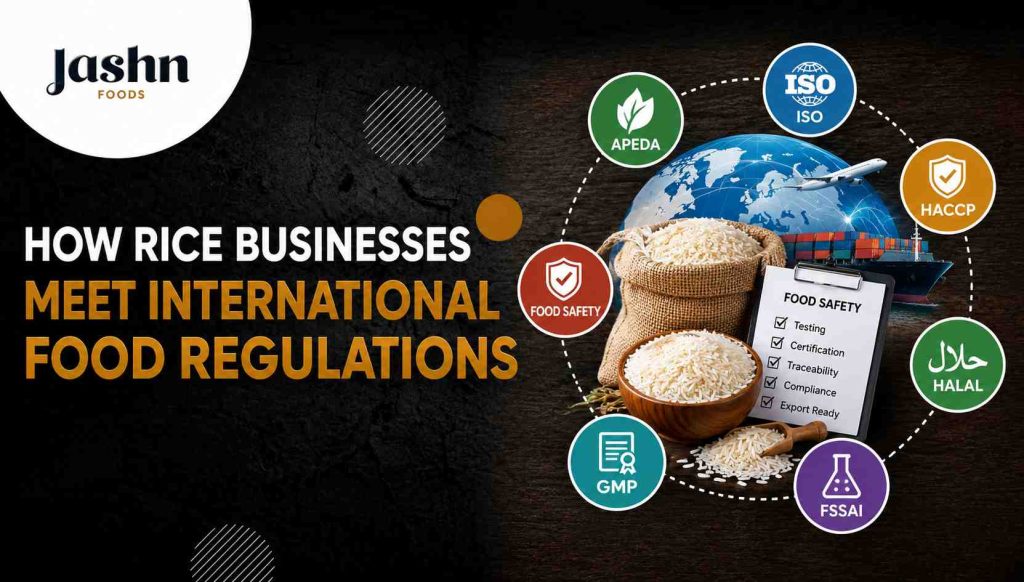
Sending rice to another country may look simple from the outside. In reality, a shipment can involve several documents, tests, certificates, labels, and buyer requirements before it is cleared. A buyer may want laboratory reports, origin details, batch information, or specific packaging instructions before approving an order. For that reason, understanding how rice businesses meet international food regulations is important for companies that sell rice overseas. Indian exporters, including established basmati rice manufacturers, need a system that keeps track of the product from sourcing and processing to packing and final dispatch.
Avoid last-minute compliance issues. Discuss your rice export requirements with Jashn Foods.
How rice businesses meet international food regulations in practice
There is no universal checklist that works for every rice shipment. Import conditions can vary from one country to another. Food safety standards, permitted residue levels, labelling rules, inspections, and documentation may all depend on the destination.
APEDA, or the Agricultural and Processed Food Products Export Development Authority, provides information on export procedures and country-specific requirements for rice. This makes the destination market the logical starting point for any compliance process.
Start with the destination market
Before an order is finalized, exporters need to understand what the importing country expects. In some cases, this may include residue limits, inspection certificates, approved processing facilities, specific labels, or laboratory testing before shipment.
These requirements can influence several parts of the order. They may affect which raw material is selected, how the rice is processed, what tests are arranged, and when the shipment can leave.
APEDA provides different requirements for markets such as Saudi Arabia, the United States, China, Indonesia, and countries in Europe. Exporters therefore need to check the conditions that apply to the actual destination rather than relying on an old checklist.
A simple order-level checklist can make this easier. The sales team can record the destination, rice specification, pack size, buyer instructions, testing requirements, and required certificates. Production and logistics teams can then work from the same information. Jashn Foods can follow this approach when discussing requirements with distributors, wholesalers, and other commercial rice buyers.
Keep quality controls inside the mill
Food compliance does not begin when a container is ready to leave the warehouse. Much of the work happens earlier, inside the processing and storage operation.
Rice needs to be handled properly throughout production. Cleaning, storage, pest control, processing, and packaging all have a role to play. Foreign material needs to be removed, storage areas need to be maintained properly, and bags must be protected from damage or contamination.
There is another side to this process that is easy to overlook: records.
A business should be able to identify the raw material lot used for production and connect it with the finished rice stored in the warehouse. Cleaning records, test results, maintenance details, and corrective actions can help establish that connection.
Good documentation does not have to mean unnecessary paperwork. The goal is to have useful information available when a buyer, auditor, or authority asks a question.
Test the product before shipment
Not every quality issue can be identified simply by looking at a bag of rice. Some characteristics require laboratory analysis. Depending on the product and destination, exporters may need to consider moisture, pesticide residues, contaminants, or other quality parameters.
The testing plan should match the requirements of the destination market. Sending a sample to a laboratory is not enough by itself. The company also needs confidence that the sample represents the batch that will actually be shipped.
Sampling and traceability therefore go together. The sample should be connected with the production lot, packing information, and shipment reference.
For commercial buyers, having the relevant specifications and testing expectations clear before packing can prevent unnecessary changes later. Jashn Foods can discuss these requirements with buyers before an order reaches the final packing stage.
Start your order with the right product specifications, testing expectations, and packaging requirements in place.
Get labels and packaging right
A rice bag is not only a container. In international trade, the information printed on it can also be checked against the shipment documents.
Depending on the destination, a package may need information such as the product name, net weight, country of origin, lot details, dates, storage instructions, and importer information. The exact format and requirements can differ between markets.
This is why packaging artwork should not be finalized without checking the destination requirements.
Even a small mismatch can create questions. For example, if the product description on the label differs from the invoice or other shipment documents, customs or the buyer may need clarification.
Using one approved product specification across the invoice, packing information, label, and related documents can reduce these inconsistencies. It also gives sales, quality, logistics, and the buyer a common reference.
Keep export paperwork organized
International rice trade depends heavily on accurate documentation. The exact documents required to export rice can vary depending on the destination, product, shipment, and applicable Indian export regulations.
APEDA identifies requirements such as the Importer Exporter Code, APEDA e-RCMC, phytosanitary certification, and applicable Registration-cum-Allocation Certificate among the requirements relevant to rice exports from India.
The timing of these documents matters. Finding a missing certificate after a container has already been loaded can create a much bigger problem than identifying it during order planning.
A practical approach is to review the invoice, packing list, certificates, laboratory reports, and transport details before dispatch. Digital copies should also be stored in an organized location. If a buyer asks for a document later, the team should be able to find it without searching through multiple folders or email threads.
Check country-specific rules every time
A successful shipment does not mean that the same process can automatically be used for every future order.
Import requirements may differ by market. They can also change when authorities introduce new controls or update existing requirements. APEDA lists market-specific conditions for several destinations, including requirements involving testing, registered processing units, inspection certificates, and other controls.
For that reason, exporters should review the applicable official requirements when starting business with a new destination.
Buyer instructions are useful, but they should not be treated as a substitute for government requirements. The same care is needed when the product, packaging, or shipment conditions change.
Understanding how to import rice from India therefore begins with knowing what the destination country allows, what it requires, and what documents must accompany the shipment.
Choose suppliers who can show consistency
Compliance becomes easier when the supply chain is consistent.
An overseas buyer does not only evaluate the first sample. They also want to know whether the next shipment will meet the agreed specification. That means the supplier needs clear production standards, controlled processing, suitable storage, and appropriate testing procedures.
Price is only one part of the buying decision.
A supplier should be able to explain the product in practical terms. Buyers may want information about grain length, broken percentage, moisture, packaging, and other agreed specifications. These details should remain reasonably consistent from one order to the next.
For distributors, wholesalers, and food businesses, dependable supply can be particularly important. Jashn Foods can support commercial buyers by discussing rice varieties, specifications, packaging requirements, and other sourcing details before an order is finalized.
Consider what happens after the first shipment
Getting the first shipment through successfully is not the end of the process.
Repeat orders bring their own responsibilities. Documents need to remain current, suppliers need to be reviewed, buyer feedback needs attention, and destination requirements should be checked again when necessary.
This is especially relevant for businesses planning to start rice mill business. If export markets are part of the long-term plan, compliance should be considered while the operation is being designed.
Hygiene, traceability, storage, testing, documentation, and employee responsibilities all need a place in the operating system. Trying to introduce these controls after production has already expanded can be more difficult and expensive.
A mill does not need an unnecessarily complicated system. It needs clear responsibilities and processes that employees can actually follow every day.
Prepare for inspections and questions
A shipment may attract questions even when there is no obvious problem with the rice itself.
Authorities or buyers may request information about the product’s origin, laboratory results, processing facility, packaging, or traceability. The response is usually easier when the relevant information has already been organized.
Batch numbers, production dates, test reports, invoices, and shipment references should connect with one another. If those records tell a consistent story, the team can answer questions without having to reconstruct the shipment from memory.
This is one reason traceability matters so much in international food trade. It provides a clear link between what was produced, what was tested, what was packed, and what was eventually shipped.
Build compliance into buyer communication
Compliance should also be discussed during the sales process rather than left until the shipment is almost ready.
A buyer may have specific expectations for bag size, label design, testing, certificates, or facility approvals. Some of these requirements can affect production costs and delivery schedules.
Discussing them early gives the exporter time to plan.
This is particularly useful when buyers are sourcing basmati rice for retail stores, restaurants, foodservice operations, or distribution networks. Jashn Foods can use early discussions to understand the required rice variety, packaging format, quality specifications, and destination conditions before dispatch planning begins.
A clear product brief helps both sides avoid last-minute changes.
A practical routine for international shipments
A straightforward process can make export compliance easier to manage.
First, identify the destination requirements and confirm what the buyer needs. Then align procurement, processing, testing, packaging, and documentation with those requirements. Before dispatch, review the shipment once more and keep the complete records for future reference.
The system does not have to be complicated.
A shared checklist, an organized document folder, and clearly assigned responsibilities can handle many routine tasks. Employees can then spend more time dealing with unusual situations instead of repeatedly checking the same basic information.
That is the practical side of how rice businesses meet international food regulations without making every shipment unnecessarily slow or difficult.
Conclusion
Meeting international food regulations is a process that runs through the entire rice supply chain. It starts with understanding the destination market and continues through sourcing, processing, testing, packaging, documentation, and dispatch.
Exporters also need to remember that requirements can vary between countries. A procedure that worked for one destination should not automatically be treated as suitable for another.
For overseas buyers, working with a supplier that understands product specifications, documentation, testing, and packaging can make the purchasing process more straightforward.
Jashn Foods works with business-focused rice requirements and can discuss product specifications, packaging, and export-related expectations with commercial buyers before an order moves ahead. When compliance is treated as part of everyday operations rather than a final checklist, international rice trade becomes easier to organize and manage.
Get your product, testing, packaging, and documentation requirements aligned before dispatch.