
Walk through a rice market in India and the scale becomes obvious very quickly. There are sacks everywhere. Trucks keep moving. Mills work through huge volumes each season.
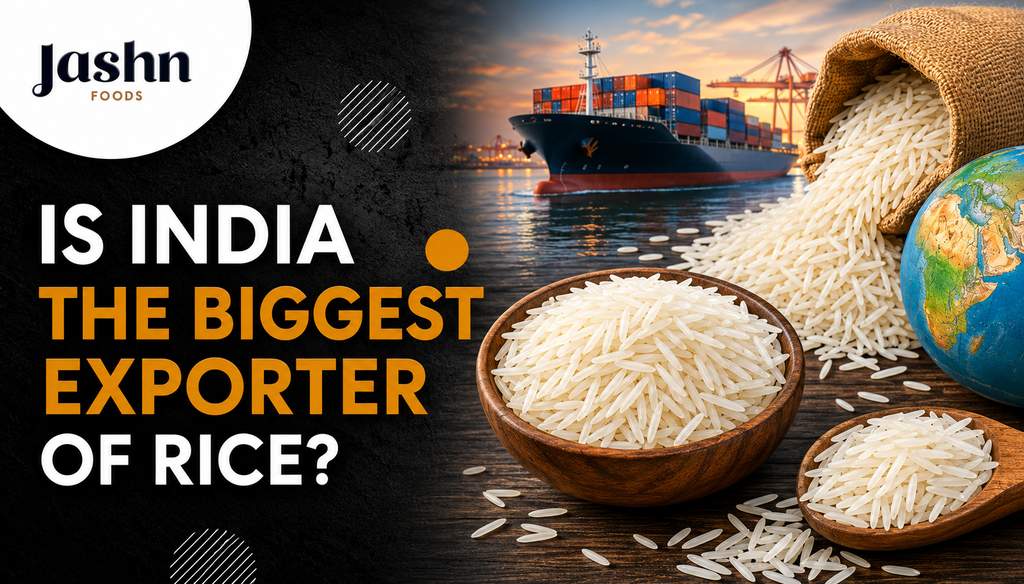
That domestic strength has helped India build a huge presence overseas. So, is India the biggest exporter of rice? Yes. India has held the top position in global rice exports for years, according to APEDA. The agency says India has remained the world’s largest rice exporter since 2012.
India exported 20.19 million metric tonnes of rice during 2024–25. The shipments were worth about US$12.47 billion. The country’s export share stayed around 30–35% over the past five years.
The story becomes even more interesting when basmati enters the picture. The reputation of the basmati rice of India has helped Indian suppliers build strong relationships in premium markets.
Choose a reliable export partner for your next shipment.
Is India the Biggest Exporter of Rice? The Latest Numbers Say Yes
The latest international estimates leave little room for doubt.
APEDA’s data show India exported 20.19 million metric tonnes during 2024–25. That was a significant rise from 17.73 million tonnes in 2020–21. Export value also increased from US8.82billiontoUS12.47 billion during the same period.
USDA figures tell a similar story from the global trade perspective.
For marketing year 2025/26, APEDA’s market dashboard places India’s projected exports at about 24 million tonnes. That equals roughly 39% of world rice exports. Vietnam follows far behind at about 7.9 million tonnes. Thailand comes next with around 7 million tonnes. That gap is not small.
India is shipping roughly three times as much rice as Vietnam under the current projection. Its lead is therefore structural rather than temporary.
USDA’s May 2026 report also expects India to account for roughly 40% of global rice exports in 2026/27. So, the answer remains straightforward. India is currently the world’s biggest rice exporter by volume.
Why India Has Built Such a Strong Export Position
India did not become a leading exporter overnight.
The country has enormous production capacity. APEDA estimates 2024–25 rice production at 150.18 million tonnes. Uttar Pradesh, Telangana, West Bengal, Punjab, Chhattisgarh, Odisha, Madhya Pradesh, Bihar, Andhra Pradesh, and Tamil Nadu all contribute heavily.
There is another advantage. India grows many types of rice.
That matters because international buyers do not all want the same grain. Some need economical white rice. Others look for parboiled rice. Premium buyers often want aromatic basmati.
Indian exporters can therefore serve different price points and food markets.
Processing infrastructure adds another layer of strength. Rice moves through mills, sorters, warehouses, testing facilities, transport networks, and major ports before reaching overseas buyers.
India also benefits from scale in procurement. When production is strong, exporters can source substantial quantities without depending on a single growing region.
Price plays a role too.
Indian rice has often remained competitive in large-volume markets. Reuters reported that Indian exports surged in 2025 after several export restrictions were lifted. Shipments reached about 21.55 million tonnes, close to the previous national record.
For companies like Jashn Foods, that export ecosystem creates room to serve importers, wholesalers, food businesses, and distributors looking for consistent Indian supply.
India’s Role in the Global Rice Trade
There is no single number for every reporting period. So, how much rice is exported from India? The answer depends on the reporting period and source, but APEDA records 20.19 million metric tonnes of rice exports for 2024–25.
Different agencies use different marketing years, financial years, and trade periods. That is why published figures sometimes appear slightly different.
APEDA recorded 20.19 million tonnes during 2024–25. Reuters, using calendar-year trade data, reported around 21.55 million tonnes for 2025.
USDA’s current marketing-year estimate for India is higher again. Its 2025/26 projection sits around 24 million tonnes.
The important point is the direction of travel.
Indian exports have remained extremely large. The country is supplying a substantial part of the world’s internationally traded rice.
Reuters reported that non-basmati shipments reached about 15.15 million tonnes in 2025. Basmati shipments also touched a record 6.4 million tonnes.
Those figures show how broad the Indian export basket has become.
India is not relying on one niche product to maintain its position. It has both scale and variety behind the numbers.
Two Very Different Segments Drive Overseas Sales
Indian rice exports are easier to understand when the market is split into two broad groups. The first is non-basmati rice.
This segment is important because many countries need large quantities of affordable rice. APEDA says India exported 15.01 million tonnes of non-basmati rice during 2025–26. The shipments were valued at about US$5.82 billion.
Benin, Bangladesh, Guinea, Togo, and Côte d’Ivoire were among the leading destinations.The second segment is basmati.
Basmati sells on a different value proposition. Aroma, grain length, cooking quality, ageing, and appearance all matter. The product also has a strong cultural connection with Indian cuisine.
APEDA reports that India exported 6.52 million tonnes of basmati rice in 2025–26. Export value stood at roughly US$5.67 billion. Saudi Arabia, Iran, Iraq, the UAE, Yemen, and the United States were among the important markets.
The contrast tells us something useful. Non-basmati gives India enormous volume. Basmati adds premium value and strengthens India’s position in higher-value markets.
India’s Rice Exports: Scale, Growth and Global Reach
Exporting rice sounds simple until the paperwork begins.
A buyer first needs to decide what product is actually required. For new international buyers, a practical guide to export rice from India can help explain the key steps involved, from product selection and documentation to shipping and compliance.
The next step involves finding a suitable exporter. Grain length, broken percentage, moisture, processing method, packaging, and destination standards can all affect the shipment.
Price matters, but it should not be the only consideration. Buyers should also examine testing systems, packing quality, consistency between batches, documentation, and previous export experience.
India’s export process has specific regulatory requirements. APEDA currently publishes procedures and market-specific guidance for rice exports. It has also issued recent advisories covering markets such as China, Saudi Arabia, Senegal, Indonesia, Lebanon, and the Philippines.
Export documentation can include invoices, packing lists, shipping documents, certificates, and regulatory registrations.
For rice shipments, product compliance matters just as much as logistics. A rejected shipment can create losses on several sides.
Jashn Foods works with buyers who need a more structured sourcing process. The company supplies rice for bulk trade, food businesses, distributors, and international buyers.
That kind of support becomes valuable when a buyer wants repeat shipments instead of a one-time purchase.
Secure a dependable Indian rice supplier before your next bulk requirement.
Where Indian Rice Is Sold Around the World
India’s rice does not go to one region.
It reaches the Middle East, Africa, Asia, North America, Europe, and other markets. APEDA lists Saudi Arabia, Benin, Iraq, Iran, Guinea, Côte d’Ivoire, the UAE, and Togo among major destinations for Indian rice.
African markets often buy substantial quantities of competitively priced rice.
Middle Eastern markets have stronger demand for aromatic varieties as well as everyday rice. Basmati remains especially important in Gulf food markets.
The United States and Europe represent another type of opportunity. Buyers there often place greater emphasis on packaging, traceability, food safety, lab testing, and product specifications.
That variety gives Indian exporters an unusual advantage.
They are not dependent on one geography.
A weak season in one market does not automatically destroy the entire export business. Shipments can move toward other destinations where demand remains stronger.
Still, markets can change quickly.
Recent events in West Asia have already affected Indian rice shipments. Reuters reported that disruption in 2026 reduced basmati exports during the first four months of the year.
For exporters, market diversification has therefore become increasingly important.
What the Basmati Rice Market Reveals About India’s Position
Basmati deserves separate attention because it shows that India’s export story is not only about cheap bulk rice.
There is a large premium market behind the headline numbers.
Demand for Indian basmati comes from households, restaurants, caterers, retailers, foodservice companies, and importers. Product selection can vary considerably by market.
Some buyers prefer long-grain varieties. Others focus on aged rice, steam processing, or parboiled options.
The basmati rice market size in India reflects this growing commercial importance. IMARC estimates that India’s basmati rice market reached INR 499.5 billion in 2025 and expects continued growth over the following years.
That growth matters for exporters. Premium rice is not sold purely on price. Buyers care about grain appearance, aroma, cooking performance, packaging, and consistency.
This is an area where experienced suppliers can make a noticeable difference.
Jashn Foods, for example, can position different rice products for different buyer requirements rather than treating every shipment as the same commodity.
India’s Biggest Advantage May Be Its Scale
The strongest argument for India’s leadership is not one statistic.It is the combination of several advantages.
India produces enormous quantities of rice. India grows many varieties, has a mature milling industry, maintains established export routes, and serves a wide range of overseas buyers.
Put those pieces together and the result is difficult for competitors to match.
USDA’s latest projections make the gap particularly clear. India could ship about 24 million tonnes in 2025/26, while Vietnam is projected at 7.9 million tonnes and Thailand at around 7 million tonnes.
India’s export lead is therefore measured in millions of tonnes.
That scale influences global prices too.
When India increases supply, buyers may have more negotiating power. When India restricts exports, international prices can react quickly.
The 2023 export restrictions provided a strong example. Global rice prices climbed as buyers searched for alternative origins.
Later, restrictions were eased. Indian exports recovered sharply, and competing suppliers faced greater pressure. Reuters linked the 2025 export surge to the removal of several restrictions.
What Could Threaten India’s Lead?
Being number one does not mean the market is risk-free.
Weather remains one concern.
Rice production depends heavily on water. Erratic rainfall, heat, drought, and flooding can create problems for farmers and processors.
Government policy is another factor.
India sometimes adjusts export rules to protect domestic food supplies or manage prices. Those decisions can affect exporters almost immediately.
International regulations are also becoming stricter. Food safety standards, residue limits, traceability, and market-specific certificates all require closer attention.
Then there is competition.
Vietnam, Thailand, Pakistan, Cambodia, Myanmar, and the United States remain serious players. They continue to compete for buyers across Africa, Asia, the Middle East, and other regions.
India will therefore need to protect its strongest advantages.
Reliability will matter. Quality will matter. Efficient logistics will matter. So will responsible sourcing.
Why India Leads the Global Rice Market
So, is India the biggest exporter of rice? Current trade figures give a clear yes.
India has held the world’s top export position since 2012, according to APEDA. Its shipments reached 20.19 million tonnes in 2024–25, while current international estimates put upcoming exports much higher.
The country also has something many competitors cannot easily reproduce: a huge domestic production base combined with an established export network.
That explains why Indian rice remains important to importers across continents.
For buyers, choosing the right supplier still requires care. Product quality, documentation, packaging, consistency, and communication can make or break an order.
Companies seeking dependable sourcing can work with experienced rice exporters in India such as Jashn Foods, especially when regular supply and clear specifications matter.
India’s lead may face pressure in the years ahead. Climate risks, regulations, policy changes, and competition will keep the market moving.
But the present picture is clear.
India is not simply a large rice-producing country. It is the world’s dominant rice exporter, and global buyers continue to watch its market closely.
Get export-quality rice backed by reliable processing and supply.