
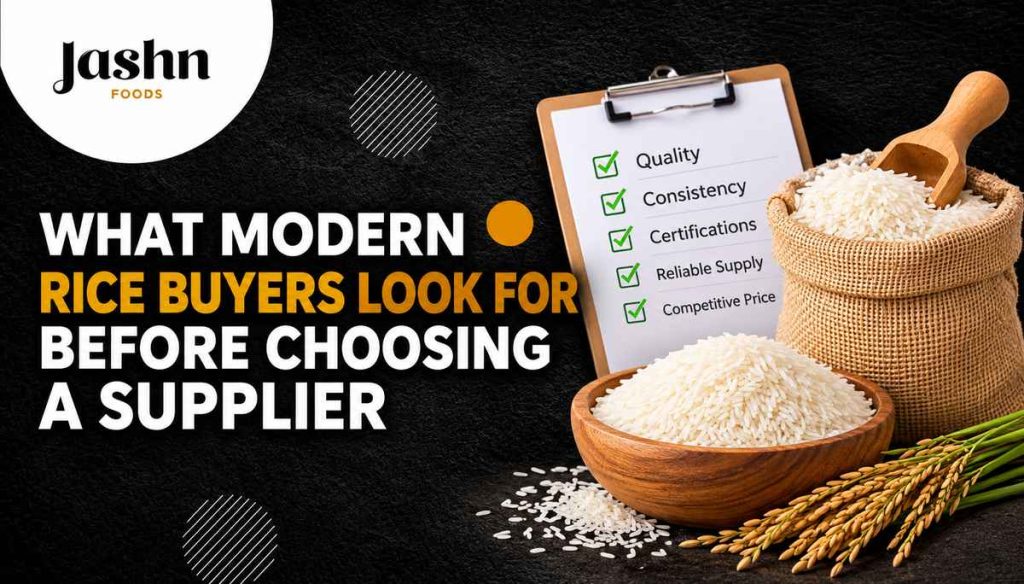
A quotation and a good sample are a useful start, but they do not tell buyers everything. Will the next batch match? Can the supplier meet the quantity, label the bags correctly and ship on time?
That is why knowing what modern rice buyers look for before choosing a supplier matters. Importers, distributors, retailers and food businesses need a rice supplier who understands their market and delivers what both sides have agreed.
For businesses sourcing from India, the decision involves quality, processing, documentation, packaging and communication. Price matters, but the lowest quote is not always the best deal.
Explore reliable rice sourcing options with Jashn Foods before your next order.
What modern rice buyers look for before choosing a supplier in a changing market
A good sample must be repeatable
Most buyers begin by asking for a sample. It is a sensible first step, but it should not be the final quality check. A sample can be carefully selected. The real test is whether the supplier can deliver the same standard across a full order and maintain it in later shipments.
Check grain length, colour, aroma, moisture, broken percentage, damaged grains and foreign matter. Cooking performance matters too; rice that looks similar in a bag may behave differently in a kitchen.
Ask how the team checks incoming paddy, monitors processing and tests finished lots. A recent quality report is useful when it identifies the batch and explains the measures used.
Once a sample is approved, keep a reference sample and record the specification in writing. Include acceptable tolerances rather than relying on phrases such as “premium quality”. This gives both sides a clear point of reference if a later delivery raises questions.
Match the variety to the customer
No single rice type suits every buyer. Restaurants may want long, slender grains for biryani, while household customers may look for a balance between cooking results and price.
When comparing Indian basmati rice brands, look beyond the name on the bag. Variety, ageing, processing style, grain characteristics and available pack sizes all affect whether a product fits the market. A suitable range can simplify sourcing for businesses serving different customer groups.
Jashn Foods offers basmati and non-basmati varieties, including 1121, 1718, 1509, 1401 and Pusa Basmati Rice. Buyers can browse the rice portfolio and shortlist products that fit their requirements.
Consider how the rice will be used
A variety that suits one dish may not suit another. Aroma, texture, cooking time, elongation and grain separation all influence the cooked result.
For example, buyers considering 1121 basmati rice may be targeting customers who value long grains and an attractive cooked appearance. Another market may prefer a different variety or a different balance between price and performance.
Cook the sample using the method your customers follow. A restaurant could test a larger batch; an importer could compare it with a product already selling well. Note the aroma, texture, consistency and grain separation.
Look beyond the quoted price
A low price is tempting, but compare quotations only when they describe the same product and delivery terms.
Basmati rice prices can vary with variety, crop conditions, ageing, grade, processing, broken percentage, order quantity and packaging. Freight, insurance and delivery arrangements affect the final cost as well. A cheaper offer may be for a different grade or may leave important charges out of the quotation.
Get a written offer showing the specification, quantity, packing, currency, payment terms, taxes and delivery terms. For exports, clarify responsibility for freight, insurance, customs paperwork and destination charges.
Compare the landed cost at your warehouse, not only the supplier’s rate. This gives your team a clearer view of resale margins.
Compare bulk rice sourcing options with Jashn Foods.
Check how the supplier handles stock and orders
Rice quality depends on what happens before dispatch. Processing, storage and packing all affect the final product. Poor stock handling can undo the work done earlier.
Ask where the rice is processed and stored, and how the supplier manages moisture, hygiene, pest control, stock rotation and batch identification. For a large order, consider a site visit or video walkthrough.
Check capacity too. Discuss available stock, production capability, lead times, peak-season demand and how the supplier reserves quantities for repeat orders.
Jashn Foods operates from Karnal, Haryana, and states that it has a 25,000 MT storage facility, along with processing and packaging capabilities. Buyers with regular requirements can discuss product availability and order planning with the team.
Get the paperwork right for the destination
Discuss documentation before dispatch. Depending on the destination, an export order may need a commercial invoice, packing list, product specification, certificates and shipping documents, along with market-specific food-safety or labelling details.
India plays a major role in the international rice trade. The Agricultural and Processed Food Products Export Development Authority (APEDA) reports that India exported 20.19 million metric tonnes of rice, valued at about US$12.47 billion, in 2024–25. Buyers can consult APEDA’s rice export information for market context and export guidance.
Ask which documents the supplier can arrange, then confirm current import rules with a customs broker or local authority. Requirements vary by market.
Review food-safety certificates and test reports carefully. Check the issuing body, validity period, product scope and site covered. Where traceability is important, ask how the supplier identifies batches and retrieves records. Agree on how quickly those records can be shared if a concern arises.
Choose packaging for the journey and the customer
Packaging must protect the rice and suit the buyer’s channel. Wholesalers may need large bags, retailers smaller branded packs, and food-service businesses sizes that staff can handle easily.
For export shipments, consider bag material, stitching or sealing, stacking and container loading. Discuss the label before production begins. Confirm the product name, net weight, origin details, language, customer branding and any information required by the destination market. Correcting artwork before printing is much easier than changing thousands of finished bags.
Businesses developing their own retail brand may also need help with pack sizes and artwork. Jashn Foods provides private-label rice solutions. Buyers should discuss minimum order quantities, design approval, lead times and responsibility for label compliance before confirming a project.
Pay attention to communication after the order
A supplier relationship does not end when the purchase order is signed. Buyers need updates while an order is processed, packed and dispatched. They also need someone to contact when a document is missing, a schedule changes or a quality concern needs attention.
The quotation stage offers an early indication: are answers specific, limitations clear and specification changes confirmed in writing?
Agree on a main contact, update schedule and escalation route. Keep approvals, revised specifications and delivery changes in writing so purchasing, quality and logistics teams share the same information.
Compare suppliers on the same basis
When deciding how to choose the right rice manufacturer, use the same checks for every supplier. Otherwise, one company may be judged on price while another is judged on its product range. That is not a fair comparison.
Compare samples, specifications, quality checks, capacity, certificates, packaging, payment terms and delivery schedules. Speak with the people who will manage the order.
A trial order lets both sides test the product, paperwork, packing and communication before committing to larger volumes. It cannot remove every risk, but it may reveal issues early.
Small oversights can become expensive
Some mistakes to avoid when buying rice are easy to prevent. One is approving a sample without recording the agreed specification. Another is choosing the lowest quotation without checking the grade, broken percentage, packaging and delivery terms.
Other common oversights include ignoring certificate scope, delaying label approval and assuming the supplier will arrange every destination document. Settle these points before dispatch.
Put the key terms in the purchase order: variety, grade, quantity, tolerances, packing, price, payment terms, delivery schedule and the process for handling a discrepancy. Both parties should know what happens if the goods do not match the agreed specification.
Choose a partner, not just a price
A suitable rice supplier can meet the agreed requirements and keep the buyer informed when circumstances change. That takes more than a competitive quotation. It calls for consistent quality, a relevant product range, realistic capacity, clear documentation and packaging that reaches the customer in good condition.
Jashn Foods supplies basmati and non-basmati rice and offers processing, bulk supply and private-label support for domestic and international buyers. To discuss a requirement, share the variety, grade, quantity, preferred packaging and destination market. A clear brief helps the team understand the need and prepare a relevant proposal.
Check the sample, ask about the process and put the important details in writing. A careful first order is a stronger foundation for a lasting supplier relationship.
Share your rice requirements with Jashn Foods and start your sourcing journey.