

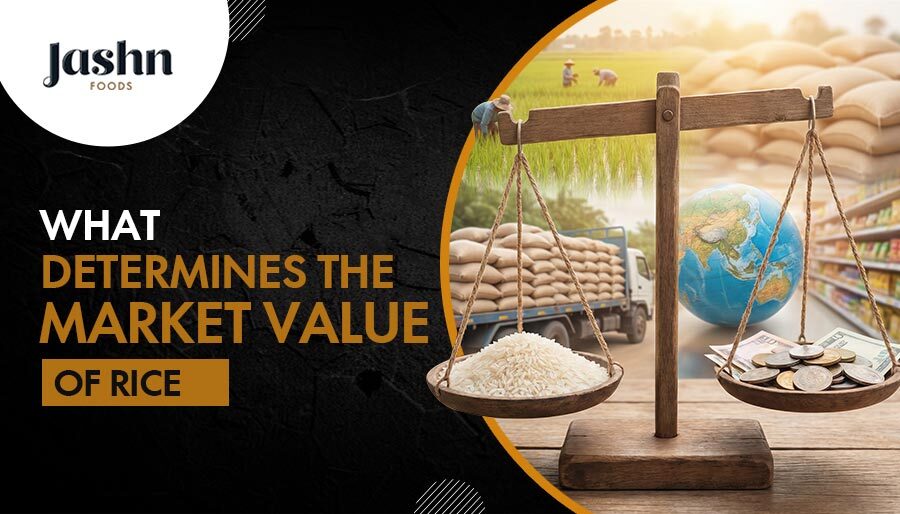
Rice is one of those staples that almost every household and food business depends on, but when it comes to pricing, things are rarely straightforward. On paper it feels simple—more supply should mean lower prices. In reality, anyone involved in bulk buying knows it doesn’t work like that. Prices move for a mix of reasons: weather, quality, processing, transport, and even how demand shifts during different seasons.
For restaurants and bulk buyers, even a small change in price can mess with monthly planning. And when it comes to premium varieties like basmati rice, things get even more sensitive. Buyers aren’t just looking at availability—they expect consistent grain length, aroma, and cooking quality every single time.
Stable quality and smarter bulk deals before market rates shift again.
Understanding What Determines the Market Value of Rice
Pricing in rice isn’t stable at all
If you’ve observed the rice market for even a short time, you’ll notice one thing—it never really stays still. Something is always pushing it up or pulling it down.
A lot of it starts in the fields. Weather is probably the biggest factor. If the monsoon is weak or uneven, the harvest gets affected. And the moment that happens, supply starts tightening even before the crop fully reaches the market.
But even after harvesting, the price story doesn’t settle. Milling quality, storage conditions, and transport all create differences. Two batches from the same region can easily end up with different pricing just based on how they were handled after harvest.
Then there’s the global side of things. Rice is consumed everywhere, so demand stays steady. But “steady demand” doesn’t mean stable pricing. Even small disruptions in supply can move the market quickly and affect rice prices across regions.
Seasonality also plays its part. When fresh crops arrive, prices usually cool down a bit. Later, as supply slows, prices pick up again. Most experienced traders already plan around this pattern because it repeats every year.
So what actually decides rice prices?
There’s no single answer. It’s more like several small factors working together at the same time. Quality, supply flow, demand, transport costs, trade rules—everything adds up.
Once you’ve been around procurement for a while, you stop looking for fixed pricing. Instead, you start reading the situation behind it.
Quality matters more than people think
Pricing usually begins with quality. Long grains, fewer broken pieces, and uniform size naturally fetch better value.
But buyers don’t stop there. What really matters is how the rice behaves when cooked—texture, aroma, how fluffy it becomes. That’s what defines whether it feels premium or average.
Experienced buyers often don’t rely only on packaging. Over time, they develop their own checks because what’s inside the bag doesn’t always match what’s printed outside.
Not all rice is treated the same in the market
Different varieties behave differently in pricing. Everyday rice moves steadily, while premium varieties depend heavily on demand patterns.
Basmati rice is a good example. Its pricing doesn’t stay fixed for long. It changes with aging, export demand, and availability. Buyers who deal with it regularly already know it can shift within short periods.
Farming conditions still control everything at the base
No matter how big the market gets, everything starts with farming.
Good rainfall usually keeps things balanced. But if the monsoon is weak or uneven, output drops—and the market reacts quickly. Supply becomes tight and prices adjust.
Even smaller issues like pests or delayed sowing can have a ripple effect. The important thing is that demand usually doesn’t slow down at the same pace, so pricing responds faster than consumption changes.
Demand from food businesses keeps things moving
Hotels, restaurants, and caterers are always in the market. Their demand doesn’t stop—it only rises or falls depending on the season. Wedding seasons, festivals, and tourism peaks push demand higher. That’s when procurement spikes and prices often follow. During these periods, demand for staples from trusted basmati rice brands also increases as businesses look for consistent quality and timely supply.
For suppliers, long-term success is less about chasing discounts and more about being consistent. That’s why serious buyers usually care more about reliability than short-term price drops.
Logistics quietly affects pricing too
Even when production is fine, prices can still move because of transport and storage. Fuel costs, distance between mills and buyers, and handling all add hidden expenses. These don’t always show up directly, but they definitely reflect in final pricing.
Storage is another silent factor. If grain isn’t stored properly, quality slowly drops, and that affects usable quantity.
Government rules can shift the market fast
Policies around exports, imports, and procurement can change pricing quite quickly. Sometimes these rules are meant to stabilize supply or protect farmers. But in the short term, they often create confusion in the market.
Eventually things adjust, but during that phase, pricing can feel unpredictable even if production hasn’t changed much.
Get premium basmati sourced before the next market fluctuation hits.
Global trade also plays a big role
Rice isn’t just a local commodity anymore. It moves across countries. If demand rises in importing countries, exporting regions feel it immediately. Currency changes also affect competitiveness, which then impacts local pricing too.
This global connection is one reason rice prices rarely stay flat for too long.
Trust matters more than just price now
In today’s market, buyers don’t decide based only on price. Consistency, packaging, and reliability matter just as much. In bulk procurement, even a slightly higher price is acceptable if quality stays stable.
Suppliers like Jashn Foods operate in this space where repeat trust matters more than one-time deals.
Buyers mostly look for stability
From a buyer’s point of view, the real challenge isn’t finding cheap rice. It’s finding rice that performs the same way every time.
Same quality. Same cooking results. No surprises between deliveries. Most experienced buyers rely more on past performance than specifications on paper.
Consistent quality and dependable supply for long-term business growth.
Final thought
Rice pricing isn’t controlled by one factor. It’s a combination of farming output, supply chain movement, logistics, demand cycles, and global trade conditions all working together.
Once you start looking at it this way, it stops feeling random. At the end of the day, rice isn’t just about price—it’s about consistency, reliability, and how smoothly it moves from farm to final plate.