
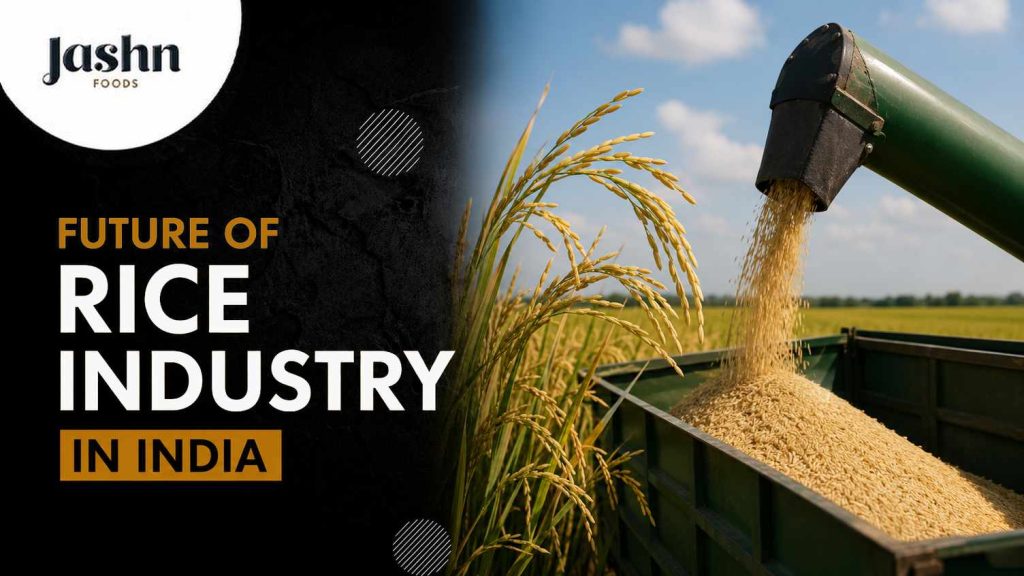
Rice runs through Indian life in a way few other crops manage. Punjab’s flooded paddies. The export docks at Kandla and Mundra. A small mill down the road from someone’s house, running the same way it has for decades. It all adds up to a trade that millions of families depend on. So when someone asks about the future of the rice industry in India, they’re not asking an abstract question. They’re asking whether their livelihood still makes sense five years from now.
India remains the world’s biggest rice exporter, and basmati rice alone brought in thousands of crores in foreign exchange last year. This piece looks at where the industry seems to be heading, and where a brand like Jashn Foods fits into that picture.
Discover how Jashn Foods helps importers and distributors stay ahead with reliable quality and global exports.
Future of Rice Industry in India: A Quick Snapshot
This sector was never going to slow down, and it hasn’t. Domestic production hit a record in the 2025-26 crop season, crossing 154 million tonnes (Rice News Today). Better milling technology explains part of that. Plain old demand, both urban and global, explains the rest. There’s a quieter shift happening too.
Mandatory rice fortification under the Public Distribution System now touches over 21,000 mills fitted with blending equipment, mostly to meet public health targets set by the government (Mordor Intelligence). Add it up and you get a sector that is bigger, more formal, and far more tied to exports than it was ten years ago.
How Big Is India’s Rice Trade Right Now?
The numbers are worth sitting with for a second. The rice market size in India stood near USD 49.32 billion in 2026. Analysts expect it to touch USD 62.09 billion by 2031, a CAGR of roughly 4.72 percent (Mordor Intelligence). Packaged rice is climbing even faster, as households move away from loose grain and toward sealed, branded bags (Markets and Data).
City buyers want a bag that looks the same every single time they open it. They also want it delivered fast. In several metro cities, quick-commerce apps now drop off rice within minutes. That barely existed five years ago.
Who Grows and Processes India’s Aromatic Rice?
The heartland sits in Punjab, Haryana, western Uttar Pradesh, and the foothill belts near Jammu, all covered under a Geographical Indication tag that protects where the grain can legally come from (APEDA). The manufacturers of Indian basmati rice fall roughly into two camps. There are family-run mills that have operated for a hundred years, sometimes longer.
And there are large, listed processors running plants spread across hundreds of acres. India shipped over 60 lakh tonnes of this aromatic variety abroad in 2024-25, worth close to USD 5,944 million. Saudi Arabia, Iraq, Iran, and the UAE bought most of it (APEDA). That export pipeline keeps a lot of small farmers plugged into a genuinely global market, which is more than most Indian crops can claim.
From premium quality to timely shipments, we help businesses source Indian rice with confidence.
Which Names Dominate Indian Kitchens and Export Shelves?
Pick up almost any rice bag in an Indian supermarket and a familiar name looks back at you. India Gate, owned by KRBL Limited, leads the branded space and sells in more than 80 countries. Daawat, under LT Foods, built its premium niche around two years of grain ageing. Kohinoor used to be independent; now it’s split between Adani Wilmar and McCormick, though the name still carries weight with older buyers who grew up on it.
Figuring out the top rice brand in India really depends on what’s cooking. Biryani wants length and aroma. Everyday meals want consistency and a fair price. Smaller players like Lal Qilla and Aeroplane skip mass retail entirely and stick to exporting parboiled Sella grades to Gulf kitchens instead.
What Is Happening to Prices in 2026?
This has been a rough year for pricing, plain and simple. Basmati rice prices touched INR 3,871 per quintal for paddy in February 2026. Then a shipping crisis near the Strait of Hormuz stranded close to 400,000 tonnes of export cargo, and the market pulled back down fast (APEDA Monthly Dashboard). Premium 1121 export values dropped nearly 15 to 17 percent between February and March alone, falling from around USD 1,150 a tonne to under USD 1,000.
Non-basmati grades stayed calmer. The government’s Minimum Support Price of INR 2,369 per quintal acts like a floor under that segment, so it doesn’t swing as wildly. Anyone buying in bulk this year should keep an eye on the monsoon and on Gulf demand. Both can move prices within weeks, sometimes days.
Thinking About Starting Your Own Rice Business?
A lot of first-time entrepreneurs ask how to start rice mill business operations in India. The appeal is easy to understand: steady domestic demand, a real export runway, and a product that doesn’t go out of fashion. Registration comes first. Pick a structure, proprietorship, partnership, or private limited, then register under Udyam or MSME to unlock subsidy access. Rice counts as a food product, so an FSSAI licence isn’t optional, and neither is GST registration once sales get commercial (FSSAI FoSCoS).
Bring on ten or more workers with powered machinery and a Factory Licence plus a Pollution Control NOC become necessary too. Husk dust is a genuine issue that inspectors take seriously. Costs swing a lot depending on scale. A modest one-tonne-per-hour setup might start around two to three lakh rupees. A fully automated, export-ready plant can eat up crores before it ships a single bag.
Partner with a trusted rice exporter before demand rises. Get premium rice sourcing solutions tailored to your business.
Technology and Sustainability Are Reshaping the Fields
Drones fly over paddy fields now, tracking crop health from above. Precision irrigation and direct seeded rice methods are cutting water use without dragging yields down. Punjab and Odisha have digitised paddy procurement too, so farmers get paid faster and mills get cleaner grading data at the gate. Some of the more interesting work is happening in labs, where researchers have developed higher-protein, low-glycemic rice varieties aimed at health-conscious buyers (Mordor Intelligence). Climate stress and tightening water supplies are turning what used to be nice-to-have upgrades into basic survival tools for anyone running a mill.
Trading looks different too. Warehouse-based systems with standardised checks are replacing a lot of the old informal middleman network. Moisture content, broken-grain percentage, grading, all of it gets verified before money changes hands. That builds trust on both sides and gives export mills better data for planning ahead. Cold storage and modern silos are quietly pushing out old-style godowns in major producing belts, which matters a lot during a bad monsoon stretch when spoilage used to eat straight into margins.
Retail has shifted as well. Shoppers compare brands, scroll through reviews, and get a five-kilo bag delivered within the hour. That convenience is pulling loose, unbranded rice buyers toward packaged options faster than most people expected. It’s also giving smaller regional brands a real shot at competing online.
Roadblocks the Industry Still Faces
None of this growth comes free of friction. Erratic monsoons keep threatening yields in districts that can least afford the loss. Price volatility, stirred up by shifting export policy and stiff competition from Vietnam and Thailand, eats into margins for smaller millers who don’t have much cushion to begin with. Storage and logistics gaps still cause real post-harvest losses in several states. Grain rotting in a warehouse helps nobody.
Shocks like the recent shipping slowdown near the Middle East show how exposed this sector is to events happening thousands of kilometres away. These problems aren’t new, honestly. They’re just showing up more often lately, which is exactly why resilience planning matters more than it used to.
What This Means for Jashn Foods and You
Businesses that win from here forward will combine quality with real traceability. Jashn Foods operates in exactly that space, whether the goal is stocking Indian kitchens or shipping premium grain overseas. Buyers today want to know where their rice actually comes from, how it got milled, and whether it clears modern safety checks.
Brands that answer those questions honestly, backed by certification instead of marketing copy, tend to build loyalty that actually sticks around. The next chapter of India’s rice story probably belongs to companies that treat transparency as a core feature, not an afterthought bolted on for a press release.
Build a long-term supply partnership with Jashn Foods before the next buying season begins.