
Bulk rice procurement sounds simple on paper. You find a supplier, agree on a price, and place the order. In practice, it rarely works that cleanly and businesses that treat it as a straightforward transaction often pay for that assumption later, sometimes literally.
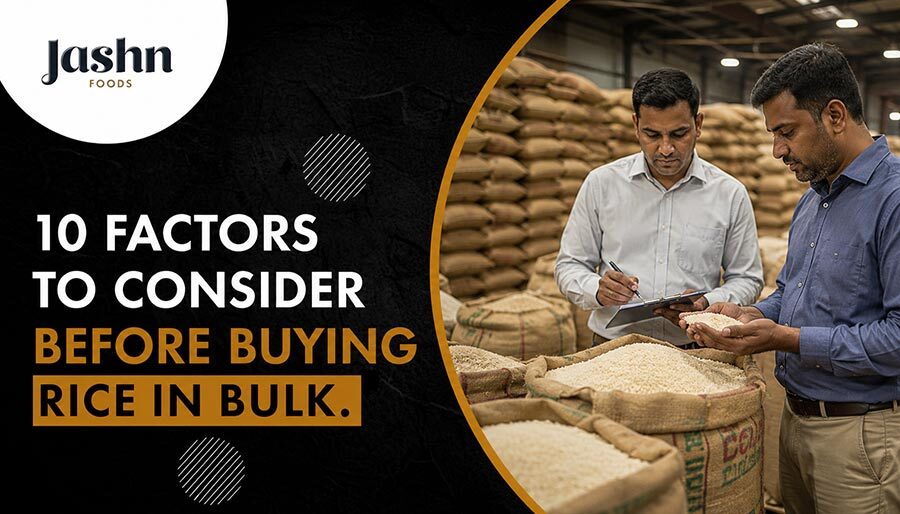
For importers, distributors, food manufacturers, retailers, and hospitality operators, the supplier relationship touches almost every part of the business. Quality complaints, stock shortages, customs rejections, unexpected freight costs, these aren’t abstract risks. They happen regularly to buyers who skip proper evaluation. Understanding the 10 factors to consider before buying rice in bulk gives you a framework to avoid those outcomes and build a procurement process that actually holds up over time.
India is a natural starting point for many global buyers. The country’s rice industry is vast, well-established, and widely respected. Demand for premium basmati rice in India continues to grow internationally, driven by the grain’s aroma, cooking qualities, and the variety of export-grade options available at different price points. But sourcing from India, like sourcing from anywhere, still requires careful, deliberate evaluation. Here’s what that looks like in practice.
Get supplier pricing, quality specifications, and export support before your next procurement cycle.
Understanding Factors to Consider Before Buying Rice in Bulk
Select the Right Rice Variety for Your Market
This is where everything starts, and it’s worth spending real time on before you approach any supplier.
Rice variety isn’t just a product specification, it’s a market decision. Aged Basmati suits fine dining restaurants where aroma and grain elongation matter to chefs and customers alike. Retail supermarkets often balance quality with price sensitivity, depending on their customer base. Food manufacturers running high-volume operations typically lean toward non-Basmati varieties that offer consistency without the cost premium.
Geography plays a role too. A distributor supplying Middle Eastern markets will almost certainly be asked about 1121 Basmati Rice, it’s well-known there, trusted, and in consistent demand. That same variety might mean little to a buyer supplying cafeteria contracts in Southeast Asia, where different grain types dominate.
Define the end market and the intended use before anything else. It makes every subsequent decision, variety, grade, packaging, volume, considerably easier.
Evaluate Grain Quality and Uniformity
There’s no shortcut here. Quality has to be assessed directly, not assumed from a price point or a supplier’s marketing material.
When reviewing samples, look at grain length and whether it’s consistent across the batch. Check the color, good milling produces a clean, uniform finish. Smell the rice; aroma is a genuine quality indicator in Basmati varieties. Look for impurities, foreign matter, and variation within the sample itself.
Uniform grains reflect processing discipline. They also perform better in retail settings where visual presentation matters and customers make decisions based on what they can see through the packaging.
Consider this situation: two suppliers quote similar prices for similar volumes. One sample is visually consistent, clean grain, good polish, almost no variation. The other has noticeable irregularities in size and color. Even at the same price, the first option is almost always the better commercial decision. Fewer complaints, stronger product reviews, better repeat purchase rates.
Request physical samples before finalizing any large order. Reports are useful, but handling the product yourself tells you things numbers alone won’t.
Check the Percentage of Broken Grains
Broken grain percentage is a small detail with a significant commercial impact.
Rice exports are typically graded by this figure, 1%, 2%, 5%, 10% broken grains are common categories. Lower broken percentages indicate more careful harvesting, handling, and milling. They also support higher retail prices and broader market acceptance.
A retailer positioning rice in the premium segment generally needs to stay at 2% or below. For institutional buyers, bulk supply to hospitals, canteens, or large catering operations, 5% broken may be perfectly acceptable, and the associated cost reduction might actually be a selling point.
Whatever you agree to, get it in the contract. Specification disputes are far more common than they should be, and written confirmation is your protection.
Verify Moisture Content
Moisture content doesn’t get enough attention in procurement conversations, and that’s where problems begin.
Rice that leaves a supplier’s warehouse within acceptable moisture limits can still deteriorate significantly during a long ocean shipment, especially through humid shipping corridors or into tropical destination markets. The consequences range from reduced shelf life to visible fungal growth and complete product loss.
Picture a container of rice sitting at sea for five to six weeks in warm, humid conditions. If moisture was already at the upper edge of acceptable levels when it left port, what arrives may be commercially unusable. The cost of that mistake, product loss, replacement shipping, potential contract penalties, far exceeds the cost of simply requesting a laboratory moisture report before dispatch.
Make this a standard requirement in your procurement checklist, not an optional extra.
Assess Supplier Reputation and Industry Experience
Experience in rice export isn’t just about years in business, it’s about what those years have produced.
Established exporters, particularly the top rice manufacturers in India, have typically built out proper quality control systems, developed relationships with reliable freight partners, and navigated enough complex export situations to handle most problems without drama. That institutional knowledge has real value for an international buyer.
When evaluating suppliers, dig past the sales pitch. What countries have they exported to regularly? What types of clients, retail chains, food manufacturers, government contracts? Can they provide references from buyers with similar volume requirements? A supplier with a strong and varied export history has likely already encountered and resolved the kinds of issues a newer supplier would be experiencing for the first time on your account.
See how leading importers evaluate quality, pricing, and supply reliability before placing large orders.
Review Certifications and Compliance Standards
Food safety compliance has become a baseline expectation in international trade, not a differentiator. If a supplier can’t demonstrate it, that’s a red flag worth taking seriously.
Relevant certifications vary by destination market, but commonly include food safety management systems, quality standards, and export compliance documentation required by the importing country. Ask to see these early in the conversation, legitimate suppliers have them ready and share them without hesitation.
Getting compliance right before shipment prevents port delays, customs rejections, and the kind of regulatory problems that can damage your business relationships with buyers downstream.
Understand Packaging Options and Protection Standards
Packaging decisions deserve more attention than they typically get in bulk procurement.
At minimum, packaging needs to protect the product from contamination, moisture exposure, and physical damage through loading, transit, and unloading. Beyond that, requirements vary considerably depending on what you’re doing with the rice once it arrives.
A retail distributor may need branded consumer packaging in specific weights and label formats. A wholesale importer may want large woven polypropylene sacks designed for efficient container loading and easy forklift handling. These are different products in terms of packaging, and a supplier needs to understand your requirements clearly.
Sort this out before production begins. Changing packaging specifications mid-order adds cost, causes delays, and creates friction that doesn’t need to be there.
Analyze Pricing Beyond the Product Cost
The per-kilogram price is the number that dominates early procurement conversations. It’s also, on its own, one of the least useful numbers in the analysis.
Buyers who anchor on the current basmati rice price without modeling total landed cost regularly end up surprised by what the purchase actually costs them. Freight, insurance, port handling fees, customs duties, packaging upgrades, warehousing at destination, each of these adds to the real cost of the goods.
Run a realistic scenario: Supplier A quotes lower per-kilogram pricing but uses an inefficient shipping arrangement that adds meaningful freight cost. Supplier B quotes slightly higher product pricing but has better logistics relationships and consolidates shipments more effectively. Supplier B’s landed cost may well be lower. You won’t know unless you build the full model.
Do that before you decide, not after.
Get supplier pricing, quality specifications, and export support before your next procurement cycle.
Consider All Landed Costs Before Purchasing
For importers, a clear-eyed understanding of the total cost of Importing rice from India is essential before entering any supplier agreement.
The variables are numerous: applicable import duties, shipping route and transit time, container availability and current freight rates, port inspection requirements at destination, local handling and last-mile delivery. Two buyers sourcing identical rice from the same Indian exporter can end up with meaningfully different landed costs based purely on their destination country and logistics setup.
Build a detailed import cost model. Include realistic estimates for each cost component, not optimistic ones. Use that model to stress-test your pricing assumptions and make sure your margins hold even if freight rates shift or duties change.
Confirm Supply Capacity and Delivery Reliability
A supplier’s ability to deliver one shipment well is not the same as their ability to deliver reliably over twelve or eighteen months.
For businesses with recurring inventory needs, monthly container orders, seasonal restocking programs, continuous supply chain commitments, reliability is arguably the most operationally critical factor on this list. A two-month supply gap doesn’t just affect stock levels. It affects customer relationships, retail shelf space, and the trust you’ve built with your own buyers.
Before entering a long-term agreement, ask direct questions about production capacity, how inventory is managed during peak harvesting season, and what happens when shipping schedules slip. Request documented lead times. Ask for references from buyers with comparable volume requirements and delivery frequency.
Build reliability criteria into your supplier evaluation from the start, it deserves as much weight as price and quality, not an afterthought position at the end of the process.
Conclusion
Bulk rice procurement done well is a disciplined process. Variety selection, grain quality, moisture management, supplier credibility, compliance, packaging, and total cost analysis each matter independently, and together they determine whether a supplier relationship strengthens your business or quietly creates problems for it. Work through each factor carefully, and the decisions you make will hold up well beyond the first shipment.
Get supplier pricing, quality specifications, and export support before your next procurement cycle.