
Open two bags of rice side by side and you’ll notice something odd. One cooks up soft, separate, fragrant. The other turns gummy and smells of nothing much at all. Same word on the label. Completely different rice inside. So what factors determine rice quality, really? It comes down to grain structure, moisture, aroma, and a handful of processing standards most shoppers never hear about — the same standards that separate everyday stock from premium basmati rice on a store shelf.
Buyers in India, the Gulf, Europe, and the US are asking sharper questions these days before they buy. This piece walks through what actually decides whether a batch earns its place in your kitchen.
See why businesses worldwide choose Jashn Foods.
What Factors Determine Rice Quality: The Core Elements Explained
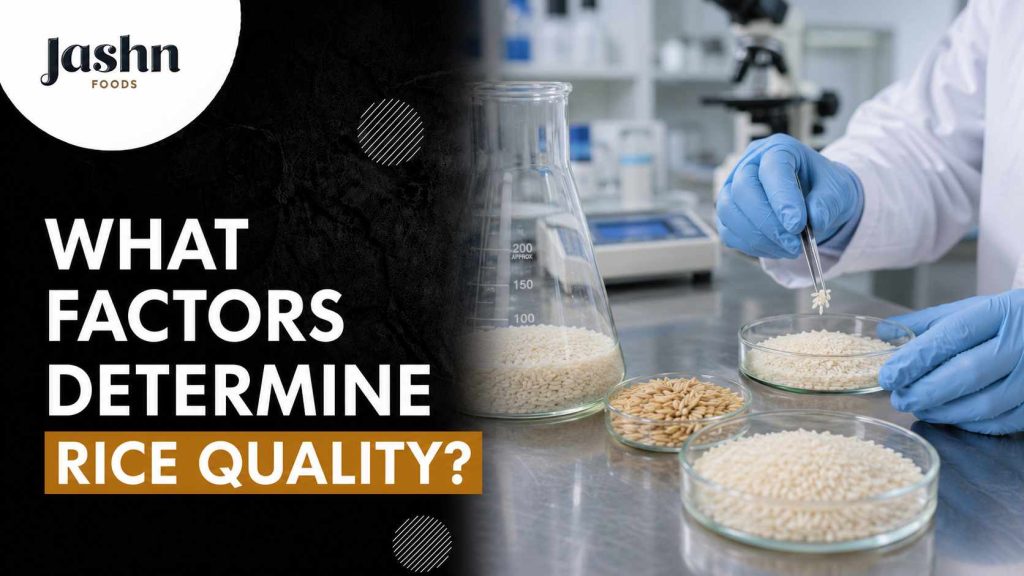
Nobody grades rice on taste alone. Millers, exporters, and lab technicians run through a checklist before a batch gets approved for sale — one that decides everything from grading to pricing to shelf life.
The main things they look at:
- Grain length, shape, and uniformity
- Natural aroma
- Moisture percentage
- Broken or damaged grains
- Age of the rice after harvest
- Chalkiness and visual clarity
- Safety limits for pesticides and heavy metals
No single factor tells the whole story. It’s the combination that decides whether a bag performs well on your stove or lets you down halfway through cooking.
India alone supplies close to seventy percent of the world’s basmati trade. That scale means these checkpoints affect millions of kitchens, not just a curious buyer reading labels at the supermarket.
Grain Length Tells You More Than You’d Think
Long, slender grains catch the eye first. A good batch shows consistent length, grain after grain. Mixed sizes usually mean poor sorting, or worse, blended stock passed off as something premium.
Export standards typically expect a minimum grain length of 6.6 mm before cooking, and the grain should stretch further once it hits the pot, not snap. Uniform grains cook at the same rate. Mixed lengths don’t — some turn mushy while others stay half-raw.
Restaurants care about this more than most home cooks realize. Presentation sells a dish almost as much as flavour does.
India grows several well-known varieties here — 1121, Pusa Basmati, Dehradun basmati among them — each with its own natural length and cooking behaviour. Traders sometimes blend batches to hit a length target for export contracts, though honest labelling should still name the dominant variety used.
The Aroma Test Nobody Can Fake for Long
Real basmati has a smell you notice the second you open the bag. Nutty, a little floral, unmistakable once you’ve smelled the genuine article a few times. That fragrance comes from a naturally occurring compound called 2-acetyl-1-pyrroline, formed as the grain develops in the field.
Every basmati rice brand on the shelf claims this aroma on the packaging. Lab tests tell a more honest story than marketing copy does. Weak or artificial-smelling rice usually means it’s been cut with cheaper, non-aromatic varieties somewhere along the supply chain.
Heat and long storage wear this fragrance down over time, so packaging matters almost as much as the variety itself.
See why premium rice delivers better long-term value.
Moisture: The Boring Factor That Decides Everything
Rice with too much moisture invites fungus and insects. Too little, and grains turn brittle during milling.
Millers measure moisture content in paddy using electronic meters before it reaches the mill floor. Export contracts generally cap moisture between 12 and 14 percent by weight — tight enough to survive weeks at sea without spoiling.
You can spot high-moisture rice at home without any equipment. It clumps together and feels faintly damp between your fingers.
FSSAI rules allow a somewhat wider moisture ceiling — up to sixteen percent — for rice sold within India. Export contracts stay stricter, since a container ship crossing the ocean faces humidity swings and a local kitchen shelf never will.
Broken Grains Give Away More Than Sloppy Milling
Broken grains drag down the visual grade of a batch, even when the flavour underneath is fine. Premium export lots usually run 0 to 2 percent broken. Standard commercial batches allow up to 5 percent.
Purity checks go a step further. Agencies like APEDA rely on DNA testing in India to confirm no other rice variety has slipped into the mix. A high broken percentage often points to rough handling, tired old milling equipment, or a deliberate blend meant to cut cost.
Over-polishing during milling chips grain edges too. Sound paddy can still end up with a higher broken count simply because the polishing went too far.
Why Older Rice Often Cooks Better
Fresh isn’t always best, at least not with basmati. Millers store it for twelve to twenty-four months on purpose, letting it age before it reaches a packet.
During that stretch, residual moisture keeps dropping and the starch inside firms up. Cook it after that, and the grain elongates more — sometimes stretching past twice its raw length. That stretch is called the elongation ratio, and buyers treat a high one as a genuine mark of quality.
Aged rice turns less sticky too. That single trait explains why aged basmati often costs ten to twenty percent more than new-crop stock sitting right next to it on the shelf.
Some warehouses now speed this along with controlled temperature and humidity rooms — faster, but still aiming for the same aroma and texture gains that old-fashioned aging has always produced.
Chalky Grains Are a Warning Sign
Chalky white patches on a grain usually mean it was harvested too early, or dried badly. Those patches weaken the grain’s structure and lead to more breakage once milling starts.
Graders hold samples under bright light to spot this. Clear, translucent grains score higher every time. You can do the same check at home — hold a handful up to daylight before you cook it.
High temperatures during the grain-filling stage in the field are usually to blame. Farmers who time their harvest around cooler weather tend to produce clearer, higher-scoring grain.
The Safety Side of Rice Quality
Looks and aroma only tell half the story. Labs also test for pesticide residue and heavy metals like lead and arsenic — and this matters just as much for a family kitchen as it does for an export order.
Export norms typically cap lead near 0.2 mg per kg and arsenic near 1.1 mg per kg. Cross that line and a batch gets rejected outright, no matter how good it smells or looks on paper. Domestic buyers in India are asking for these test reports more often now too.
Phytosanitary certificates and fumigation records add one more layer of proof for shipments heading to Europe, the Middle East, or North America.
Compare the quality before placing your next order.
What This Means for the Price You Pay
Every factor above feeds directly into cost, which is exactly why it pays to check before you buy, not just glance at the price tag. Grain length, aroma strength, moisture level, and broken percentage all affect rice prices at both the wholesale and retail level, so knowing them upfront helps you judge whether a rate is fair. You can check current basmati rice prices by variety before placing a bulk or retail order.
Aged, low-broken, aromatic rice will always cost more than fresh stock with a higher broken count. Certification adds its own cost too — APEDA registration and FSSAI licensing both demand ongoing compliance work. It’s exactly why branded basmati sits at a premium over loose rice sold in open markets. You’re paying for consistency as much as for the name on the bag.
Global demand plays its part too. Heavy buying from the Gulf, Europe, and the US tends to push wholesale rates up during peak export months.
Picking Rice for Everyday Cooking
Not every meal calls for the longest, most fragrant grain on the shelf. For daily cooking, most households just want the best rice for daily use — reliable, reasonably priced, nothing fussy.
Even everyday rice should clear a few basic checks though. Low moisture. Minimal broken grains. A clean, natural smell with nothing chemical about it. Skip anything with visible dust or husk mixed in.
Rinse it two or three times before cooking, until the water runs mostly clear. That one habit alone improves texture more than people expect.
Where Jashn Foods Fits Into All This
Most of us can’t run a lab test before buying a kilo of rice, so trust does a lot of the work. Jashn Foods is a reliable basmati rice manufacturer that tests every batch for moisture, purity, and aroma before it gets packed.
Sourcing stays traceable, right back to farms known for basmati cultivation across seasons — not just a single good harvest. That consistency is what turns a one-time buyer into someone who reorders without thinking twice.
Small family kitchen or a restaurant going through sacks a week, the same batch-to-batch reliability saves you the guesswork every time.
Final Word
Rice quality isn’t one thing. It’s grain shape, moisture, aroma, age, and safety testing, all pulling together. Miss one, and the rest won’t save the bag.
Next time you’re standing in front of a rice shelf, look past the price tag for a second. Check the grain. Smell it. Look for a certification mark on the label. That small habit saves a lot of disappointment later, right at the dinner table.
Discover the quality standards trusted by global buyers.