
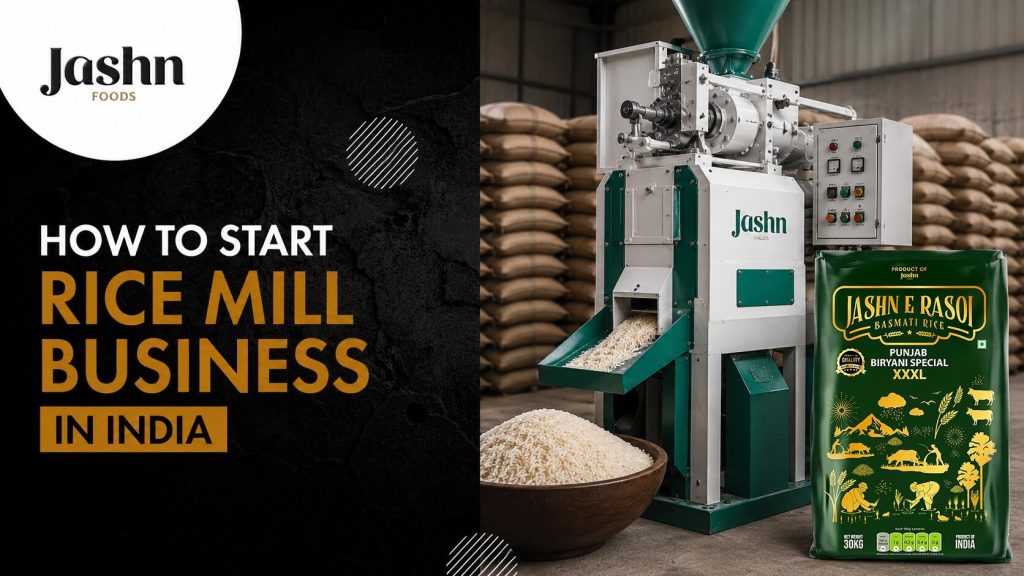
If you are seriously thinking about how to start a rice mill business in India, you are asking a question worth asking. The market is enormous, the raw material grows in almost every state, and the demand, both domestic and export, is not going anywhere. That said, jumping in without preparation is how mills end up sitting half-built or running at a loss. If you also want to consider quality basmati rice as your core product, there is real money in that segment, but it comes with its own set of requirements. We will get to all of it.
Whether you’re launching a new rice mill or expanding your operations, explore Jashn Foods’ premium rice solutions designed to help businesses succeed.
How to Start Rice Mill Business in India: The Full Roadmap for Entrepreneurs
Before anything else, understand what you are actually entering. The FAO’s 2024–25 data puts India’s rice production at 150.18 million tonnes, more than any other country on the planet. India has been the world’s top rice exporter without a break since 2012, accounting for 30 to 35 percent of global rice trade in recent years. These are not just big numbers to impress people. They mean paddy is available nearly everywhere, buyers exist at every level of the chain, and the infrastructure, mandis, cold storage, logistics networks, has been built up over generations.
But none of that automatically makes your mill profitable. What it does is remove the question of whether a market exists. It does. The question is whether your particular operation can find its place in it and survive long enough to grow.
Step 1: Conduct Market Research and Choose Your Business Scale
Most people skip this. They get excited, visit a machinery dealer, get a quote, and start thinking about land. Then six months later they are sitting on milled rice they cannot sell because three other mills in the same district already have all the buyers locked up.
Do the research first. Find out which varieties of paddy are actually grown near you. Talk to local farmers about what they are producing this season. Visit a few mandis and watch what moves quickly and what sits. Uttar Pradesh accounts for 13.82% of India’s rice production, Telangana 11.62%, West Bengal 10.67%, Punjab 9.56%. If you are in or near one of these states, raw material is not your problem. If you are further away, your transport costs will eat into margins faster than you expect.
Then be honest about your scale. Not what you hope to build eventually, what you can actually fund and manage today:
Small-scale rice mill:
One to three tonnes of paddy per hour. Good for testing the waters, serving local traders, grain shops, ration depots. You are not making a fortune but you are learning the business and not risking everything.
Medium-scale rice mill:
Three to five tonnes per hour. You need more capital, better systems, and a clearer sense of who your buyers are before you build this. Suits people with existing trade relationships or family in the grain business.
Large-scale commercial rice mill:
Five to ten-plus tonnes per hour, often fully automated. Export-grade output, private-label contracts, institutional buyers. The returns are much better but so is the exposure if something goes wrong.
Step 2: Build a Solid Business Plan
Not a glossy document for a bank presentation, a working plan you actually refer to. Cover your production targets, where the paddy is coming from, who you are selling to, and what your cash flow looks like month by month for the first year.
The paddy procurement part matters more than people realise. If you buy from farmers directly, you often get better prices but you need to pay early, sometimes before the harvest is even in. That locks up working capital. If you buy from mandis, it is more flexible but prices can spike. Some mills use contract farming arrangements, which give predictability but require you to manage farmer relationships, which is its own full-time job.
On margins, volume mills typically make 5 to 10 percent. Mills that brand their output, export directly, or sell to institutions can push 20 to 40 percent. ROI usually comes through in two to three years when the operation is managed well. Neither of those numbers is guaranteed, but they are reasonable anchors for your planning.
See how partnering with Jashn Foods can help you stay competitive from day one.
Step 3: Understand the Investment and Setup Cost
This is the question everyone actually wants answered: how much money do you need?
Small rice mill (1–3 TPH):
₹10 to ₹25 lakhs covering machinery, basic construction, and early working capital.
Medium rice mill (3–5 TPH):
₹25 to ₹50 lakhs for a semi-automated setup with decent throughput.
Large or fully automatic commercial mill (5–10+ TPH):
₹50 lakhs to ₹5 crore and beyond. Wide range because automation level, land cost, and building specifications vary enormously.
Machinery is the biggest single cost. A full set, paddy cleaner, husker, separator, whitener, polisher, grader, elevator, packaging unit, starts at around ₹5 lakhs for a basic small mill and goes past ₹80 lakhs for a modern large plant. On top of that, your building needs 2,000 to 5,000 square feet at minimum. Electrical infrastructure, transformer, cabling, control panels, adds another ₹8 to ₹15 lakhs for anything medium-sized or larger.
One thing many first-time operators miss: register under MSME early. The Pradhan Mantri Formalisation of Micro Food Processing Enterprises (PMFME) scheme gives a 35 percent credit-linked capital subsidy on eligible costs, capped at ₹10 lakhs. It is not a fortune, but it is real money, and a surprising number of new mills never claim it simply because the paperwork gets delayed.
Step 4: Obtain the Required Licenses and Registrations
Getting this wrong delays your opening and can expose you to fines or shutdowns. Work through this list in parallel with your setup:
FSSAI License:
Mandatory for any unit that processes food. Rice qualifies. No exceptions.
GST Registration:
You cannot issue a proper invoice without it. Buyers will not take you seriously.
Under the Factories Act, 1948, required if you have 10 or more workers using power machinery, or 20 workers without powered equipment.
Factory License:
MSME Registration: Access to subsidies, priority credit, and government tender eligibility.
NOC from State Pollution Control Board:
Required before you turn anything on.
PFA Act Registration:
Matters particularly if you are selling packaged retail rice.
ESIC Registration:
Kicks in once your payroll crosses 10 employees.
Go to a local CA or regulatory consultant if this feels overwhelming. The cost of getting help is far less than the cost of a license rejection or a delayed opening.
Step 5: Select the Right Location and Machinery
Location affects everything, cost of raw material, cost of transport to market, labour availability, electricity reliability. There is no perfect answer, but a mill that sits inside or close to a major paddy belt will always have a structural cost advantage over one that does not. Punjab, Haryana, Uttar Pradesh, Andhra Pradesh, and West Bengal are the obvious zones to consider for this reason.
On machinery, do not just buy from the first dealer who gives you a good pitch. The equipment list you need is: paddy cleaner, rubber roll husker, paddy separator, whitener or polisher, grader, bucket elevator, and packaging unit. If you are targeting premium buyers or exports, add a colour sorter and a moisture tester. Rejects go down, product consistency goes up, and buyers notice.
When you are comparing vendors, ask specifically about after-sales support and spare parts lead times. A broken husker sitting idle for three weeks waiting for a spare part is a much bigger cost than a slightly higher upfront machine price.
Step 6: Learn from Leading Brands
Pay attention to what the well-known basmati rice brands in India actually did to get where they are. Daawat under LT Foods, India Gate under KRBL Limited, Kohinoor, Lal Qilla, none of these started as giants. They built over time on the back of consistent grain quality, controlled aging, and marketing that made households ask for them specifically.
What separates them from commodity millers is not access to better paddy. It is milling precision, packaging that protects the grain, and a brand identity that creates repeat purchases. If you are entering retail or export and you want margins above the commodity floor, you need to think about these things sooner rather than later. Even a regional brand with a distinct identity and reliable quality can command better rates than a generic mill selling loose rice to a middleman.
Step 7: Find the Right Partner In India for Your Export Goals
If you are new to the business, studying established rice manufacturers in India operating at export scale can save you from expensive trial and error. Jashn Foods, based in Karnal, Haryana, is a practical example worth looking at. They manufacture and export 1121, 1509, 1718, 1401, and Pusa Basmati to markets across Asia, the Middle East, Europe, and Africa.
They also offer private-label services, meaning international distributors can sell their product under a custom brand name. With 25,000 MT of storage capacity and a modern processing setup, the way they have built their operation gives you a concrete reference point for what a mill aimed at export needs to look like, in terms of certifications, storage, quality control, and buyer management.
From sourcing to quality, Jashn Foods supports businesses that aim for long-term success.
Step 8: Monitor Pricing and Plan Your Procurement Strategy
This is a habit most mill owners develop after they get burned once. Before you commit to paddy contracts or quote your buyers a price for milled rice, check basmati rice price online, through Jashn Foods, APEDA’s trade data portal, NCDEX commodity exchange, or established agri B2B platforms. Rice prices move with the monsoon, with government MSP revisions, with export policy shifts, and with what Pakistan and Thailand are doing in international markets.
Here is a concrete example of why this matters: as of mid-2025, India’s rice export prices had fallen to around $875 per metric tonne, about 32 percent below the five-year average, according to APEDA’s monthly dashboard. If you had locked in paddy at peak prices without watching the export market trend, your margin would have been squeezed badly. Watching price movements is not a nice-to-have. It is one of the basic operating habits that separates mills that stay solvent from mills that do not.
Step 9: A Realistic Look at Indian Rice Sourcing Costs
For international buyers or Indian entrepreneurs thinking about the export side of the equation, the cost of importing rice from India depends on variety, quality grade, and how you structure the deal.
Non-basmati white rice generally goes FOB in the range of $400 to $550 per metric tonne, depending on grade. Premium basmati runs higher, typically $800 to $1,200 per tonne FOB. A standard 20-foot container carries roughly 24 to 28 metric tonnes of bagged rice.
On top of the FOB price, an importer’s landed cost adds ocean freight, marine insurance, destination country import duties, port handling, third-party inspection fees, and local regulatory compliance costs. These additions can run to several hundred dollars per tonne depending on the country. Anyone building a sourcing model from India needs to model the full landed cost, not just the FOB, before they decide whether the margin justifies the deal.
Reliable quality today can lead to stronger customer loyalty tomorrow.
Step 10: India’s Trade Policy on Rice Imports
The rice import duty in India is set deliberately high to protect farmers and domestic mills from foreign competition. Under HS Code 10063020, semi-milled or wholly-milled basmati rice, the basic customs duty is 80 percent. Add 5 percent IGST and the total effective duty comes to roughly 89 percent, per Connect2India’s customs data.
Broken rice under HS Code 10064000 carries the same 80 percent base duty. The practical result of this structure is that India is essentially a one-way gate for rice, it exports heavily and imports almost nothing. For domestic mill owners, that is actually good news. Your home market is protected, and you have full access to the export channel. That combination is rarer than most people appreciate.
Step 11: Tap Into Export Opportunities
For international buyers wanting to understand how to import basmati rice from India, here is the process without the bureaucratic fog:
Find a verified Indian exporter
One registered with APEDA and holding a valid Registration Cum Membership Certificate (RCMC). This is the baseline proof that the supplier meets India’s export quality framework.
Get the documents right
Your supplier needs an Import Export Code (IEC) from DGFT, a Registration-cum-Allocation Certificate (RCAC) from APEDA, a Phytosanitary Certificate from the Directorate of Plant Protection, and an active FSSAI license. If any of these are missing, the shipment stalls.
Pick your variety thoughtfully
1121 basmati rice makes up roughly 70 percent of India’s total basmati exports. It is the default choice for Gulf markets and premium dining. 1509 is cheaper and suits retail. 1718 is valued for cleaner cooking properties and field resilience.
Agree on shipping terms and logistics
Most basmati exports leave from Mundra, Nhava Sheva, Kandla, or Chennai. APEDA charges ₹82.60 per metric tonne of contracted quantity for RCAC processing. Decide upfront whether you want FOB or CIF terms, as this determines who bears freight risk.
Know your destination’s requirements cold
The EU requires a Certificate of Inspection from India’s Export Inspection Council. Saudi Arabia requires ISO 22000 or HACCP certification from the originating mill. The USA requires FDA Prior Notice filing and HACCP compliance before clearance.
India shipped 6.06 million metric tonnes of basmati rice worth about $5.94 billion in 2024–25, per APEDA data. Saudi Arabia, Iraq, Iran, UAE, and Yemen were the leading buyers. If you are building an export customer list, those markets are not random, they reflect where the real, consistent demand for Indian rice actually sits.
Final Thoughts: Is a Rice Mill Business Worth Starting in India?
Yes. But go in with your eyes open.
This is not a business where things happen automatically. The market is there, no question about that. But the mills that struggle are almost always the ones that got the setup right and got the business wrong. They bought decent machinery, got their licenses, then discovered they had no reliable paddy source in the lean season, or no buyers willing to pay above the commodity floor, or no cash to cover a month of low throughput.
The ones that hold up over time tend to be run by people who did the boring work early. They figured out their paddy supply chain before opening and built two or three buyer relationships before they had finished goods to sell. They watched prices, kept their machinery maintained, and resisted the temptation to over-expand before the foundation was solid.
Do that, and this industry will give you a durable business. It has done it for generations of mill owners across India. There is no reason it cannot do it for you.
Partner with Jashn Foods for premium-quality rice and industry expertise that helps your business grow.