

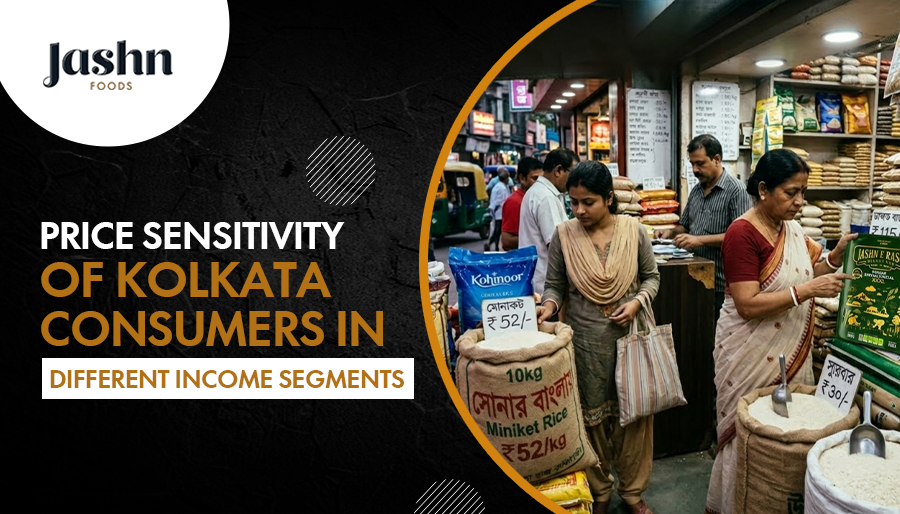
Kolkata has always had a special relationship with food. It’s not just about eating — it’s about identity, tradition, and daily ritual. But no matter how deeply food is woven into the city’s culture, what people actually buy comes down to what they can afford. That’s why understanding the price sensitivity of Kolkata consumers in different income segments has become so relevant for anyone in the food business — whether you’re a rice supplier, a retailer, or a manufacturer trying to reach the right shelf in the right neighborhood.
Walk into any market across the city and you’ll notice it quickly. The way a household in Behala shops looks nothing like the way one in Alipore does. Pack sizes differ. Brand choices differ. How often people buy, and how much they’ll spend before reconsidering — all of it differs. And those differences aren’t random. They follow income, and they follow priorities.
Premium basmati rice is a good example to look at closely. It sits in an interesting middle ground — consumed across income levels but purchased very differently depending on who’s buying.
Explore quality rice varieties that meet changing consumer expectations without compromising value.
Understanding the Price Sensitivity of Kolkata Consumers in Different Income Segments
No city of Kolkata’s scale is ever one kind of consumer. The same product can feel like a bargain to one family and a luxury to another living three lanes away. Lower-income households tend to think in terms of survival budgets — what’s necessary, what can be stretched, what needs to be cut. Middle-income families want good value, but they’ve got a little more room to consider quality. Wealthier buyers? Price is often the last thing on their mind.
These aren’t just academic categories. They translate into real purchasing decisions every day, and businesses that ignore these differences tend to either price themselves out of a market or leave money on the table.
Understanding Price Sensitivity in Consumer Markets
Simply put, price sensitivity is about how much a price change actually changes what someone buys. For some products and some shoppers, a ten-rupee increase barely registers. For others, it’s enough to switch brands entirely.
Income is the biggest factor, but it’s not the only one. Inflation, family size, and whether someone believes a product is genuinely worth what it costs — these all shape how sensitive a buyer is to pricing shifts. People also respond differently when they feel pinched. Some cut quantities and some look for promotions or just move to the next brand on the shelf.
In practical terms, the basmati rice price is a real variable in many Kolkata households’ monthly calculations — not just a number on a packet.
Kolkata’s Diverse Consumer Landscape
The city’s consumer base is genuinely wide. You’ve got IT professionals in Salt Lake, traders in Burrabazar, factory workers in Howrah, retired teachers in the suburbs, and daily wage earners scattered across dozens of neighborhoods. Each group has different financial realities and different ideas about what a food product should cost.
This is what makes Kolkata such a challenging and interesting market. There’s no one-size-fits-all approach. A pricing strategy that works beautifully for one income group will alienate another. Companies that understand this — really understand it, not just in theory — tend to build stronger, more lasting market presence.
Budget Is the Primary Decision Driver
For lower-income families, food shopping is often a carefully managed exercise. Every purchase is weighed. Monthly budgets are planned around staples, and any unexpected price hike can genuinely disrupt how a household eats that week.
These consumers watch prices closely. They compare costs across different stores and local markets. They’re also more willing to drop a brand they’ve used for years if something cheaper comes along that does the job.
That said, it’s not always about cutting corners. Some families will occasionally splurge on something like 1121 basmati rice for Eid, Durga Puja, or a wedding at home — then go back to more economical options the following week. Festive purchases exist even in tight budgets. They just look different.
Buying Habits of Lower-Income Consumers
How lower-income consumers shop is just as telling as what they buy. Small pack sizes are preferred not because people don’t want more, but because buying in bulk requires upfront cash many households simply don’t have available.
Purchases happen frequently — sometimes weekly, sometimes more often. And because margins are thin, outside influences carry more weight here than in other segments. A shopkeeper’s recommendation, a visible discount sticker, or a well-placed promotional offer can actually change what ends up being purchased.
When prices go up, this group is the first to feel it and the first to react.
Balancing Quality and Affordability in Middle-Income Households
Middle-income buyers tend to think through purchases a bit more. Price still matters — it always does — but they’ll also ask whether a product is consistent, whether the brand has a decent reputation, and whether it’s actually worth paying a bit more for.
This is the segment most likely to be swayed by a well-timed discount or a bundle offer. They’re not looking for luxury, but they’re not purely chasing the lowest number on the shelf either. They want to feel like they made a sensible decision.
For this group, value isn’t just about price. It’s about price relative to what they get.
Growing Preference for Packaged Rice
Something has noticeably shifted in recent years across urban India — people are increasingly reluctant to buy loose, unpackaged staples. This shows up clearly in the market for rice in Kolkata, where packaged products have gained real ground.
Part of it is hygiene awareness. Part of it is the trust that comes with a labeled product — you can see where it’s from, what grade it is, how it was processed. Branded packaging has come to represent a kind of assurance that loose grain simply can’t offer.
Manufacturers have responded by putting more thought into packaging design and tightening quality controls, knowing that presentation now influences purchase decisions across income levels.
Lower Price Sensitivity Among Affluent Consumers
Higher-income buyers operate by a different logic. A moderate price increase on a product they like probably won’t change their behavior at all. What might change their behavior is a drop in quality, a bad experience, or finding something they consider genuinely better.
This segment gravitates toward premium offerings — specialty varieties, carefully packaged products, brands that carry a sense of authenticity and craftsmanship. They’re not looking for the best deal. They’re looking for the best product.
As household incomes rise in urban India, this kind of premium-oriented thinking is spreading further into the mainstream.
Explore quality rice varieties that meet changing consumer expectations without compromising value.
The Role of Packaging and Pack Sizes
Packaging is doing more work than it used to across all income segments. Smaller packs give budget buyers flexibility without forcing a large upfront commitment. Medium packs serve families that want convenience without overspending. Larger packs appeal to those focused on household efficiency and cost-per-unit savings.
At the premium end, packaging becomes part of the product itself. A well-designed bag communicates quality before the first grain is cooked.
How Inflation Is Reshaping Consumer Behavior
Inflation makes everyone reconsider. When the cost of staples creeps up, even households that weren’t previously price-sensitive start paying closer attention. Discretionary spending gets trimmed. Brand loyalty gets tested. People experiment with alternatives they might have ignored before.
For businesses, this is both a risk and a window. Companies that manage to hold quality steady while keeping prices competitive tend to come out of inflationary periods with stronger customer relationships than they started with.
What Rice Brands Can Learn from Kolkata Consumers
Kolkata’s buying behavior offers a fairly direct lesson: don’t assume your customer. The same product category contains multitudes. Some buyers want the cheapest option that does the job. Others want provenance, aroma, grain length, and a brand they’ve trusted for a decade.
Top basmati rice brands have figured out how to serve more than one of these groups — sometimes through separate product lines, sometimes through tiered packaging, sometimes just through consistent quality that earns loyalty over time.
The brands that struggle tend to be the ones that only speak to one kind of buyer.
Opportunities for Rice Suppliers in a Changing Market
The market in Kolkata isn’t static. Consumer expectations are shifting, incomes are changing, and food awareness is growing. That creates room for suppliers who are paying attention.
Flexible packaging, clear quality communication, and pricing that doesn’t alienate entire income brackets — these are real competitive advantages. Basmati rice exporters in India such as Jashn Foods that take regional consumer behavior seriously, maintain product consistency, and remain accessible across price points are building something more durable than just sales volume.
Understanding what different buyers actually need is, in the end, what separates good market strategy from guesswork.
Conclusion
Kolkata’s market is a reminder that income shapes everything downstream — what people buy, how often, in what quantity, and how loyal they stay when prices change. Lower-income consumers put affordability first. Middle-income families look for a balance they can feel good about. Wealthier buyers prioritize experience and quality over cost.
Grasping the price sensitivity of consumers across different income groups isn’t just useful background knowledge — it’s genuinely actionable intelligence for brands, retailers, and rice suppliers trying to build something lasting. Markets keep moving, and the companies that keep listening tend to be the ones that stay relevant.
The market is evolving quickly. Explore trusted rice varieties that help you serve every income segment effectively.