

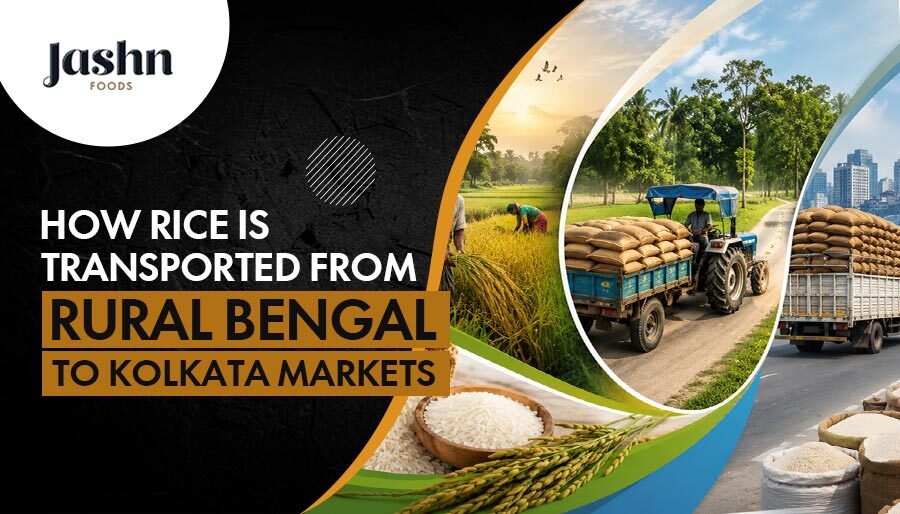
If you reach Kolkata’s wholesale zones before sunrise, you’ll notice rice already arriving from different corners of Bengal. Trucks line up in the dim light, drivers step out for tea, and unloading starts almost immediately. By the time most of the city is awake, a large part of the day’s rice supply has already changed hands.
But that arrival is only the final moment of a much longer movement. The system behind How Rice is Transported from Rural Bengal to Kolkata Markets stretches across villages, mills, storage yards, highways, and crowded city markets. It is not one organised pipeline—it is a chain of many small, repeated actions held together by timing, habit, and long-standing trade relationships. It also keeps thousands of people active, from farmers and mill workers to wholesalers, retailers, restaurants, rice exporters in Kolkata, and transport operators.
Understanding How Rice is Transported from Rural Bengal to Kolkata Markets
The process begins quietly in rural districts like Burdwan, Nadia, Murshidabad, and Hooghly. These places don’t treat rice as a commodity in the abstract sense—it is part of the seasonal rhythm of life.
After harvest, the landscape itself changes. You’ll see paddy spread almost everywhere that space allows—courtyards, open plots, roadside stretches. It stays there until it dries properly. Nothing moves forward until that step is done.
And yet, nothing about this phase is fully predictable. A clear sky can turn into sudden rain, and that alone can push everything back. Farmers often adjust their entire schedule around weather rather than fixed timelines.
Once the grain is ready, it doesn’t leave in one step. Small traders come in, collecting from multiple farmers and assembling bulk loads. That in-between layer is what quietly holds the system together.
First Movement Out of Villages
The first movement is short, but it’s where everything starts to shift from farm activity to trade movement.
Village roads are rarely suited for heavy transport. They are narrow, uneven, and often affected by seasonal rain. So movement depends on what can physically manage those conditions.
You’ll typically see:
- tractors pulling loaded trolleys through narrow routes
- small cargo vehicles running repeated short trips
- shared rural carriers moving between nearby points
- cycle-based transport in tighter interior lanes
There is no fixed structure here in the formal sense. What exists instead is familiarity—farmers, local traders, and transporters who understand each other’s timing without needing much explanation.
At collection points, grain isn’t tested in laboratories or machines. It is checked by eye and experience. People look at colour, feel the texture, and decide quality within moments.
Rice Mills and the Turning Point of the Chain
Once paddy leaves rural collection points, it reaches rice mills. This is where the actual transformation happens.
Inside mills, the flow is continuous. Cleaning, drying, dehusking, polishing, grading, and packing happen in a sequence that rarely pauses during peak season. Trucks keep arriving while others leave fully loaded.
What stands out is how human the system still is. Despite the scale, much of the coordination happens through calls, messages, and long-term relationships rather than formal digital systems. Drivers often know mill schedules simply from experience repeated over years.
Organised businesses like Jashn Foods sit within this space where traditional trade practices are slowly becoming more structured, but still rely heavily on trust and repetition.
Packing Before Movement to the City
After processing, rice is packed for wholesale dispatch. This is one of the more straightforward stages, but physically demanding.
Most stock moves in 25 kg or 50 kg sacks. Jute packaging still exists in older setups, but woven plastic sacks have become more common because they handle transport stress and moisture better over longer distances.
Loading is usually done in the evening or late at night. There is a practical reason for this—trucks can leave before congestion builds up on highways and city entry routes. Labourers stack sacks continuously until vehicles are full, then they move out without much delay.
Roads Leading Into Kolkata
From mills, trucks travel through a mix of rural roads and highways before entering Kolkata. On paper, the distance doesn’t feel large. In reality, timing is never predictable.
Drivers work through conditions that shift constantly:
- waterlogged rural stretches during monsoon
- slow movement near city entry points
- older road patches that reduce speed
- fuel and waiting pressure during peak demand
Even with these issues, movement never really stops. The reason is simple—demand in Kolkata is constant. Households, hotels, restaurants, and small food vendors all depend on uninterrupted supply.
In trade discussions, comparisons often come up with markets such as those served by rice suppliers in Chennai, where restaurant demand strongly influences logistics patterns.
Wholesale Markets Before Daylight
By early morning, Kolkata’s wholesale rice markets are already fully active. Zones around Burrabazar and Posta Bazaar begin receiving trucks one after another.
Unloading is fast and direct. Sacks are moved down manually, checked quickly, and placed into piles for distribution. Traders move through the space constantly, inspecting quality and negotiating rates while work continues around them.
There is noise everywhere, but not confusion for those who work there daily. The system depends on repetition, and repetition makes it predictable.
Most trade still runs on trust. Many retailers prefer staying with familiar wholesalers rather than switching frequently, even when prices fluctuate slightly.
Distribution Across the City
Once rice enters wholesale markets, it spreads through smaller distribution networks into neighbourhood shops and restaurants.
Demand is not uniform. Some households prefer softer rice for daily meals, while others stick to long-grain varieties based on long-established cooking habits.
Restaurants are more specific. Biryani kitchens focus on aroma and grain length, while traditional kitchens care more about texture and consistency.
These differences often get compared with the expanding wholesale basmati rice market in Chennai, where restaurant-driven consumption has become a major part of supply planning.
When Weather Disrupts the System
Monsoon doesn’t stop the rice supply chain, but it changes its rhythm completely.
The issues are practical and repetitive:
- moisture entering sacks during transport
- slower vehicle movement on rural routes
- delays in unloading at city markets
- storage quality risks if humidity stays high
Even well-managed systems feel the pressure when rain continues for days. Rural routes are usually the first to slow down.
A System That Changes Without Breaking
Over time, the rice trade has become more organised, but not completely modernised.
Warehousing systems are better, communication is faster, and logistics planning is more structured than before. Growth in basmati rice market size has encouraged traders to improve handling, storage, and distribution processes.
Still, informal systems remain deeply embedded. Many transactions continue through direct conversation and long-standing relationships.
Policy changes such as the impact of gst on rice business have also influenced documentation and interstate movement procedures.
The Chain Ends Where It Started
By the time rice reaches a home in Kolkata, it has already passed through multiple hands—farmers, traders, mill workers, transporters, wholesalers, and retailers.
It is a system that runs quietly every day, without drawing attention, but never really stopping.
The same dependence exists in other cities as well, where rice in Hyderabad continues to play a central role in both household cooking and commercial food supply.
What looks like a simple grocery item is actually the end point of a long, continuous movement that begins in rural Bengal long before the city wakes up.