
In Chennai, most restaurant owners don’t really sit and discuss rice quality when they talk about profit margins. It’s not usually the first thing that comes up. The focus is more on rent, wages, vegetables, gas, delivery commissions—those kinds of things.
Rice is just… always there in the background.But anyone who has worked inside a busy kitchen knows it’s not that simple.
Rice can quietly decide how smooth a service feels. Some days everything runs fine. Some days a batch behaves differently, and suddenly the kitchen has to adjust on the fly. That kind of thing doesn’t show up in reports, but it definitely affects how the day goes.
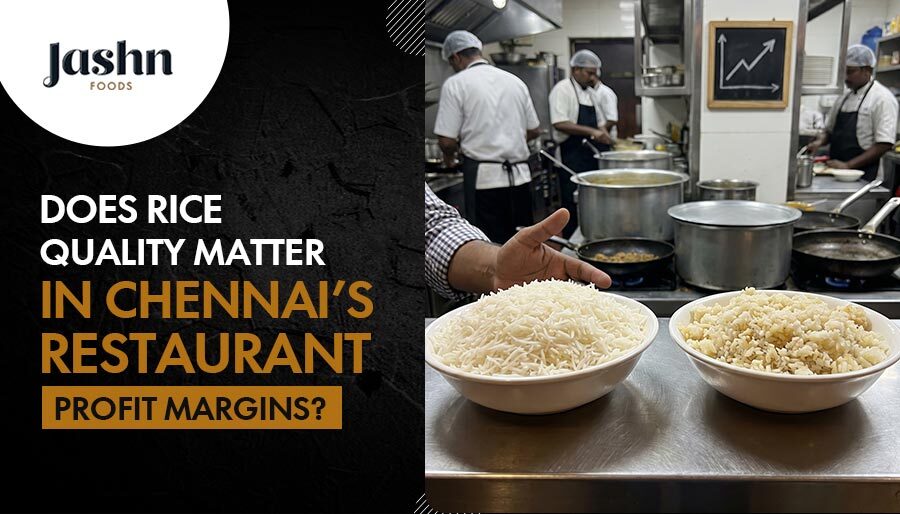
That’s really where the question of rice quality matter in Chennai’s restaurant profit margins comes from. It’s not academic. It comes from experience in day-to-day cooking.
In a lot of kitchens, people eventually move toward more consistent sourcing—sometimes from suppliers like basmati rice from Jashn Foods—not because it sounds premium, but because it reduces uncertainty during rush hours.
Small changes in rice quality can silently affect your profits every day.
Does Rice Quality Matter in Chennai’s Restaurant Profit Margins? Let’s Understand
Why this question even exists
If rice was perfectly consistent every time, nobody would even think about it. But it isn’t.
One delivery cooks slightly differently from another. Grain breakage changes. Water absorption changes. Sometimes even the aroma is different.
And in a restaurant kitchen, those small differences matter more than people outside the industry think.
So when someone asks does rice quality matter in Chennai’s restaurant profit margins, what they’re usually reacting to is this constant adjustment that happens behind the scenes.
Chefs may not talk about it openly, but they deal with it every day during service.
Why Rice Plays a Critical Role in Chennai Restaurants
In Chennai, rice is not just part of the meal—it is the meal. Everything else is built around it. Curries, gravies, sambar, rasam, biryani—it all depends on how rice holds up on the plate.
Customers here also don’t need anyone to explain rice quality to them. They’ve eaten it their whole lives. So they notice quickly when something feels off.
That’s why rice in Chennai carries a kind of silent importance in restaurants. If rice is not right, the rest of the food doesn’t really matter as much.
The cost that doesn’t show up on paper
Cheaper rice usually looks like a smart decision on paper.Lower cost per kilo. Same selling price. Better margin.
But kitchens don’t run on paper logic.
Lower-grade rice tends to behave unpredictably. It might break more during cooking, or turn sticky, or just not hold texture properly.
When that happens, staff end up adjusting things constantly—changing water levels, checking batches, sometimes even discarding portions that don’t look right.
None of this is written down as a cost. But it still affects the business. Wastage goes up. Service slows down slightly. Customers may not complain directly, but they notice consistency issues.
When better rice makes things feel easier
You usually don’t notice better rice immediately. There’s no obvious “before and after” moment. But over time, the kitchen just feels less stressful.
Cooking becomes more predictable. Fewer corrections are needed during service. Plates look more uniform without extra effort.
It doesn’t feel like a big operational change. It just feels like fewer problems happening in the background.
And in a busy restaurant, fewer problems means everything runs better.
Consistency in every grain builds long-term restaurant success.
It’s not cheap vs expensive—it’s stable vs unstable
People often think this is a cost issue. But in practice, it’s more about consistency.
When rice behaves differently every day, the kitchen has to adjust every day. That constant adjustment slowly eats into efficiency.
Time gets lost. Portions vary slightly. Staff spends more attention fixing issues instead of just cooking.So over time, stability matters more than saving a small amount per kilo.
How rice varieties in Chennai influence kitchen decisions
Restaurants don’t pick rice randomly.They choose based on what they want the food to do.
Some need grains that stay separate. Some need softer texture for gravies. Some need rice that holds up during delivery.
That’s where rice varieties in Chennai becomes a practical decision, not just a food preference.
Because the wrong variety doesn’t just change taste—it changes how much work the kitchen has to do.
Why simple dishes expose everything
Some dishes can hide inconsistency. Rice-based dishes don’t.
That’s why Chennai rice recipes like curd rice, lemon rice, and tamarind rice are often where quality shows up the most.
There’s nothing strong enough in those dishes to cover texture problems. No heavy spices. No complex layers. If the rice is off, the dish is off. It’s as simple as that.
Supplier consistency matters more than people think
A lot of people assume profit is controlled inside the kitchen. But a big part of it actually starts earlier—with sourcing.
If rice quality changes between deliveries, everything downstream becomes unstable.
That’s why some restaurants prefer long-term suppliers, including established basmati rice exporters in india, where grading and consistency are more controlled.
Less variation means fewer surprises. And fewer surprises usually means fewer hidden losses.
Less wastage, smoother cooking, and more stable margins start here.
Final thought
Restaurants don’t lose profit in one big moment. It happens slowly, through small inefficiencies that repeat every day. Rice quality sits exactly in that category.
So when people ask does rice quality matter in Chennai’s restaurant profit margins, the simplest honest answer is: Yes. Because it affects how stable the kitchen feels every single day.