
In theory, importing rice looks simple. You contact a supplier, agree on a price, ship a container, and sell it in your market.
In practice, it rarely works like that.
Most first-time importers only understand the process after something goes wrong — a delay at port, a mismatch in quality, or paperwork that doesn’t clear customs. That’s usually when they realize importing food products is more about process control than just buying.
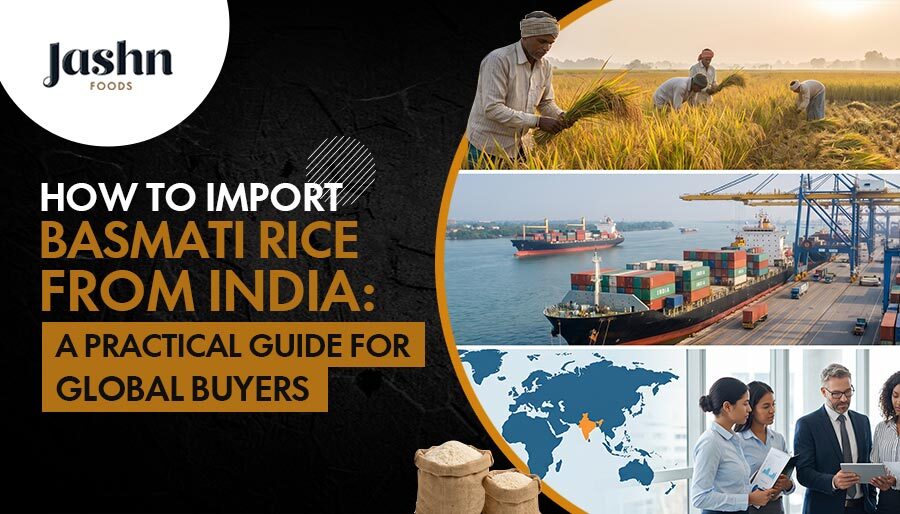
If you are trying to figure out how to import basmati rice from India, the first thing to understand is this: the supplier you choose matters as much as the product itself.
India is one of the largest sources for rice exports globally. Buyers from the Middle East, Africa, Europe, and North America source regularly because supply is consistent and the export ecosystem is well established. Demand for basmati rice is steady because it fits both retail and food service markets, but consistency is what keeps buyers coming back — not just price.
Avoid shipment delays and sourcing uncertainty with experienced suppliers.
Understanding How to Import Basmati Rice from India
How the Import Process Actually Starts
Most people think the first step is finding a supplier. It’s not.
The real first step is knowing your own market.
Before approaching basmati rice manufactures in India, You need clarity on things like:
- Who is buying the product in your country
- Whether you are targeting retail or bulk buyers
- What price range actually moves in your market
- What packaging sizes are commonly accepted
- What quality level customers already expect
Without this, every supplier will look “fine” on paper, and you won’t know what you’re comparing.
There’s also a practical angle most new importers ignore: distribution. Even if you get good rice at a good price, you still need to know how quickly it will move in your market. Slow-moving stock ties up cash and creates storage issues.
Samples Are Not Optional
One mistake that repeats often is skipping samples.Photos and videos are controlled. Samples are not.
When you test a sample, you’re checking things that don’t show up in marketing:
- How the rice behaves after cooking
- Whether the grains stay separate or break
- Aroma after boiling, not just raw smell
- Moisture and texture consistency
- Whether the batch feels clean or processed too roughly
Most experienced buyers don’t even start negotiation seriously until they’ve tested at least one or two samples.
There’s another reason samples matter. Rice is not a uniform product across suppliers. Even within the same grade, processing methods differ — aging, polishing, storage, and sorting all affect final output.
Supplier Reality Check
Not every exporter operates at the same level.
Some are structured for large-volume shipments. Others are more trading-focused and flexible with smaller orders.
Before you commit, it’s worth being direct about:
- Minimum order quantity
- Whether they handle your destination country regularly
- Packaging formats they actually produce (not just offer)
- How long production takes in real terms
- Whether they handle documentation or push it back to the buyer
The answers usually tell you more than the price list.
This is also where many importers make a mistake — they assume all suppliers are equally export-ready. In reality, export capability is very different from local trading capability.
A supplier who understands documentation, labeling rules, and port coordination will save you far more trouble than a supplier who simply offers a lower rate.
Why India Is Still the Main Source
There’s a reason buyers keep coming back to India instead of switching suppliers frequently.
It’s not just production volume. It’s the ecosystem — farming, milling, grading, export handling — all already in place.
Another practical reason is flexibility. Indian exporters usually work with:
- Bulk packaging for distributors
- Retail packs for supermarkets
- Private labeling for brands
- Mixed quality grades depending on budget
And shipping routes are already established to:
- Middle East markets
- Europe
- US and Canada
- Africa
- Southeast Asia
For importers, that reduces uncertainty.
There’s also a hidden advantage: scalability. Once a buyer builds trust with a supplier, increasing order volume is usually easier compared to switching countries or origins.
Connect with exporters who understand international compliance requirements.
Paperwork Is Where Most Problems Start
If shipments get stuck, it’s usually not the product. It’s the documents.
Typical export documents include:
- Invoice
- Packing list
- Bill of lading
- Certificate of origin
- Phytosanitary certificate
- Fumigation report
Different countries may add their own requirements on top of this.
A lot of delays happen simply because details don’t match across documents — spelling, weights, or product description differences.
Even small errors like inconsistent product naming can trigger inspections at customs. That’s why experienced importers treat documentation as seriously as pricing negotiations.
Regulations Depend Entirely on Destination
There is no single import rulebook.
For example:
United States shipments often involve FDA-related checks.
Europe focuses heavily on residue levels and traceability.
Middle Eastern markets are strict on labeling and certifications.
What this means in practice is simple: the same product may need different documentation depending on where it’s going.
This is where exporters with experience in multiple regions become valuable. They already understand how to adjust documentation based on destination requirements.
Working With Exporters in India
At some point, buyers realize that working through too many intermediaries creates confusion.
Direct exporters usually help with:
- Packaging decisions
- Export paperwork
- Shipment planning
- Label adjustments for different markets
- Quality coordination across batches
And more importantly, they tend to understand recurring buyers better — not just one-time shipments.
That matters if you are building a steady import business, not a one-off trade.
There is also a communication advantage. When you deal directly with the source, you reduce the risk of misinterpretation between trading layers.
Connect with exporters who understand international compliance requirements.
Pricing Is Not Just “Rate per Ton”
Most new buyers focus only on the quoted price. But that number rarely reflects the real cost.
What actually affects pricing:
- Crop season and availability
- Processing level (cleaning, grading, aging)
- Packaging type
- Freight charges (which fluctuate often)
- Currency movement
The number that matters is landed cost — what it costs once it reaches your warehouse.
A common mistake is ignoring inland costs at destination. Trucking, unloading, storage, and duties often change the final margin completely.
Packaging Is Not Just Branding
Packaging often gets treated like design work. In imports, it’s logistics protection first.
Rice travels long distances in containers. If packaging is weak, moisture or handling damage becomes a real issue.
Common formats include:
- Woven bags for bulk trade
- Retail packs for supermarkets
- Vacuum packs for premium segments
Each one serves a different type of buyer.
Retail packaging also plays a commercial role. In supermarkets, packaging often influences buying decisions before brand recognition does.
Manufacturer Selection Matters More Than Price
Most import problems don’t start in shipping. They start at supplier selection.
A reliable manufacturer is usually consistent in:
- Product quality across batches
- Communication speed
- Documentation accuracy
- Delivery timelines
A low price doesn’t compensate for inconsistency in supply.
One overlooked factor is grading discipline. Some manufacturers maintain strict grading standards, while others mix quality levels depending on stock pressure. That difference becomes visible only after repeated shipments.
Why Many International Buyers Work With Jashn Foods
Global importers often prefer exporters that combine quality-focused production with professional export management. Companies that understand international compliance standards can simplify sourcing for distributors, wholesalers, supermarkets, and hospitality businesses.
Buyers usually prioritize suppliers that offer:
- Consistent quality standards
- Flexible packaging solutions
- Reliable communication
- Timely deliveries
- Export documentation support
Experienced exporters help businesses maintain supply continuity in competitive international markets.
Freight and crop rates fluctuate fast — plan your next shipment early.
Shipping and Real-World Delays
Sea freight is still the standard for rice imports.But planning matters more than booking.
You need clarity on:
- Transit time variability
- Port congestion at destination
- Container availability
- Insurance coverage
Delays are normal in this industry. What matters is whether they are predictable or not.
Experienced importers always build buffer time into inventory planning. They don’t rely on “ideal schedules” because shipping rarely follows perfect timelines.
Inspections Save Arguments Later
Many experienced importers don’t rely on trust alone.
They use third-party inspections to check:
- Grain quality
- Moisture levels
- Broken percentage
- Packaging condition
This avoids disputes after shipment arrives, which are harder to fix at that stage.
Inspections also help maintain consistency when multiple shipments are involved over time. It ensures that batch quality does not drift unnoticed.
Selling After Import Is a Different Game
Importing is one part of the business. Selling is another.
Markets that grow usually focus on:
- Stable supply
- Consistent quality
- Predictable pricing
- Reliable packaging
Customers don’t remember suppliers who were cheap once. They remember suppliers who are consistent.
This is especially true in food distribution. Restaurants and retailers prefer predictability over occasional savings.
Get quicker answers on packaging, MOQ, shipping, and documentation.
Final Thought
Importing rice from India is not complicated, but it is detail-heavy.
Most problems don’t come from the product itself. They come from unclear expectations between buyer and supplier, weak documentation, or rushed decisions.
The importers who last in this business are usually not the ones chasing the lowest price — they are the ones who understand process, consistency, and long-term supply stability.