
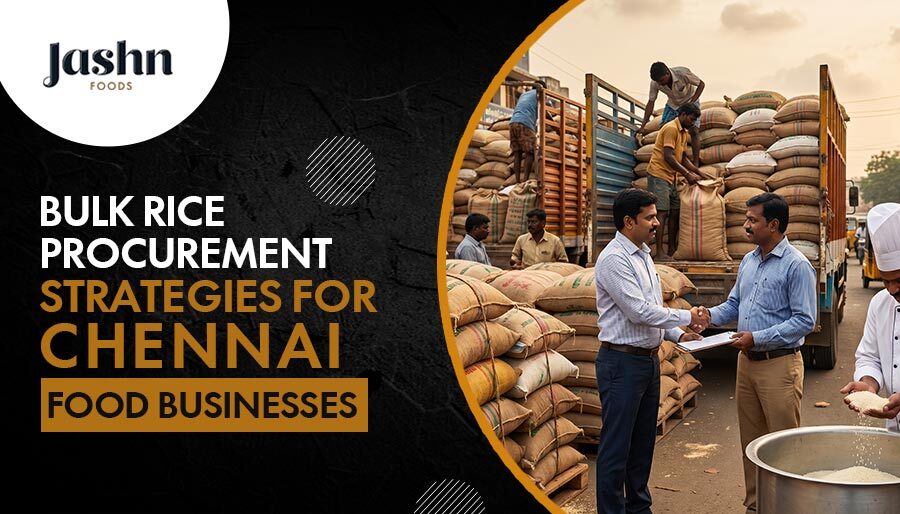
If you’ve been around restaurant or catering operations in Chennai, you already know rice procurement is not something that sits quietly in a spreadsheet. It keeps showing up in day-to-day work. One delay in delivery, one slight change in grain quality, and suddenly kitchen planning gets disturbed.
That’s the reality behind bulk rice procurement strategies for Chennai food businesses. It sounds like a topic, but in practice it is just how kitchens stay running without interruptions.
Most businesses don’t struggle because rice isn’t available in the market. It is available. The problem is you don’t always get the same consistency every time. One batch behaves differently, or delivery timing shifts, and kitchens end up adjusting operations around that.
Even with something like basmati rice, which many kitchens use for biryani or premium servings, the expectation is not just aroma or grain length. It’s repeatable. Same output every time.
Get timely delivery for daily business needs.
Understanding Procurement in real kitchens is very straightforward, sometimes too straightforward
In actual food businesses, procurement is rarely a structured process.
It usually starts when someone notices stock is getting low. A call is made, the price is checked quickly, and the order goes out. There is not always time for comparison or long evaluation. The kitchen can’t wait.
Over time, most experienced buyers don’t try to over-engineer this. They just try to reduce uncertainty. Same supplier when possible, similar ordering cycle, fewer surprises.
Not because it looks good on paper, but because kitchens run better when decisions are predictable.
Also, procurement is not separate from kitchen pressure. If yesterday was a tough service day, today’s buying decision often becomes reactive without anyone planning it consciously.
Demand in Chennai doesn’t behave in a clean pattern
Rice consumption in Chennai food businesses is not stable in a straight line.
Some days are normal. Some weeks feel easy. Then suddenly there is a spike because of weddings, catering orders, or festival periods, and everything changes quickly.
You cannot fully plan around it. You just learn to manage it.
A small restaurant might adjust without much stress. A catering unit or hotel kitchen feels it immediately because volumes change fast.
So what most businesses do is simple—they don’t rely only on planning. They keep a buffer and adjust as demand shifts.
Rice selection is mostly about how it performs in real cooking
There is a lot of technical talk around rice—grain size, polish level, aroma, classification.
But in actual kitchen conditions, none of that matters if the rice doesn’t behave consistently during bulk cooking.
Some rice stays stable under pressure cooking. Some changes slightly depending on water or heat or even batch variation. These differences don’t show up when you test small samples, but they show up during service.
That’s why many kitchens stop switching once they find a rice that works. Not because they don’t want options, but because consistency matters more than variety.
Reliable rice supply for busy service hours.
Where cost issues actually come from
Most procurement cost problems are not because rice is expensive. They come from timing.
When stock runs low, buying becomes urgent. At that moment, there is no comparison or negotiation. You just buy what is available.
That is where cost control gets weak.
Over time, businesses try to avoid this by managing bulk rice demand more carefully. Not with complex systems, but by simply ordering earlier and avoiding last-minute situations.
It sounds small, but it changes cost behaviour more than people expect.
What other markets quietly show
If you observe how rice is handled in other cities, the same patterns repeat.
A lot of mistakes rice buyers make in Hyderabad come from switching suppliers too often for small savings. But what gets missed is consistency, which directly affects cooking output in the kitchen.
Storage is another issue. Rice doesn’t spoil suddenly. It changes slowly depending on conditions. Because it happens gradually, people don’t notice it until food quality starts feeling slightly off.
By then, the issue is already part of the system.
As volume increases, consistency becomes more important
At a smaller scale, small variation is manageable. At a larger scale, even minor inconsistency affects hundreds or thousands of plates.
That is why structured sourcing becomes more important as operations grow. Export-level grading systems used by exporters of Indian basmati rice exist for exactly this reason—uniform output across batches.
Large kitchens eventually start valuing consistency more than anything else, even if they don’t describe it in technical terms.
Why supplier stability becomes important over time
At some stage, procurement stops being about finding better deals and becomes about avoiding uncertainty.
When supply is stable, kitchen operations become smoother. Less stress in planning, fewer surprises in service.
That is why some businesses continue working with suppliers like Jashn Foods over long periods. Not because there are no alternatives, but because switching suppliers creates operational uncertainty.
And in the food business, uncertainty is the thing most people try to reduce.
Build a dependable rice supply chain.
Closing
Rice procurement in Chennai food businesses looks simple from outside. But inside operations, it affects almost everything—cost, timing, and kitchen flow.
Most problems don’t come from lack of supply. They come from inconsistency in planning and execution.
And over time, the businesses that run better are usually the ones that keep procurement simple, stable, and predictable without overcomplicating it.