
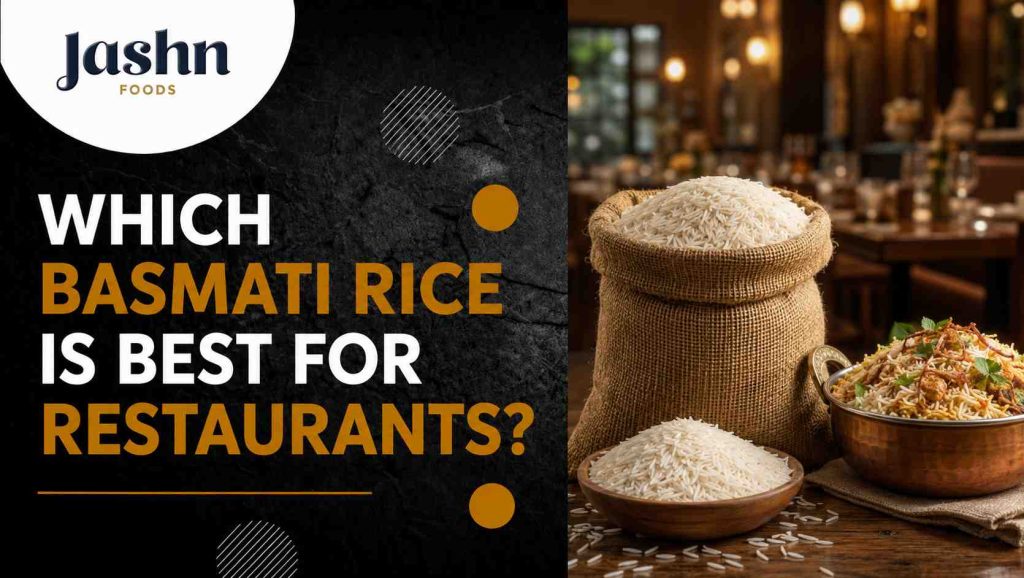
Choosing rice for a restaurant is not as simple as picking the longest grain on the shelf. The kitchen, menu, cooking method, serving style, and food budget all influence the decision. That is why which Indian Basmati Rice is best for restaurants has a different answer for every food business.
A biryani restaurant may want long grains that look impressive on a serving plate. A hotel kitchen may care more about consistency when preparing large batches. A premium dining outlet could place greater emphasis on aroma, texture, and presentation.
The better approach is to match the rice with the food being served. Restaurants should also test samples before committing to regular bulk purchases. A rice that performs well in one kitchen may not produce the same result under different cooking conditions.
Discover how the right Basmati rice can improve your signature dishes and support repeat orders.
Which Basmati Rice Is Best for Restaurants? Look at the Menu First
The menu should be the starting point when choosing Basmati rice. Restaurants serve rice in different ways, and each preparation puts different demands on the grain.
A restaurant known for biryani may need a variety that gives a long, attractive grain after cooking. A North Indian restaurant serving pulao may focus more on aroma and texture. A hotel buffet, on the other hand, may need rice that remains consistent across large cooking batches.
APEDA describes Basmati as an aromatic, long-grain rice known for slender grains, elongation during cooking, soft texture, aroma, flavour, and distinctive characteristics. These qualities make Basmati suitable for many restaurant preparations, but they do not mean every variety suits every kitchen.
Restaurant owners should first identify their most frequently ordered rice dishes. Once that is clear, comparing suitable varieties becomes much easier.
Get premium Basmati rice for consistent, high-quality rice dishes that keep customers coming back.
Grain Length Is Important, But It Is Not Everything
Long grains can make a rice dish look more appealing. This is particularly noticeable in biryani, pulao, festive meals, and premium plated dishes.
However, raw grain length tells only part of the story. What matters inside a commercial kitchen is how the grain behaves after cooking. Does it elongate well? Does it remain reasonably separate? Does it hold its shape? Does it produce too much breakage?
These details can affect both presentation and kitchen efficiency.
A restaurant should therefore judge rice after cooking rather than relying solely on its appearance in the packet. APEDA notes that Basmati grains can elongate to at least twice their original size during cooking and develop a soft, fluffy texture.
That makes a simple kitchen trial particularly useful. Cook the sample using the restaurant’s normal method and compare the result with what the menu requires.
When 1121 Basmati Rice May Be a Suitable Choice
1121 basmati rice is worth considering when a restaurant wants a long, slender grain with strong visual appeal. It is often associated with dishes where the appearance of cooked rice matters, particularly premium rice preparations.
Still, the variety name should not be the only deciding factor. Processing style, product specifications, cooking technique, and supplier consistency can all influence the final result.
For example, two products carrying the same broad variety description may behave differently when prepared in a restaurant kitchen. Soaking time, water quantity, cooking equipment, and batch size can change the outcome.
Chefs should test the exact product they intend to purchase. That trial can reveal whether the rice gives the desired texture and appearance without creating unnecessary breakage or wastage.
This is a much safer method than choosing a product simply because it is widely used in the market.
Aroma Can Make a Difference on the Plate
Rice is not only about appearance. Aroma can change the way customers experience a dish, especially when rice forms a major part of the meal.
This becomes noticeable with biryani and pulao. When the lid is opened and the fragrance reaches the dining area, it becomes part of the experience before the first bite.
APEDA identifies aroma, flavour, and texture among the distinctive characteristics associated with Basmati rice. It also notes that growing conditions, harvesting, processing, and aging contribute to these qualities.
Restaurants should therefore taste and smell cooked samples before making a purchase decision. The preferred level of aroma will depend on the cuisine and the restaurant’s recipe.
Some kitchens may want a pronounced Basmati character. Others may prefer a more balanced profile that allows spices, sauces, vegetables, or meat to remain at the centre of the dish.
Cooking Method Should Influence the Selection
Every restaurant kitchen has its own routine. Some chefs soak rice before cooking, while others use large commercial vessels for high-volume preparation. Some restaurants prepare rice throughout the day, while others cook large quantities ahead of service.
These differences matter.
A variety that works beautifully in a small batch may need different handling when cooked in a large commercial vessel. Water ratios, soaking periods, heat levels, and resting times can all influence the final texture.
The best way to judge a product is to prepare it using the restaurant’s normal process. Keep the method consistent during testing so that different samples can be compared fairly.
Chefs can record the cooking time, quantity of water used, cooked yield, grain separation, and breakage. These simple observations can be more useful than a generic recommendation found online.
Think About Yield, Not Just Purchase Price
Rice procurement becomes a business calculation once a restaurant starts buying regularly.
The price per kilogram is important, but it does not tell the complete story. A restaurant should also consider how much usable cooked rice the product provides and how much is lost through breakage or overcooking.
Suppose two products have different purchase prices. The cheaper one may appear attractive initially. But if it produces more wastage or inconsistent portions, the difference may disappear once the kitchen calculates the actual cost of serving each plate.
Consistency also matters for restaurant groups and hotels. Customers expect the same dish to look and taste similar each time they order it.
A restaurant should therefore consider purchase cost, cooking yield, wastage, portion size, and menu pricing together. That gives a more realistic picture of value.
Biryani Kitchens Need a Different Set of Priorities
A restaurant built around biryani usually pays closer attention to the cooked grain. The rice has to complement the meat, vegetables, spices, and cooking technique without losing its character.
Biryani rice should therefore be judged according to the restaurant’s own recipe. Grain length matters, but so do separation, texture, aroma, cooking time, and the ability to handle the preparation method.
The best way to compare options is to prepare the same biryani with different samples. Keep the recipe unchanged and evaluate the rice after cooking.
Look at the grains from a serving distance as well as up close. Check whether they remain separate and whether the final texture matches the restaurant’s style.
There is no reason to assume that the most expensive product will automatically produce the best biryani. The kitchen’s recipe and customer expectations should have the final say.
Choose premium Basmati rice from Jashn Foods and serve dishes that taste better, and bring customers back.
Steam, Raw and Sella Rice May Suit Different Kitchens
Basmati is available in different processing forms, and restaurants should understand how those options fit their cooking routines.
Steam rice, raw rice, and Sella rice can have different preparation requirements. The choice may depend on the restaurant’s cooking process, preferred texture, service style, and menu.
A restaurant that prepares rice quickly during busy service may value one set of characteristics. Another kitchen that follows a longer soaking and cooking process may prefer something else.
Rather than choosing based on terminology alone, chefs should test the actual product. The trial should cover preparation, cooking, resting, and serving.
This is particularly useful for businesses ordering in larger quantities. A small sample can expose potential issues before they become expensive procurement problems.
Budget Still Matters
Quality is important, but every restaurant has a food-cost target.
A premium restaurant may be able to justify a higher rice cost if the product supports its menu positioning. A busy value-focused restaurant may need to achieve a different balance between quality and cost.
Market conditions can also influence procurement decisions. The latest rice price may change with supply, demand, crop conditions, processing costs, and market activity.
Restaurants should avoid making long-term purchasing decisions from one quotation alone. Compare the product specification with the price and consider how the rice performs after cooking.
A slightly more expensive product may make sense if it gives consistent results and reduces wastage. Conversely, a premium product may not be worthwhile if the restaurant’s menu does not require its particular characteristics.
The right question is not simply, “Which rice costs less?” It is, “Which rice gives this restaurant the value it needs?”
Sample Testing Can Prevent Expensive Mistakes
A sample order is one of the simplest ways to reduce uncertainty.
Instead of placing a large order immediately, restaurants can request suitable samples and test them in their own kitchens. This allows chefs to work with the same equipment, recipes, and staff practices used during normal operations.
The testing process does not need to be complicated.
Prepare the same dish with each sample. Keep the water ratio and cooking method consistent. Then compare the cooked grains, aroma, texture, breakage, yield, and overall appearance.
It is also useful to involve the chef and procurement team together. The chef understands cooking performance, while the purchasing team can evaluate cost and supply considerations.
Their combined feedback can produce a much more practical buying decision.
Supply Consistency Matters for Restaurants
Finding a suitable rice is only the first step. Restaurants also need a supplier that can support regular procurement.
This becomes particularly important when a menu depends heavily on one rice specification. A sudden change in grain characteristics can affect cooking results and customer expectations.
Restaurants should discuss product specifications, packaging, order quantities, lead times, and repeat availability before establishing a long-term arrangement.
India has a substantial Basmati export market. APEDA reports that the country exported 6.52 million metric tonnes of Basmati rice during 2025–26, valued at ₹50,138.28 crore or about US$5.67 billion. Saudi Arabia, Iran, Iraq, the UAE, Yemen, and the United States were among the major destinations listed by APEDA.
That international demand also creates opportunities for restaurants and food businesses outside India to source Indian Basmati through established suppliers.
What Should Restaurants Check Before Ordering?
Before confirming a regular order, buyers should have a clear understanding of the product they are purchasing.
Start with the variety and processing type. Then look at grain characteristics, cooking behaviour, packaging, order volume, and expected supply schedule.
A sample should ideally be tested before a larger commitment. Restaurants can also ask suppliers about available specifications and whether the same product can be supplied consistently for repeat orders.
International buyers may have additional requirements depending on their destination market. Domestic restaurant buyers may have different concerns around delivery schedules and local distribution.
The important point is to discuss these details before the first large shipment. Clear communication at the beginning can prevent avoidable problems later.
How to Choose Based on Restaurant Type
Different restaurant formats naturally have different priorities.
A premium dining restaurant may place more emphasis on aroma, appearance, and the overall eating experience. A biryani specialist may focus on grain length, separation, and texture.
A hotel buffet may need dependable performance when cooking large quantities. A catering business may give greater weight to yield and cost because it serves a high number of portions.
A restaurant chain may have another concern: consistency across locations. The rice selected for one kitchen should ideally produce comparable results when used by another branch following the same recipe.
This is why which basmati rice is best for restaurants cannot be answered with one variety for every business. The correct choice depends on the restaurant’s own priorities.
How Jashn Foods Can Help Restaurant Buyers
Jashn Foods supplies Basmati rice options for businesses that need to evaluate products according to their menu, cooking style, order volume, and budget.
Restaurant buyers can compare suitable options through samples before moving to regular procurement. This gives the kitchen an opportunity to assess the product under real working conditions.
For larger buyers, consistency becomes especially important. A restaurant should know exactly what it is ordering and what result it can reasonably expect from that specification.
The goal should be a long-term supply relationship built around clear product requirements rather than choosing rice based only on a variety name or a temporary price advantage.
Final Thoughts
So, which basmati rice is best for restaurants?
There is no universal winner. A rice that suits a premium biryani restaurant may not be the most practical choice for a hotel buffet or a large catering operation.
Start with the menu. Think about grain appearance, aroma, cooking method, yield, consistency, and food cost. Then test a few suitable samples using the restaurant’s normal recipe.
The final decision should come from the plate, not just the product description.
A good rice should perform reliably in the kitchen, fit the restaurant’s menu, meet customer expectations, and make commercial sense. Once the right specification has been identified, working with a dependable supplier can make regular procurement much easier.
For restaurant owners and food businesses, that approach is more useful than searching for a single “best” Basmati rice. The best choice is ultimately the one that works consistently for the restaurant you actually operate.
Partner with Jashn Foods for quality Basmati rice designed to elevate your menu and customer experience.