
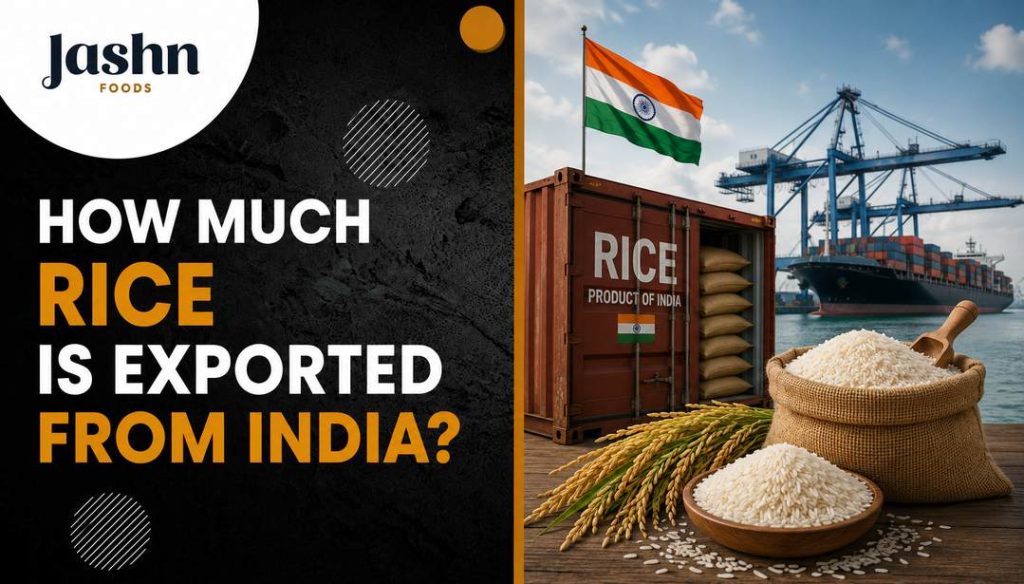
India has built one of the strongest positions in the global rice trade over several decades. But how much rice is exported from India each year, and where does it go? According to APEDA, India exported 20.19 million metric tonnes of rice during 2024–25, worth approximately US$12.47 billion. India has remained the world’s largest rice exporter since 2012, with a global share of around 30–35% during recent years.
These numbers include both basmati and non-basmati rice. They show the scale of India’s agricultural export industry and its importance to international food supply chains. India serves buyers across Asia, Africa, the Middle East, Europe, and other global markets.
For businesses, understanding export volumes helps reveal market demand, sourcing opportunities, and future trade potential. Jashn Foods supports bulk buyers with dependable rice sourcing and export-oriented supply solutions from India.
Choose a supplier built for global buyers.
How much rice is exported from India each year?
During 2024–25, India exported about 20.19 million metric tonnes of rice globally. The total export value reached approximately US$12.47 billion, according to APEDA data.
The figure represents a substantial rise compared with 2020–21. Rice export quantity increased from 17.73 million metric tonnes to 20.19 million metric tonnes during that period. Export value also increased from US8.82billiontoUS12.47 billion.
This growth reflects strong international demand and India’s broad production capacity. It also highlights the country’s ability to supply different rice varieties for different markets.
India produced an estimated 150.18 million tonnes of rice in 2024–25. Uttar Pradesh, Telangana, West Bengal, Punjab, and Chhattisgarh were among the major producing states.
A large domestic crop gives exporters access to multiple varieties and sourcing regions. It also helps Indian suppliers serve buyers with different price, grain, and cooking requirements.”
For international buyers, this scale provides an advantage. Consistent procurement becomes easier when exporters can source from established production and milling networks.
Basmati and non-basmati exports
India’s rice exports consist mainly of two broad categories. These are basmati rice and non-basmati rice.
Basmati is particularly important because of its premium positioning and strong demand across international markets. APEDA reports that India exported approximately 6.06 million metric tonnes of basmati rice in 2024–25, valued at around US$5.94 billion.
Major destinations included Saudi Arabia, Iraq, Iran, the United Arab Emirates, and Yemen. These markets value long grains, aroma, cooking performance, and consistent quality.
India also exports large quantities of non-basmati varieties. These include Sona Masuri, Ponni, IR-64, Swarna, Kolam, and other regional varieties. APEDA describes non-basmati rice as a major contributor to India’s international rice trade.
The strength of both categories makes India highly competitive across premium and value-focused markets. Buyers can choose products based on cuisine, budget, grain preference, and regional demand.
Which countries buy the most rice from India?
Indian rice reaches a wide range of markets worldwide. However, demand is especially strong in the Middle East, Africa, and parts of Asia.
APEDA lists Saudi Arabia, Benin, Iraq, Iran, Guinea, Côte d’Ivoire, the UAE, and Togo among the major destinations during 2024–25.
Market demand varies by country. Middle Eastern buyers often seek aromatic basmati varieties for traditional dishes. African markets frequently purchase rice based on affordability, grain preferences, and household consumption.
The diversity of destinations reduces India’s dependence on one single market. It also creates opportunities for exporters that can adapt packaging, quality specifications, certifications, and logistics.
Jashn Foods serves buyers seeking consistent Indian rice for wholesale distribution, foodservice, retail, and international procurement requirements.
Connect with Jashn Foods for bulk orders tailored to your business requirements.
Why does India export so much rice?
India’s export strength begins with its enormous agricultural base. The country has extensive rice-growing regions with different climates, soils, and farming practices.
That diversity supports numerous rice varieties and quality grades. It also allows exporters to source products suited to different international markets.
India has another major advantage. Its rice processing industry includes modern milling, sorting, grading, polishing, packaging, and quality-control facilities.
Exporters can therefore provide different levels of processing and packaging according to buyer requirements. Large production volumes also support competitive pricing in many global markets.
Trade infrastructure plays an important role too. Major ports and established logistics networks connect Indian suppliers with overseas destinations.
Government-backed export institutions also support the industry. APEDA provides information, registration services, market guidance, and export-related systems for agricultural products.
This combination of production, processing, logistics, and market experience has strengthened India’s global rice position.
Key Steps for Entering the International Rice Trade
Anyone researching how to export rice from India should first understand the regulatory and commercial requirements.
Exporters generally need an Import Export Code issued by DGFT. APEDA also identifies e-RCMC registration, phytosanitary certification, and applicable Registration-cum-Allocation Certificates among the general requirements for rice exports.
The exact requirements can vary by product and destination. Importing countries may impose additional testing,
registration, certification, or inspection rules.
For example, APEDA notes specific requirements for markets such as the European Union, Saudi Arabia, China, the United States, Russia, Indonesia, and Japan.
Successful exporters also need reliable sourcing and quality systems. Buyers usually expect consistency across every shipment, not just a competitive first quotation.
That means exporters should evaluate grain length, moisture, broken percentage, foreign matter, milling quality, packaging, and other specifications before shipment.
Reliable suppliers can make this process easier. Jashn Foods works with buyers that require consistent rice specifications for regular commercial orders.
Essential Export Documentation and Compliance
The documents required to export rice from India depend on the product, destination, and shipment structure. However, exporters should prepare their compliance documentation carefully before dispatch.
APEDA lists an IEC, APEDA e-RCMC, phytosanitary certificate, and relevant RCAC among the general requirements for rice exports.
Commercial shipments may also involve invoices, packing lists, shipping documents, certificates of origin, inspection certificates, and destination-specific certificates.
Food safety requirements can add another layer of compliance. FSSAI states that an exporter of food products requires an FSSAI licence, although an FSSAI NOC is not required simply for exporting food.
Exporters should always confirm the latest destination-country rules before shipment. Requirements can change based on government notifications, food safety standards, or market conditions.
Careful documentation reduces customs delays and helps prevent avoidable shipment problems.
Common Obstacles in International Rice Trade
The challenges rice exporters face can range from policy changes to freight costs and quality compliance.
Export policies can change when governments respond to domestic food prices or supply conditions. Such decisions can affect shipment planning, prices, contracts, and buyer expectations.
Freight rates create another challenge. Ocean shipping costs can influence the landed price paid by importers. Currency fluctuations can also affect export margins and international quotations.
Quality compliance is equally important. Different countries may apply different limits for pesticide residues, contaminants, grain quality, labeling, and food safety.
APEDA specifically highlights destination-specific requirements for several major markets. The European market, for example, has inspection requirements, while Saudi Arabia applies conditions related to food safety management for rice establishments.
Successful exporters therefore need strong supplier relationships, quality-control systems, regulatory knowledge, and dependable logistics.
India’s position in the global rice market
India’s export numbers explain why the country remains central to international rice trade. With 20.19 million metric tonnes shipped in 2024–25, India supplies a significant share of global demand.
The country also combines volume with variety. Buyers can source premium aromatic rice alongside economical non-basmati options.
This flexibility matters because global rice demand is not uniform. A distributor in the Gulf may require premium grains, while an African importer may prioritize affordability and cooking performance.
Indian exporters can respond to these differences through product selection, packaging, grading, and contract specifications.
For buyers searching for a leading basmati rice exporter in India, selecting a supplier should involve more than comparing prices. Consistent quality, transparent specifications, production capacity, documentation, packaging options, and shipment reliability all matter.
Jashn Foods focuses on these commercial requirements while supplying rice for international buyers, distributors, wholesalers, restaurants, caterers, and other bulk customers.
What does the future hold for India’s rice exports?
India’s export outlook remains closely connected to global food demand, production levels, government policy, and international prices.
Demand is likely to remain diverse because rice serves different roles across global markets. Premium varieties continue to attract consumers seeking aroma and distinctive eating quality. Value-oriented markets continue to require dependable rice at competitive prices.
India’s large production base gives exporters a strong foundation. Its established processing sector adds further value before products reach international markets.
However, future growth will require careful attention to sustainability, traceability, food safety, and destination-specific regulations. Buyers increasingly want suppliers that can provide dependable quality and documentation.
APEDA’s export data shows that India has already developed considerable scale. The next opportunity lies in strengthening value, consistency, branding, and long-term international relationships.
Final takeaway for global rice buyers
So, how much rice is exported from India? In 2024–25, the country exported approximately 20.19 million metric tonnes, generating about US$12.47 billion in export value.
Basmati accounted for about 6.06 million metric tonnes, worth approximately US$5.94 billion, showing the importance of premium aromatic rice in global trade.
The scale is impressive, but volume alone does not guarantee a successful international purchase. Buyers need reliable quality, suitable varieties, accurate documentation, competitive pricing, and dependable shipment execution.
For importers seeking Indian basmati rice or other rice varieties from a dependable Indian supplier, Jashn Foods offers export-focused sourcing and supply support.
The basmati rice of India continues to hold strong recognition worldwide. With established production, processing, and export networks, India remains a critical supplier for international rice markets.
For businesses planning regular procurement, choosing an experienced supplier can make every shipment easier to manage and more predictable.
Talk to Jashn Foods about dependable bulk rice sourcing from India.