

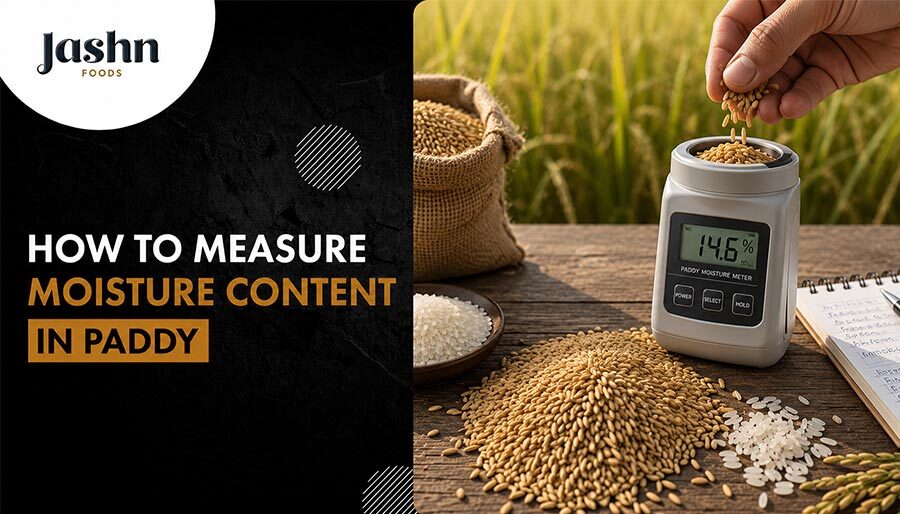
Ask any old-timer at a mandi what decides a paddy lot’s fate, and moisture is usually the first word out of their mouth. Not grain length. Not colour. At Jashn Foods, our sourcing team hears the same question from farmers and traders almost every harvest, how to check moisture content in paddy before it leaves the field.
Miss this step and a lot can spoil in the godown within weeks, or lose enough weight in drying that the farmer effectively sold it cheap without realising. Nail it, and you’ve protected the batch all the way through, whether it’s ordinary paddy or premium basmati rice destined for a container ship. Here’s what actually happens on the ground, plus the numbers Indian and international buyers care about most.
Get premium basmati rice produced with strict moisture monitoring and quality assurance.
How to Measure Moisture Content in Paddy: A Quick Look
The concept itself isn’t complicated. Every grain holds some water inside it. Too much, and mould or insects move in fast. Too little, and the rice snaps the moment it hits the huller. In practice, a miller grabs a handful from a sack or truckload and runs it through a testing device, sometimes right at the gate, sometimes in a small back-office lab.
Within seconds the reading tells them whether that batch is milling-ready, needs another day in the sun, or should be turned away. Smaller operations still trust their hands and eyes for a first pass, but few serious buyers sign off on a deal anymore without an instrument reading.
There’s a government angle here too, and it shapes pricing more than most people expect. The Food Corporation of India caps permissible moisture at 17 percent for paddy entering central pool procurement; anything above that risks rejection at the mandi.
During a heavy Kharif season, states like Punjab, Haryana, and Tamil Nadu have reported harvested paddy at 18 to 22 percent moisture right after unseasonal rain, well past what procurement centres allow. That gap is exactly why testing early, at the farm rather than the mandi gate, saves growers money they’d otherwise lose to rejection.
Why Grain Quality Depends on Moisture Balance
Weight isn’t the only thing at stake. Moisture shapes how the grain behaves from the huller all the way to the cooking pot. Paddy holding excess water tends to crack under milling pressure, which drags down head rice yield and, in turn, what a buyer’s willing to pay for the lot. Dry it too aggressively, on the other hand, and the grain turns chalky and flat-tasting, losing the aroma that basmati is prized for in the first place.
A proper rice quality test almost always starts here, with a moisture reading, well before anyone bothers checking grain length or polish. Skip it, and you’re guessing at everything downstream.
Simple Methods Farmers Have Used for Generations
Long before meters showed up in mills, farmers judged moisture by feel. Bite into a grain, if it snaps cleanly, it’s probably dry enough. If it bends or feels soft, there’s still water in there. Rubbing a handful between the palms works too; dry paddy has a distinct, dry rustle that damp grain doesn’t make.
Some older farmers spread a fistful on a metal sheet under direct sun and watch how the colour shifts. None of this is unreliable exactly, and generations have leaned on it, but it’s subjective. Hand the same sample to two people and you’ll often get two answers, which becomes a real headache once you’re dealing with tonnes rather than handfuls.
A few veteran millers can even judge dryness just by chewing a grain, a skill nobody teaches in a classroom, honestly. Useful for a quick gut check, but not something you’d want written into a contract.
Digital Moisture Meters and Why They Work Better
A digital moisture meter takes most of the guesswork out of the process. Drop a grain sample into the chamber, and the device reads electrical resistance or capacitance and converts it into a moisture percentage in under a minute.
Portable, battery-run meters are common across Indian mills now, mainly because testing can happen right at the farm gate instead of after a long trip to a lab. A decent handheld unit costs a few thousand rupees and usually pays for itself within a season or two, simply by preventing underpricing on one end and spoilage on the other. Bigger export-facing plants often step up to near-infrared sensors mounted along the conveyor, testing continuously instead of pulling one sample and hoping it’s representative.
Calibration is the part people forget. A meter that hasn’t been checked against a known reference in months can drift a percentage point or more, which sounds trivial until you multiply it across a few hundred tonnes. Mills that take this seriously recalibrate every season and occasionally cross-check readings against the old oven-drying method, slower, hours instead of seconds, but still the benchmark everything else gets measured against.
The Right Moisture Level Before You Store Your Harvest
Fresh-cut paddy in India commonly sits between 18 and 22 percent moisture, sometimes higher if the rains came at the wrong time. That’s nowhere near safe for storage. Agricultural extension advisories generally recommend drying down to roughly 12 to 14 percent before bagging or moving grain into a silo.
In that range, mould struggles to take hold, insects stay away, and the grain keeps its weight month after month. If your goal is to store rice for a long time without quality dropping off, this drying stage isn’t something to shortcut. Even a percentage point of laziness here can cut shelf life noticeably, and the damage usually shows up later, once it’s costly to fix.
Airflow and warehouse temperature matter almost as much as the reading itself, since a humid godown can quietly undo weeks of careful drying. Jute sacks breathe and forgive small mistakes; sealed containers don’t, so the grain going in needs to be right before the lid closes.
What Global Buyers Look For From Indian Suppliers
Overseas buyers rarely accept a shipment without a moisture certificate in hand. Importers across the Middle East, Europe, and North America expect paddy or milled rice to fall within pre-agreed moisture bands, and they’ll test again once the shipment lands.
It’s one reason Indian basmati rice exporters such as Jashn Foods build moisture checks into every stage of procurement rather than treating it as a final packing-line formality. One inconsistent container can undo a buyer relationship built over years, so the testing happens more than once, at intake, mid-process, and before loading. Paperwork carries almost as much weight as the reading itself; clean moisture records and batch numbers clear customs far faster than someone’s word alone.
Choose expertly processed rice with optimized moisture levels for dependable quality.
Building Trust the Way Established Rice Brands Do
What separates a one-off supplier from a long-term partner usually comes down to consistency, not price. Buyers remember who sends grain that shows up exactly as promised, shipment after shipment. That kind of reliability is how well known rice brands hold onto shelf space and repeat orders.
Behind every dependable bag sits a chain of small quality checks, and moisture testing is where that chain starts. Cut corners there, and it surfaces eventually, either as a complaint or a rejected export lot.
From moisture control to final packaging, every step is managed to deliver premium quality.
How Grain Moisture Affects Pricing in the Market
Moisture swings the price a trader’s willing to offer, sometimes more than people realise. Grain holding extra water weighs heavier on the scale, but any experienced buyer knows a chunk of that weight will disappear during drying, so the offer gets adjusted downward before the deal is struck.
That’s part of why the latest basmati rice price for a 14-percent-moisture lot can look different from an 18-percent lot from the same field, same week. Traders who track moisture closely negotiate from firmer ground, since they’ve got a number to point to instead of a guess.
A Quick Note for Anyone Planning a Rice Milling Venture
Anyone researching how to start a rice mill business eventually bumps into moisture testing as a core requirement, not an optional add-on. Licensing authorities, banks financing the setup, and future buyers all expect proper testing equipment on site from day one.
Budget for at least one reliable meter, alongside drying and storage capacity, while you’re still drawing up the plan. Skip this early on, and you’ll likely retrofit equipment later at a higher cost, usually after a few avoidable losses.
Final Thoughts
Moisture testing looks like a small step wedged between harvest and sale. It isn’t. It touches grain quality, shelf life, price, and how much a buyer trusts you next season. Whether you’re drying your first crop or managing container loads out of India, the principle stays the same: check before you decide. A few minutes with a proper meter can save weeks of loss down the line.
Partner with Jashn Foods for quality-tested rice trusted by retailers, exporters, and food businesses.