
If you’re new to this trade, here’s the blunt truth: paperwork comes first. Rice simply doesn’t leave an Indian port without a solid stack of it behind every shipment. Anyone researching the documents required to export rice from India usually runs into long, dry government lists. They rarely explain why each one matters or what happens if you skip it. This guide tries to fix that. We’ll walk through every certificate and form you’ll actually need, including the extra layer that applies specifically to Indian basmati rice. That way, nothing catches you off guard once your first shipment is booked.
From premium quality rice to export assistance, we help businesses ship with confidence.
Understanding What Documents Are Required to Export Rice from India
The Full Checklist at a Glance
Rice exporters end up juggling two kinds of paperwork. There’s the general trade stuff every exporter needs, regardless of what they’re selling. And then there’s the rice-specific approvals. These exist because agricultural products, Basmati especially, sit under tighter government control than most goods. And together with the general paperwork, they answer three questions for customs officials and overseas buyers: is this business legitimate, is the product safe to eat, and is the shipment declared correctly.
Getting Your IEC Sorted First
Nothing moves without an Import Export Code. DGFT issues it, it’s a simple 10-digit number, and honestly, it’s one of the easier parts of this whole process. You’ll need your PAN, bank details, and a digital signature certificate, and the application itself runs entirely online. Skip this step and you’ll find out the hard way — banks won’t touch your export payments, and customs won’t release your cargo.
Registering with APEDA (and Why It Matters for Basmati Sellers)
Rice sits on APEDA’s list of scheduled products, so registration isn’t optional. Once you’re in, APEDA hands you a Registration-Cum-Membership Certificate, or RCMC, which is basically your license to operate in agricultural exports; a lot of Indian basmati rice exporters treat this document almost like a business card — foreign buyers ask for it before they’ll even discuss a contract seriously. You’ll need your IEC, PAN, GST certificate, and bank certificate to apply, and expect a few weeks of waiting before it comes through.
The RCAC Layer for Basmati Shipments
Selling Basmati specifically? There’s one more certificate to collect. The RCAC gets issued once you register your export contract with APEDA, and it lets your shipment legally carry the “Basmati” label under India’s GI protection rules. The grain itself has to meet certain physical standards too — length past 6.61 mm, with a length-to-width ratio above 3.5. Miss this registration and customs can reclassify your Basmati shipment as ordinary rice, which changes the duty picture entirely.
Quality Checks Buyers Actually Ask For
Legal paperwork proves you’re allowed to export. It doesn’t prove the rice is clean. That’s where a Phytosanitary Certificate comes in — issued by the Directorate of Plant Protection, Quarantine & Storage. It confirms there’s no pest contamination, and most countries flat-out won’t accept a shipment without one. Depending on where the rice is headed, you might also need an FSSAI export certificate or AGMARK grading. Pesticide-residue test results often get added to that list too, especially for buyers in the EU, UK, or Gulf, where food safety checks run stricter. The trusted rice brands that keep winning repeat orders aren’t necessarily the cheapest ones. They’re the ones whose lab reports never have surprises in them.
The Paper Trail Once Goods Are Moving
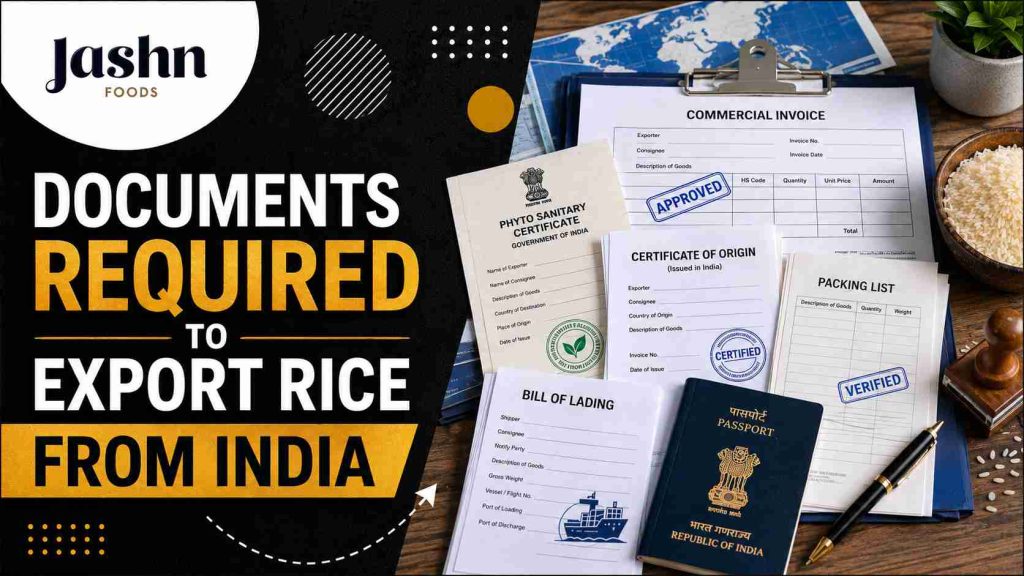
With registrations out of the way, attention shifts to the shipment itself. It needs its own set of documents: commercial invoice, packing list, certificate of origin, and bill of lading. The invoice spells out who’s buying, how much, and at what price. The packing list breaks down exactly how the rice is bagged and loaded. The certificate of origin confirms it was grown and processed in India. Some buyers need this specifically to claim reduced duties back home. And the bill of lading, issued by the shipping line, is another key piece. Banks almost always want to see it before they’ll release payment on a letter of credit.
Rules That Change Depending on the Buyer’s Country
Here’s something new exporters miss: your job isn’t done once the container clears Indian customs. The EU wants a Certificate of Inspection from the Export Inspection Council before rice even reaches its ports. Saudi Arabia only accepts stock from SFDA-accredited rice mills. Indonesia insists on pre-shipment testing from its own approved labs. Shipments get stuck at foreign customs more often than you’d think, and it’s rarely because the Indian-side documents were wrong — it’s because nobody checked what the destination country wanted.
Where Basmati Pricing Stands Right Now
Paperwork costs are honestly a rounding error compared to what price swings can do to a deal. The price of Indian basmati rice moves constantly based on grain length, crop year, and variety — premium 1121 Basmati has recently been trading somewhere between $800 and $1,250 per tonne on an FOB basis, depending on processing quality and where it’s headed. If you’re negotiating a contract, don’t lock in a number too early. Monsoon output and shifting global demand can move this figure within the same season.
Get expert guidance and access to high-quality rice that meets global market standards.
Duties, Explained (and a Common Mix-Up)
People searching for rice import duty in India are often surprised by what they find, because India barely imports rice at all — it exports it, at scale. What actually exists on the Indian side are export-facing duties: a 20% duty currently sits on parboiled non-basmati rice, while Basmati and a few other categories have had older minimum price rules removed to keep shipments flowing. These rules don’t stay fixed for long, either. DGFT and the Finance Ministry adjust them based on domestic supply, sometimes with very little notice.
What Buyers Actually Pay, Beyond the Invoice
If you’re on the buying end, the cost of importing rice from India is never just the FOB number on the invoice. Freight, insurance, whatever duty applies at your own port, and any testing you require locally — all of that stacks on top. Parboiled IR64, for instance, has recently moved around $355 to $380 per tonne FOB, while Basmati sits well above that depending on grade. Most serious buyers ask exporters for a full cost breakdown before signing anything, and honestly, that’s a reasonable thing to expect.
If You’re the One Buying, Not Selling
Figuring out how to import basmati rice from India isn’t complicated once you know what to check. Confirm the exporter actually holds valid APEDA and RCAC registration. Ask for recent lab and phytosanitary results — not old ones. Settle whether you’re buying FOB or CIF. And decide upfront whether you’re working with a letter of credit or some other payment structure. Suppliers who are properly certified tend to cause far fewer customs headaches on your end of the shipment.
Mistakes That Trip Up Even Seasoned Exporters
You’d think experienced exporters would have this down cold, but paperwork errors happen constantly. The usual suspects: quantities on the invoice not matching the packing list, phytosanitary certificates that expired without anyone noticing, wrong HS codes, or a missing certificate that a specific country happens to require. Any one of these can mean demurrage charges or a shipment sitting at port while everyone scrambles. A quick document check before loading is genuinely worth the half-day it takes.
Wrapping Up
None of this paperwork is glamorous, but getting it right early — IEC, APEDA, RCAC, the quality certificates — saves you from the kind of port delays that eat into margins and patience alike. It’s also, frankly, what separates exporters buyers keep coming back to from the ones they only use once. At Jashn Foods, we work with exporters and buyers who care about that kind of transparency in their rice supply chain. If you’re planning your first shipment, or just want a supplier who doesn’t cut corners on documentation, we’re happy to talk.
Disclaimer: This article is meant as general guidance, not legal or trade advice. Export rules, duties, and country-specific requirements shift periodically — always double-check current policy on the official DGFT and APEDA portals before finalizing a shipment.
Get export-ready rice with complete support and trusted supply from Jashn Foods. Contact us today.