
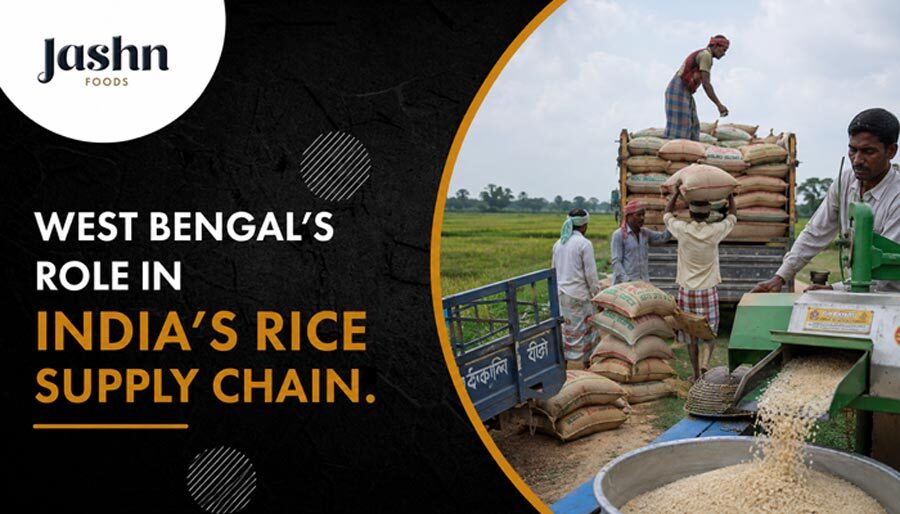
Spend an hour at a grain market in eastern India and you start to see it everywhere — sacks stamped with mill names, traders quoting prices in clipped Bengali, trucks idling for the next load. A lot of that traces back to one state. Rice isn’t just food in India. It’s the thing the agricultural economy is built around, and West Bengal’s role in India’s rice supply chain sits close to the center of it.
Good soil, decent rainfall, farmers who’ve done this for generations. It adds up, and it’s kept the state near the top of India’s producer list for a long time. Somewhere around 14-15% of national output most years, depending on who’s counting.
West Bengal touches almost every stage, from what ends up on a family’s plate to what gets loaded onto a container ship at Kolkata port. And buyers are getting choosier. People aren’t just buying rice anymore, they’re searching for online basmati rice specifically, comparing brands, reading the fine print on the bag. Knowing where that grain actually comes from has become part of the decision now, not an afterthought like it used to be.
Premium basmati, export-grade quality — order direct and skip the middleman.
Understanding West Bengal’s Role in India’s Rice Supply Chain
No single thing explains why West Bengal works so well for rice — it’s a stack of advantages that happen to line up. Rivers cut through the state and leave behind soil that makes paddy cultivation ideal. Rainfall is generous enough that farmers aren’t betting everything on one window of weather. Unlike a lot of regions that get exactly one harvest a year, parts of West Bengal pull off two or sometimes three cropping cycles. That alone changes everything downstream.
Steady output like that does more than fill local warehouses. It props up the rest of the country when other regions stumble. Demand spikes, a monsoon underperforms somewhere else, prices wobble, and West Bengal’s production tends to absorb some of that shock. Throw in its location, sitting right at the edge of eastern India with solid road and rail routes into neighboring states, big cities, and ports, and you’ve got a state that’s about as good at moving rice as it is at growing it.
West Bengal: India’s Rice Production Powerhouse
This isn’t a side hustle for the people involved in it. Millions of families depend on rice farming one way or another, some growing it. Some milling it, some just hauling it to market in a borrowed truck. Behind every bag that lands in a kitchen there’s a long line of smallholders, co-ops, mill workers, traders, and middlemen — each one doing their piece of the job, usually for less money than the work deserves.
That chain has shifted in the last few years, honestly faster than most people in the trade expected. More buyers are going digital, and the rise of online rice in Kolkata has made it a lot easier for retailers and wholesalers to find each other without relying entirely on foot traffic at the local mandi. It hasn’t replaced the old system. A faster lane now runs alongside it, and the two are learning to coexist.
Because the state can grow across multiple seasons instead of one, the scarcity that hits other regions barely shows up here. Easy thing to overlook, but that consistency does a lot of quiet work, for the state and for market stability across India generally.
Diverse Rice Varieties Strengthening the Supply Chain
Ask anyone who’s run a mill in West Bengal what makes the sector resilient and they’ll bring up variety before anything else, almost without fail. The range here covers everything from basic staples to grains people specifically seek out by name and pay extra for.
Gobindobhog is probably the best-known example. This short-grain aromatic rice has gained a following well beyond Bengal, largely because of its distinctive aroma and texture. People reserve it for payesh and special-occasion dishes rather than everyday meals. Higher-yield varieties handle the bulk demand that aromatic rice never could realistically cover. And then there’s the long-grain side of things, where 1121 basmati rice has found a solid place in India’s wider rice market among buyers chasing that particular aroma and grain length.
That spread isn’t just nice to have, it’s a kind of built-in insurance. When one segment slows down, another usually picks up, and nobody’s left too exposed to a single shift in what people want to buy that season.
Thousands of families choose premium-quality rice for better taste and consistency. Join them now.
The Journey from Farm to Market
Moving rice from a paddy to someone’s dinner table takes longer than most people assume, and farmers, millers, and distributors spend much of that time handling and processing it. Cultivation and harvest are really just the start. From there it moves to collection points and mills, and that’s where the actual work happens, cleaning, grading, polishing, packaging, all before a single grain reaches a wholesaler’s warehouse.
After that it’s transport. Sometimes a short hop to a store a few hours away. Sometimes a container that won’t stop moving until it’s halfway across the world.
None of it holds together without coordination, and that’s the part outsiders tend to underestimate. One delay at a mill, one storage problem, one transport bottleneck — any of these can knock the whole sequence off balance fast. That’s the real reason infrastructure keeps coming up whenever people talk about the sector’s future. Growing the rice is rarely the hard part. Everything after harvest is where things tend to break.
Supporting India’s Food Security Through Public Distribution
Beyond the open market, West Bengal carries serious weight in government procurement and welfare schemes. A significant share of the state’s harvest goes into buffer stocks that support the Public Distribution System, which provides affordable grain to households that cannot always rely on the open market.
When a major producing state keeps output steady year after year, the whole country feels it. Eespecially when supply gets shaky somewhere else. That reliability isn’t just good for shoppers, it also backs up the reputation of established Indian basmati rice brands working across India’s broader rice industry.
In a country this size, that kind of dependability is worth more than people usually give it credit for. It’s part of what keeps grain affordable even when other things, fuel costs, fertilizer prices, take a turn for the worse.
West Bengal’s Growing Contribution to Rice Exports
India’s spent years building a name as one of the world’s biggest rice exporters. West Bengal has had a real hand in that, even if it doesn’t always get the credit Punjab or Andhra Pradesh gets. Solid mills, consistent quality checks, and a location that makes logistics easier than in a lot of other states, all of it works in the state’s favor on the export side.
Demand abroad continues to rise as more buyers develop a taste for premium Indian grain and pay closer attention to its origin, not just the label on the bag. The companies sourcing, processing, and shipping that rice have ridden that wave for a while now.
A handful of established names have done a lot of the heavy lifting here. Top basmati rice exporters in India such as Jashn Foods have helped put Indian rice on shelves and tables far beyond the country’s borders, consistently enough that international buyers keep coming back order after order. Their work doesn’t just help their own business, it strengthens the whole export pipeline sitting behind them.
Thousands of families choose Jashn Foods for better taste and consistency.
Challenges Facing the Rice Supply Chain
It’d be dishonest to pretend this sector has no problems, because it has plenty. Monsoons aren’t getting any more predictable, flooding is a recurring risk in low-lying districts, and production costs keep creeping upward year after year. Climate variability especially has gotten harder to plan around than it used to be even a decade ago.
Land fragmentation doesn’t help either. When farms are broken into small, scattered plots, sometimes less than an acre apiece, bringing in real machinery or scaling up efficiently becomes a lot harder than it should be. Add weak storage and transport delays on top of that, and quality and margins both take hits at multiple points along the way.
None of this is unfixable, though. It takes actual investment, better infrastructure, wider access to modern tools, and tighter cooperation between everyone touching the chain, from the smallest farmer up to the biggest exporter.
The Future of West Bengal’s Rice Industry
Whatever comes next for this sector will probably be written by technology as much as tradition. Smarter irrigation, precision farming, digital tracking, these are already starting to change how productivity gets measured and improved on the ground, not just talked about in policy papers.
Sustainability has stopped being a buzzword too. Producers are actually looking for ways to hold yields steady while cutting their environmental footprint, and that shift is showing up in real decisions on the ground, not just marketing copy. Investment in warehousing, cold storage, and logistics will probably decide which regions come out ahead over the next decade or so.
There’s real optimism around the future of rice industry in kolkata, especially as digital tools and better market integration open doors for everyone involved, farmers, processors, exporters, and the people who eventually sit down and eat the rice.
Conclusion
West Bengal’s footprint goes well past the paddy fields. The state is a genuine linchpin in India’s agricultural system, touching production, processing, distribution, food security, and trade, often all at once and often without much fanfare. Generations of farming knowledge, an unusually wide range of rice varieties, and a location that makes logistics easier than most have combined to make it one of the most important pieces of India’s rice supply chain.
As global appetite for quality rice keeps growing, West Bengal looks set to stay a driving force behind it, keeping supply steady, supporting the people who depend on it, and backing up India’s name in the international rice market.
Explore our best-selling rice varieties and discover why quality sourcing makes all the difference. Order today.