
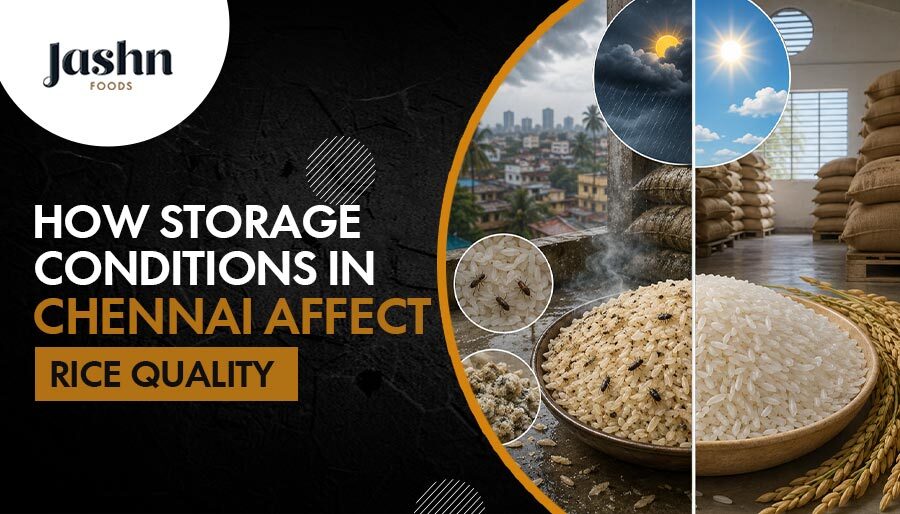
Rice doesn’t really stop changing after it is packed. It keeps reacting—slowly, quietly—to whatever surrounds it. Air, heat, moisture… they all leave a mark over time. That’s why How Storage Conditions in Chennai Affect Rice Quality is not just a technical topic, it’s something every trader, packer, and even household buyer in coastal regions indirectly deals with.
In a city like Chennai, where humidity is almost always present in the air, storage becomes a sensitive part of the entire supply chain. For Jashn Foods, which works with grain handling and sourcing, this stage is just as important as milling or selection. Even a well-processed grain like basmati rice can behave differently after a few weeks if the storage environment keeps pushing moisture into it.
Understanding How Storage Conditions in Chennai Affect Rice Quality
When you actually look at How Storage Conditions in Chennai Affect Rice Quality, the main point is not sudden damage. It’s a slow change.
Rice is not inert. It reacts to air around it. In Chennai, the air itself carries moisture almost all year round. So even when rice is stored in a closed space, it still interacts with that environment indirectly.
You don’t see it happening. But over time, the grain starts behaving differently. It may not feel “bad,” but it stops feeling as fresh as it should.
That difference usually shows up later—in cooking, storage duration, or even smell.
Chennai Weather Has a Quiet but Constant Influence
Chennai doesn’t give extreme weather shocks most of the time. It just stays consistently warm and humid.
That consistency is what makes storage tricky. There’s no long dry season that resets conditions. Moisture stays in the background all the time.
During monsoon months, the effect becomes more noticeable, but even outside that period, the air rarely feels truly dry. That means stored grains are never fully isolated from environmental pressure.
Humidity Changes Rice Without Showing Early Warning Signs
Humidity is the factor that does the most work here, even though it’s invisible.
Rice slowly absorbs moisture from air. Not in a dramatic way—but enough to change its internal balance.
At first, nothing feels wrong. The rice still looks normal. But after some time, small differences start appearing:
- grains don’t stay as loose as before
- smell becomes slightly weaker
- cooking results feel less consistent
- freshness window feels shorter
This is why humidity-related damage often goes unnoticed until quality comparison is made.
Heat Speeds Up Ageing in a Subtle Way
Heat in Chennai isn’t extreme all the time, but it doesn’t really go away either. That steady warmth keeps acting on stored rice.
It doesn’t spoil rice quickly. Instead, it speeds up aging.
And ageing in rice doesn’t look obvious—it feels like loss of sharpness.
Over time:
- aroma becomes less noticeable
- texture after cooking becomes slightly uneven
- grains don’t feel as “fresh” as newly stored stock
- shelf life feels shorter even if expiry is far away
It’s gradual, which is why it’s often ignored.
Storage Pests Thrive in This Kind of Environment
Warm and humid conditions naturally support insect activity. Rice storage in Chennai has to deal with that reality regularly.
The issue is not always visible in the beginning. Pests often start inside bags or deeper layers where inspection doesn’t reach immediately.
By the time they are noticed, the impact may already include:
- internal grain damage
- fine powder formation inside storage
- reduced usable quantity
- quality rejection during sorting
Prevention matters more than treatment here, because once it spreads, control becomes harder.
Packaging Has Become a Shield, Not Just a Cover
Earlier, storage was mostly about sacks and warehouse space. Now packaging actually carries part of the protection responsibility.
Modern systems try to reduce how much air and moisture can reach the grains.
That’s why you see:
- tightly sealed packs
- moisture-resistant layers
- vacuum-style packing for premium rice
- controlled storage zones for bulk handling
It’s less about presentation and more about slowing down environmental impact.
Storage Issues Are Mostly Visible During Cooking
One interesting thing about rice quality is that storage problems rarely show up immediately. They appear during cooking.
Rice that has been affected by poor storage can still look fine in the bag. But once cooked, differences become obvious.
Typical signs include:
- grains sticking more than usual
- weaker aroma
- uneven softness
- slightly dull eating experience
That’s usually when people realise something has changed.
Basic Storage Habits Still Matter More Than People Think
Not everything depends on high-end infrastructure. Day-to-day handling still makes a real difference.
Simple habits help maintain quality:
- keeping rice away from damp areas
- using airtight containers instead of open storage
- avoiding heat exposure from kitchens or sunlight
- not storing rice for unnecessarily long periods
- checking stock occasionally instead of ignoring it completely
These are small steps, but they prevent most common issues.
Conclusion
Chennai doesn’t damage rice suddenly—it influences it slowly, continuously. That’s the real idea behind How Storage Conditions in Chennai Affect Rice Quality.
For Jashn Foods, and anyone involved in grain handling, storage isn’t just a final step after production. It is part of quality itself. What happens in storage eventually decides what reaches the plate, and how it finally feels when cooked.