
If you really look at how rice is bought in most Indian neighborhoods, it rarely feels like a “retail decision.” It feels routine. Almost automatic.
A person walks into the same shop they’ve been visiting for years, asks for rice, maybe checks the price once, and leaves. No browsing, no comparisons in most cases.
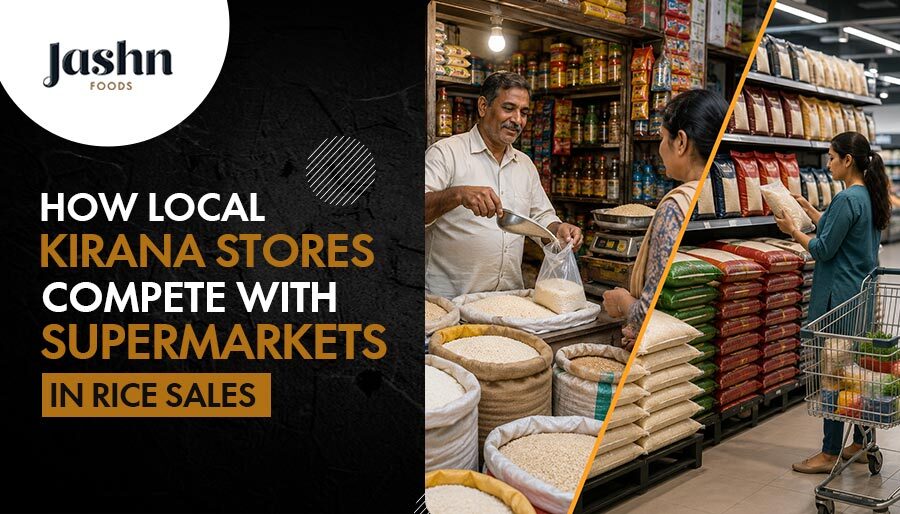
That simple behavior is really the core of How Local Kirana Stores Compete with Supermarkets in Rice Sales.
Rice is not a product people experiment with casually. It sits in the middle of everyday meals. So once a household settles on something that works, they usually stick to it. Sometimes it is regular cooking rice, sometimes something like basmati rice when guests are coming. But switching is rare unless there is a reason.
Brands like Jashn Foods exist in this kind of slow, habit-driven market. And even large rice exporters in India ultimately depend on these very ordinary, everyday buying patterns more than anything else.
Understanding How Local Kirana Stores Compete with Supermarkets in Rice Sales
Kirana stores work because they are predictable in a different way
Supermarkets try to be predictable through systems. Kirana stores are predictable through people. That is the real difference.
A shopkeeper knows who buys what. Not from a database, but from memory built over time. He knows which family prefers softer rice, which one buys more before festivals, and who always asks for something slightly cheaper when prices go up.
That kind of familiarity cannot really be replaced with packaging or branding. In supermarkets, you are mostly on your own. You pick, you compare, you decide. That works for some people, especially younger buyers. But many households still prefer having someone guide the choice, even in a small way.
Rice buying is still more emotional than it looks
People don’t usually talk about rice like it’s a sensitive purchase, but in reality it is. If the rice doesn’t cook well, it affects daily meals. If the texture changes, the entire routine feels different. So customers are careful, even if the purchase itself looks simple.
That is why they keep going back to the same local shop. Not because of loyalty in a marketing sense, but because they don’t want surprises.
Even when supermarkets offer more options, too many choices sometimes slow people down. In kirana shops, the decision is already filtered through experience.
Flexibility is where small shops quietly stay ahead
There is no fixed pattern in how households buy groceries. Some buy small quantities every few days. Some buy in bulk once a month. Some suddenly increase in quantity during weddings or festivals. Kirana shops handle all of this without any friction.
There is no system forcing a standard behavior. Even pricing conversations happen naturally. If the rate has gone up this week, customers hear it directly. If a cheaper option is available, it is suggested immediately.
This kind of back-and-forth keeps the system very human, even if it looks unorganized from the outside.
Local knowledge matters more than branding in rice
Rice is one of those products where local preference actually decides demand. What sells in one area may not move in another even a few kilometers away.
A kirana shop owner learns this slowly. Over time, he stops relying on assumptions and starts stocking what people actually ask for.
Supermarkets cannot really operate at that micro level. They need broader patterns. Kirana stores survive exactly because they operate at the opposite end of that spectrum.
Convenience is not always about scale
Big stores feel convenient in theory. Everything is available in one place. But real-life convenience is usually simpler.
Most people don’t want to walk through aisles for ten minutes just to buy rice. They want to finish the purchase quickly and move on with their day.
A kirana store is usually close enough that nobody plans the visit. They just go. And slowly, many of these shops have added small modern habits—UPI payments, WhatsApp orders, home delivery. Nothing fancy, but it works.
Supermarkets changed behavior, but not completely
It would be wrong to say supermarkets didn’t affect the market. They did. They made packaging important. They made branding visible. They made many people more aware of consistency and labeling.
That changed how rice is presented and sold at a large scale. But it didn’t fully replace older habits. It created another layer of buying behavior instead.
Some people prefer supermarkets. Some prefer kirana shops. Many switch depending on the situation.
Kirana stores didn’t transform, they adjusted
There was no sudden shift. No big modernization moment. It happened slowly. Digital payments became normal. Messaging apps became part of ordering. Some shops started keeping both loose and branded rice depending on customer type.
It doesn’t look like a transformation story from the outside. But the behavior has clearly changed over time.
Price still decides more than anything else
Rice is still a basic necessity. That keeps rice price sensitivity very real. People notice even small changes. Not always loudly, but in their buying decisions.
Kirana stores handle this better because they talk directly to customers. If one option becomes expensive, another is suggested immediately without overthinking it.
It feels more practical than structured. The supply chain still ends in small shops. Even with large distribution networks and export systems, the final step is still very local.
Goods move from wholesalers to retailers, and eventually into small neighborhood stores where daily purchases actually happen.
That is why rice exporters in India still depend indirectly on these networks even when they are focused on global markets. Without kirana stores, the last stage of retail simply doesn’t function the same way.
Final thought
Supermarkets and kirana stores are not really fighting the same battle. They exist because people don’t buy rice in one single way.
Some prefer structure. Some prefer familiarity. Many don’t think about it that deeply at all. And that is why kirana stores continue to exist—not because they are resisting change, but because they still match how a large part of India actually buys food in everyday life.