

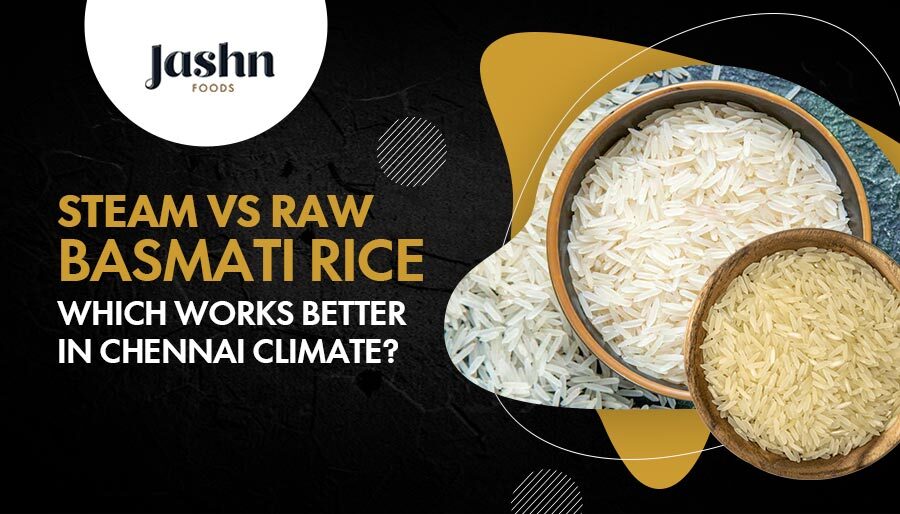
In Chennai, you don’t really need a weather report to tell you it’s humid—you can feel it in your kitchen. Open a jar of rice that’s been sitting for a while, and sometimes it just feels… different. Not spoiled, not bad, just not the same as when you bought it.
That’s where the confusion between steam and raw basmati rice usually begins. On paper, both are good. In reality, Chennai’s climate treats them very differently.
A lot of households stick to whatever they’ve always used. But if you’ve ever had rice turn slightly sticky or lose that expected texture, chances are the weather had something to do with it—not your cooking.
Steam vs Raw Basmati Rice in Chennai – Understanding the Real Difference
Let’s look at this in a practical way, not a technical one.
Steam Basmati Rice – The “No Headache” Option
Steam basmati rice is the kind most people don’t think twice about—and that’s actually its biggest advantage.
It’s processed in a way that makes the grains stronger. When you cook it, the rice stays separate, even if you’re not being overly careful with measurements.
If you’ve eaten biryani at a large function and noticed how the rice doesn’t clump together, that’s usually steam rice doing its job. Varieties like 1121 steam basmati rice are especially known for this.
The reason it works well in Chennai is simple—it doesn’t react much to humidity. It just sits there, behaves, and cooks the way you expect.
There’s a reason bulk buyers prefer it. Even many rice manufacturers Hyderabad deal heavily in steam rice because it holds up during storage and transport without creating problems.
Raw Basmati Rice – Better Aroma, More Sensitivity
Raw basmati rice feels a bit more “traditional.” When you cook it right, the aroma is stronger, and the texture is softer.
A lot of home cooks prefer it for that exact reason—it tastes closer to what they grew up eating.
But here’s the thing nobody tells you upfront: raw rice is more reactive. Especially in a place like Chennai.
Leave it stored for a few weeks, and it can start absorbing moisture from the air. You won’t always see it, but you’ll notice it while cooking. Sometimes it turns slightly sticky, sometimes it cooks unevenly.
It’s not bad rice—it’s just not built for humidity.
Chennai Climate – The Part People Overlook
If you compare rice performance across cities, Chennai stands out for one reason—constant moisture in the air.
That moisture doesn’t just stay outside. It slowly affects anything that isn’t sealed properly, including rice.
So what happens over time?
The grains pick up slight dampness
Cooking results become less predictable
Storage life quietly reduces
This is why the same basmati rice might work perfectly in a dry city but behave differently here.
The Real, Everyday Difference
Forget technical comparisons—this is what you actually notice in your kitchen:
Steam rice is stable.
Raw rice is more delicate.
Steam rice stays mostly unaffected in storage
Raw rice changes depending on the weather
Steam rice cooks the same way every time
Raw rice can vary batch to batch
Even when people compare basmati rice prices, many in humid regions prefer spending on something that won’t give them trouble later.
So, Which One Actually Works Better?
If we’re talking specifically about Chennai, steam basmati rice usually wins for practical reasons.
It’s easier to handle, easier to store, and doesn’t surprise you while cooking.
That’s why restaurants and caterers stick with it—they can’t afford inconsistency.
But raw basmati rice still has its place.
If you’re someone who:
Buys rice in smaller quantities
Uses it regularly
Stores it properly
Then raw rice can still give you great results, especially when aroma matters more to you than convenience.
Even large traders, including rice exporters in kolkata, often prefer steam varieties for humid regions because they’re simply more predictable.
Storage in Chennai – What Actually Helps
This is where most people go wrong—not in buying, but in storing.
A few simple habits make a bigger difference than you’d expect:
Don’t keep rice in the original thin packaging
Transfer it to airtight containers as soon as possible
Keep it away from the stove area (heat + moisture = trouble)
If you buy in bulk, split it into smaller containers
These aren’t complicated steps, but in Chennai, they matter.
Why the Supplier Makes a Difference
Two bags of rice can look the same and still behave differently after a few weeks.
That usually comes down to how the rice was processed and packed.
A reliable brand ensures the grain is properly dried and sealed before it reaches you. That reduces the chances of moisture-related issues later.
Brands like Jashn Foods focus on consistency, which is why their rice tends to perform more predictably over time.
If you’re trying to figure out the best basmati rice brand, don’t just judge it on the first cook. See how it holds up after sitting in your kitchen for a couple of weeks—that’s the real test.
Interestingly, even people who buy rice online in Hyderabad often look for this kind of reliability. If a brand can handle transport and storage well, it usually performs better in tougher climates too.
Final Thoughts
There’s no dramatic conclusion here—just a practical one.
In Chennai, steam basmati rice is easier to live with. It handles the weather better and gives consistent results without demanding too much attention.
Raw basmati rice, on the other hand, is more about preference. It smells better, feels softer, but needs a bit more care to stay that way.
So the choice isn’t really about which one is “better” overall. It’s about which one fits your kitchen, your storage, and how much effort you want to put in.
And once you look at it that way, the answer usually becomes pretty clear.