
Every bag of rice carries hidden information most people never think to look for. Certification marks tell you if it’s safe, tested, and export-ready. Some buyers ignore these stamps. Others won’t touch a shipment without checking every one of them first.
This blog offers common rice quality certifications explaining the way a supplier would actually explain them to a buyer, not the way a regulation manual would. You’ll learn what each mark means, why it exists, and how it protects you whether you’re buying a single sack or clearing a container at port. If you’re sourcing high quality basmati rice, this should clear things up.
Discover why businesses trust Jashn Foods for quality-tested, export-ready rice.
Common Rice Quality Certifications Explained
Rice certification isn’t one thing. It’s a stack of approvals, and most buyers only ever notice one or two of them.
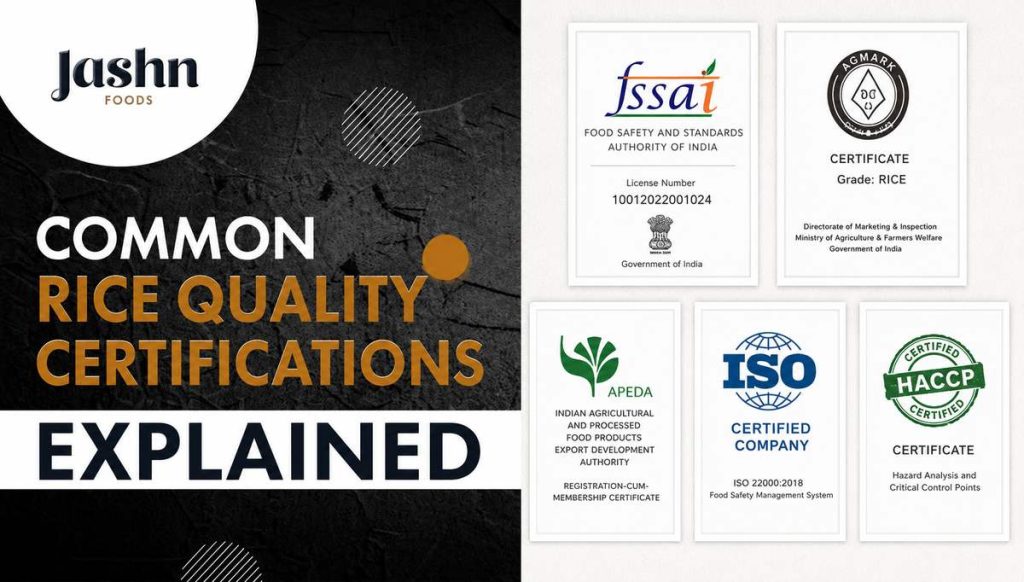
Each layer covers a different part of the journey, growing, processing, packaging, export. In India, government bodies handle most of this groundwork. FSSAI takes care of food safety. AGMARK handles grading. APEDA manages export compliance.
Internationally, buyers often ask for ISO, HACCP, or organic marks on top of all that. Together, these certifications build a fuller quality picture than any single stamp ever could.
Why FSSAI Certification Comes First
FSSAI stands for the Food Safety and Standards Authority of India, and it’s the baseline. Any rice manufacturer in India selling packaged rice domestically needs this license before anything else happens. No FSSAI number, no legal sale.
FSSAI checks basic safety parameters: moisture content, foreign matter, contamination limits. Rice that fails these checks doesn’t get approved for sale.
For consumers, that little FSSAI number printed on the pack is a quiet signal most people walk past without a second glance. It says the product met minimum safety norms before it ever reached a shelf. Not glamorous. But essential.
Understanding AGMARK Grading
AGMARK is older than most people realize, it’s been grading Indian agricultural produce for decades, rice included.
The certification looks at grain length, uniformity, and purity. For Basmati specifically, the grain has to measure over 6.61 mm, with a length-to-width ratio above 3.5. Non-basmati grains mixed in should stay under 20 percent to maintain proper quality.
A strong rice brand usually puts its AGMARK grade right on the front of the pack. It’s a fast way to signal quality without a paragraph of explanation. Shoppers recognize the logo instantly, even if they couldn’t tell you what the letters stand for.
APEDA Registration and the RCAC Requirement
APEDA stands for the Agricultural and Processed Food Products Export Development Authority. Anyone genuinely researching how to export rice from India runs into this name within the first five minutes.
For Basmati rice, there’s an extra step most first-time exporters underestimate. Exporters must secure a Registration-Cum-Allocation Certificate, called RCAC, before any shipment goes out. This certificate is what allows a shipment to legally carry the Basmati name, protected under India’s GI framework.
Skip this registration and customs authorities can reclassify the shipment as ordinary rice, which changes the duty picture entirely.
Exporters also need a valid Importer-Exporter Code from the DGFT. Registration with APEDA and a valid IEC are mandatory before export can legally begin.
A phytosanitary certificate matters too. Issued by the Directorate of Plant Protection, Quarantine and Storage, it confirms the shipment carries no pest contamination. Most importing countries simply won’t accept cargo without one.
ISO 22000 and HACCP: Global Food Safety Benchmarks
International buyers often expect more than domestic paperwork, and this is usually where first-time exporters get a rude surprise. ISO 22000 and HACCP are two certifications that come up constantly in global trade conversations.
HACCP identifies risk points across the entire production process. It’s a food safety management approach, not a one-time check. ISO 22000 builds on that same idea with a broader international framework.
Some countries make this completely non-negotiable. Saudi Arabia, for instance, requires rice establishments to adopt food safety management systems such as ISO 22000 or HACCP before exports are even permitted.
APEDA actively supports exporters here, which helps smaller operations without in-house compliance teams. The authority helps businesses obtain internationally recognized certifications like HACCP, ISO, and organic marks, easing compliance with global market requirements. And staying current on rice certifications has genuinely become part of running an export business, given how fast requirements shift from one country to the next.
These systems focus on prevention rather than inspection after the fact. A facility with HACCP in place catches contamination risks before they happen, not after a batch fails testing at some port halfway around the world.
Explore Jashn Foods’ premium rice range produced under strict quality certifications.
Organic Certification Under NPOP
Organic rice is a growing category, both in India and abroad. NPOP, the National Programme for Organic Production, is India’s official organic certification system.
USDA Organic is the equivalent expected in the American market. European buyers often look for EU Organic certification instead, these aren’t interchangeable. An exporter usually needs the specific mark that matches wherever the rice is actually headed.
Certification requires documented farming practices. No synthetic pesticides. No chemical fertilizers. Regular soil and water testing, too.
It’s a slower, more demanding process than conventional certification. But demand for organic rice keeps climbing every year, both at home and overseas.
Certification bodies also inspect storage and transport conditions. Organic rice can’t sit next to conventional stock during processing, and packaging materials get checked too.
The GI Tag and Basmati’s Protected Identity
A Geographical Indication tag isn’t a food safety certificate. It’s a legal protection, and people confuse the two more often than you’d expect.
Basmati rice carries GI status, tied to specific growing regions across northern India. This tag stops rice grown elsewhere from being sold under the Basmati name.
APEDA recently facilitated the first export of GI-tagged Joha rice from Assam to the United Kingdom and Italy, showing how regional identity now travels well beyond domestic borders.
For buyers, a GI tag adds another layer of trust. It’s proof of origin, not proof of quality, though the two often go hand in hand.
Other Indian rice varieties are following the same path, finding buyers overseas largely thanks to this kind of recognition.
International Standards Buyers Look For
Beyond Indian certifications, global retailers often ask for BRCGS or IFS Food certification. These are private, retailer-driven standards common across Europe and the UK.
GlobalG.A.P. covers farming practices specifically, how the crop was grown, not just how it was processed afterward.
Large supermarket chains frequently make these certifications a condition of doing business. Smaller exporters sometimes find this the hardest hurdle to clear, mostly because of cost and paperwork.
Countries also stack on their own requirements. Rice bound for the Russian Federation needs pre-shipment quality certification from APEDA-authorized laboratories. Shipments to Indonesia and parts of Europe need testing from designated inspection agencies too.
How Requirements Shift Across Global Markets
Certification rarely stays the same from one country to the next, which catches a lot of new exporters off guard.
The United States often asks for FDA registration alongside standard export documents. The European Union usually wants pesticide residue testing done through approved laboratories. Some Gulf countries require halal certification too, stacked on top of the usual food safety marks.
Africa’s markets tend to focus more on price and volume, though safety certificates still matter once contracts get larger. Southeast Asian buyers, meanwhile, frequently ask about fumigation records and shelf-life testing.
This is exactly why exporters rarely rely on a single certificate. A shipment heading to three different countries might need three slightly different documentation sets, even though the rice inside never changes.
Choose a trusted rice manufacturer committed to food safety, consistency, and international quality standards.
What This Means for Buyers and Exporters
None of these certifications work in isolation, and that’s the part most guides skip over. A single shipment might carry FSSAI approval, an AGMARK grade, APEDA registration, and an ISO certificate, all stacked together.
For everyday buyers, certifications simplify decision-making quite a bit. You don’t need to test the rice yourself, someone already did that work.
For businesses, certifications shift the price rice can command in competitive markets. Buyers pay more when they trust the label behind the product.
At Jashn Foods, sourcing and certification go hand in hand, and we’ve learned this over enough shipments to know it matters. Every batch gets checked before it reaches a customer’s kitchen or a container bound for export.
Documentation errors cause more shipment delays than actual quality issues. A missing certificate, an expired lab report, a mismatched HS code, any one of these can hold cargo at port for weeks.
Choosing Rice You Can Trust
Certifications aren’t just paperwork, even though they can feel that way from the outside. They’re a promise, repeated across every bag, every shipment, every season.
Understanding what each mark means puts buyers back in control of a decision that usually happens on autopilot. It also pushes manufacturers toward better practices, batch after batch.
Next time you check a rice pack, look past the brand name for a moment. Look at the certification marks instead. They tell the real story behind what’s actually inside.
Talk to our experts and secure high-quality rice for your business before your next procurement cycle.