
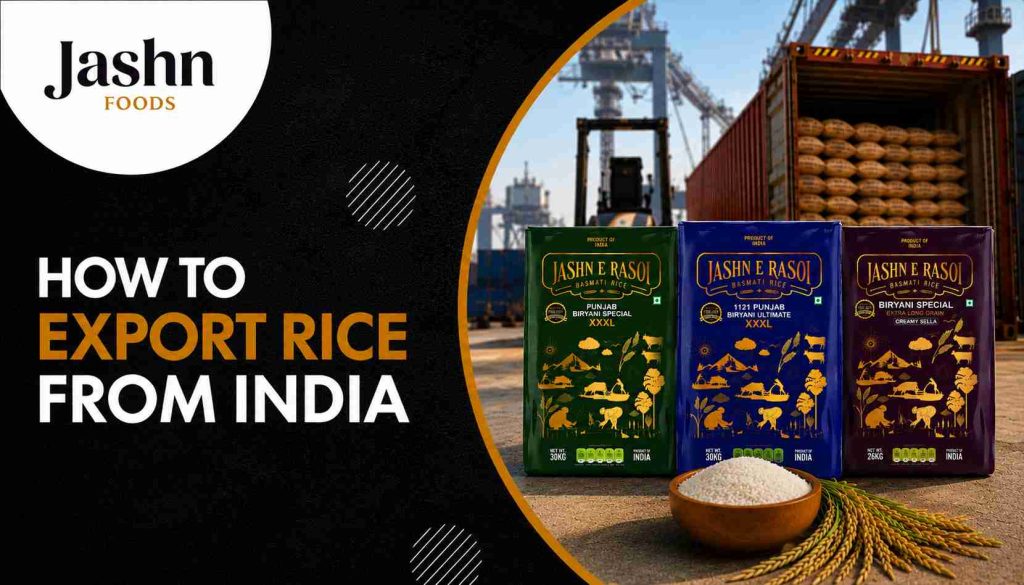
Rice never really needed a marketing push out of India. Buyers have come for the aroma and grain length for decades, long before anyone used a phrase like “export strategy.” Even so, many first-time buyers begin by searching for how to export rice from India before they know which supplier to contact or how the process works. We hear these questions regularly from importers across the US, UK, and the Gulf. Basmati rice is usually what grabs their attention first. It’s one of the main reasons overseas buyers continue paying a premium instead of settling for cheaper, similar-looking alternatives. What follows is the actual export process—the parts most guides never explain properly.
Join importers across multiple countries who source premium Indian rice directly from Jashn Foods.
Understanding How to Export Rice from India
What You Need Before Exporting Rice
The funny thing is, it’s rarely the rules that hold people up. It’s the order. You register late, or you quote a price before checking what the rate actually is this week, or you skip a certificate because nobody told you it existed, and now there’s a shipment stuck at a port that should’ve cleared three weeks ago. So that’s basically the shape of this article. Registrations, then pricing, then duty, then shipping, and somewhere in the middle, the stuff buyers check quietly before they’ll put their name on a contract.
India’s Growing Share of the Global Rice Trade
Worth saying plainly, before anything else: nobody’s building this market from scratch. India already leads global rice trade, and it’s not close. Over 20 million tonnes left the country in FY 2024-25, close to $12.5 billion worth, going out to something like 150-plus countries. Basmati crossed 6 million tonnes on its own that year. A record, according to most of the industry figures floating around. Depending on whose numbers you trust, India’s share of global rice trade sits somewhere near 39 percent. Which, for someone just getting into this, is sort of humbling once it sinks in. You’re not out there creating demand from zero. You’re stepping into lanes and price benchmarks and buyer relationships that were already moving before you ever got involved.
Where Indian Rice Finds Its Biggest Buyers
It’s not spread evenly, not even close. Basmati leans hard toward the Middle East. Iran, Iraq, Saudi Arabia, the UAE, places where biryani and pilaf aren’t occasional dishes, they’re daily cooking. Non-basmati heads further out, into Africa and pockets of Southeast Asia, where a lower price per kilo usually wins over aroma. Europe’s picked up too lately, and the UK along with it, partly thanks to newer trade arrangements between the two sides. Figure out where your particular variety already has a foothold and you’ll save yourself months of emailing importers who were never going to buy from you anyway.
Get export-ready rice with competitive pricing, quality assurance, and worldwide shipping support.
Step 1: Sort Out Your Basic Export Registrations
Nothing ships without an Import Export Code from the DGFT. That part’s not optional. APEDA registration comes next, since rice sits on its list of scheduled agricultural products. Dealing in basmati? Add an RCAC on top of that. It ties back to India’s GI protection over the word “Basmati” itself, and it isn’t recognized the same way in every country, which trips up a fair number of first-timers. We won’t run through every certificate here, since we’ve written that out properly elsewhere. For a detailed list of all mandatory export documents, read our complete guide on documents required to export rice from India.
Step 2: Pick the Right Variety and Grade
Nobody seriously asks for “rice.” They want grain length, broken percentage, moisture content, sometimes a harvest year written straight into the contract. 1121, 1509 and 1401 basmati each cook differently, price differently, and behave differently on a plate, and mixing them up at the sampling stage is a mistake you usually don’t catch until the container has already landed somewhere across the world. By then there isn’t much left to do about it. We’ve seen buyers reject entire lots over something as small as an unexpected two millimeter difference in grain length after cooking. It sounds petty until you remember these buyers have their own customers to answer to. Sona Masoori and Sugandha serve completely different kitchens, so getting the variety right matters just as much as getting the price right.
Step 3: Work With Exporters Buyers Can Trust
Landing a buyer, honestly, isn’t the hard bit. Keeping them past order number one is where things actually get tested. A lot of overseas importers now do their own homework on trusted Indian rice exporters before they’ll put pen to paper. They pull APEDA numbers, ask around about shipment history, sometimes go as far as requesting lab reports from someone other than the exporter. A quote that undercuts by a few dollars doesn’t carry much weight next to a real track record, and buyers who’ve been burned once don’t tend to give a second shot. This industry gossips more than people assume.
Step 4: Understand What Drives Rice Pricing
Rice pricing doesn’t sit still, ever. Monsoon, crop year, grain length, demand overseas, any of these can shift the number, and sometimes it happens in weeks, not months. As of now, the Indian basmati rice price for premium 1121 sits somewhere in the $800 to $1,250 per tonne range on an FOB basis, though where exactly it lands depends on quality and where it’s headed. Don’t lock a contract on old numbers. Pull current mandi rates, check recent export figures, and treat anything you saw a couple of months back as already out of date.
Request the latest export prices for Basmati and Non-Basmati rice before market rates change.
Step 5: Learn the Duty Structure Before You Quote
A lot of confusion here comes from a simple mix-up. People search for rice import duty assuming it applies inside India, when India barely imports rice at all, it’s overwhelmingly an exporter. What actually matters is export policy. Parboiled non-basmati currently carries a 20 percent duty. Basmati no longer sits under the old minimum export price rule either. If you’re quoting a duty figure to a buyer, check it against their country’s import rules, not India’s. People mix the two up more than you’d think.
Step 6: Get the Shipping and Packaging Details Right
Rice eats up space, and whatever you pack it in affects both the cost and how it holds up over a long voyage. Some climates do better with jute. Others need PP or BOPP bags instead, mostly depending on humidity and how far the shipment’s going. Loading matters just as much. Bags that get stacked carelessly shift around during a long sea crossing, and that shift quietly ruins a shipment that looked perfectly fine when it left the port. Humid-region buyers often ask for moisture-resistant packaging on their own, so get that sorted before the container’s sealed shut, not after it’s opened on the other end and someone’s asking what happened.
What Sets Reputed Rice Brands Apart
Samples and shipments don’t always match, and buyers catch that faster than most exporters expect. The top rice brands in India that keep pulling repeat business tend to do a few unglamorous things well: same grain quality every time, lab reports that hold up under scrutiny, no quiet substitutions when a variety runs short. We’ve built a chunk of our own business on exactly that, honestly, it’s not complicated, just consistent. None of it looks exciting on paper. It’s what turns a one-time order into a standing account.
If You’re Buying, Not Selling
Plenty of people land here researching how to import basmati rice from India rather than export it. The logic runs in reverse but covers the same ground. Confirm the supplier holds valid APEDA and RCAC registration. Ask for recent phytosanitary and lab results. Decide upfront whether you’re buying FOB or CIF, since that one choice changes the entire cost conversation. Suppliers with proper certification clear customs on your end with a lot less friction than the ones cutting corners somewhere along the way.
What International Buyers Actually Pay
The invoice total rarely tells the whole story. The cost of importing rice from India stacks freight, insurance, port-side duty, and local testing on top of the base price. Parboiled non-basmati has recently traded around $355 to $380 per tonne FOB. Basmati sits well above that, depending on grade. Ask for a full cost breakdown before you sign anything. If a supplier won’t give you one, that’s usually where the margin’s hiding.
Costly Errors That Can Delay Rice Shipments
Mismatched quantities between invoice and packing list. A phytosanitary certificate that expired without anyone noticing. Wrong HS codes. A document in some specific country requires that nobody flagged in time. Any single one of these can leave a container sitting at port racking up demurrage instead of moving. A short document review before loading, done properly, saves far more time than untangling the mess afterward would.
Final Thoughts
Laid out in order, none of this is particularly complicated. Registrations first. Then quality and pricing. Then duty and shipping. Then the buyer relationships that make the whole thing repeatable instead of a one-off. Skip a step and it tends to resurface later, usually between a port and a customer’s warehouse, at the least convenient moment possible. We’ve watched it happen to people who were otherwise doing everything right. At Jashn Foods, we’d rather walk someone through this properly the first time than help them untangle it after. If you’re planning your first shipment, or looking for a supplier who won’t cut corners, we’re glad to talk it through.
Get supplier pricing, export documentation support, and a customized quote from Jashn Foods today.